Choosing the material for wooden box packaging is the one decision that shapes weight, cost, finish quality and compliance for everything that follows. A wine box, a tea gift set and a watch case may all be called a wooden box, yet each performs best with a different wood or panel. This guide from Guangzhou T.wing-Pak Mfg Co., Ltd. compares solid wood, plywood, MDF and bamboo, explains how finishes change the result, and gives buyers a selection process and a troubleshooting table. It is written for brand owners, purchasing teams and gift-packaging distributors who need to brief a factory with confidence. For the wider sourcing process, see our B2B custom wooden box sourcing playbook.
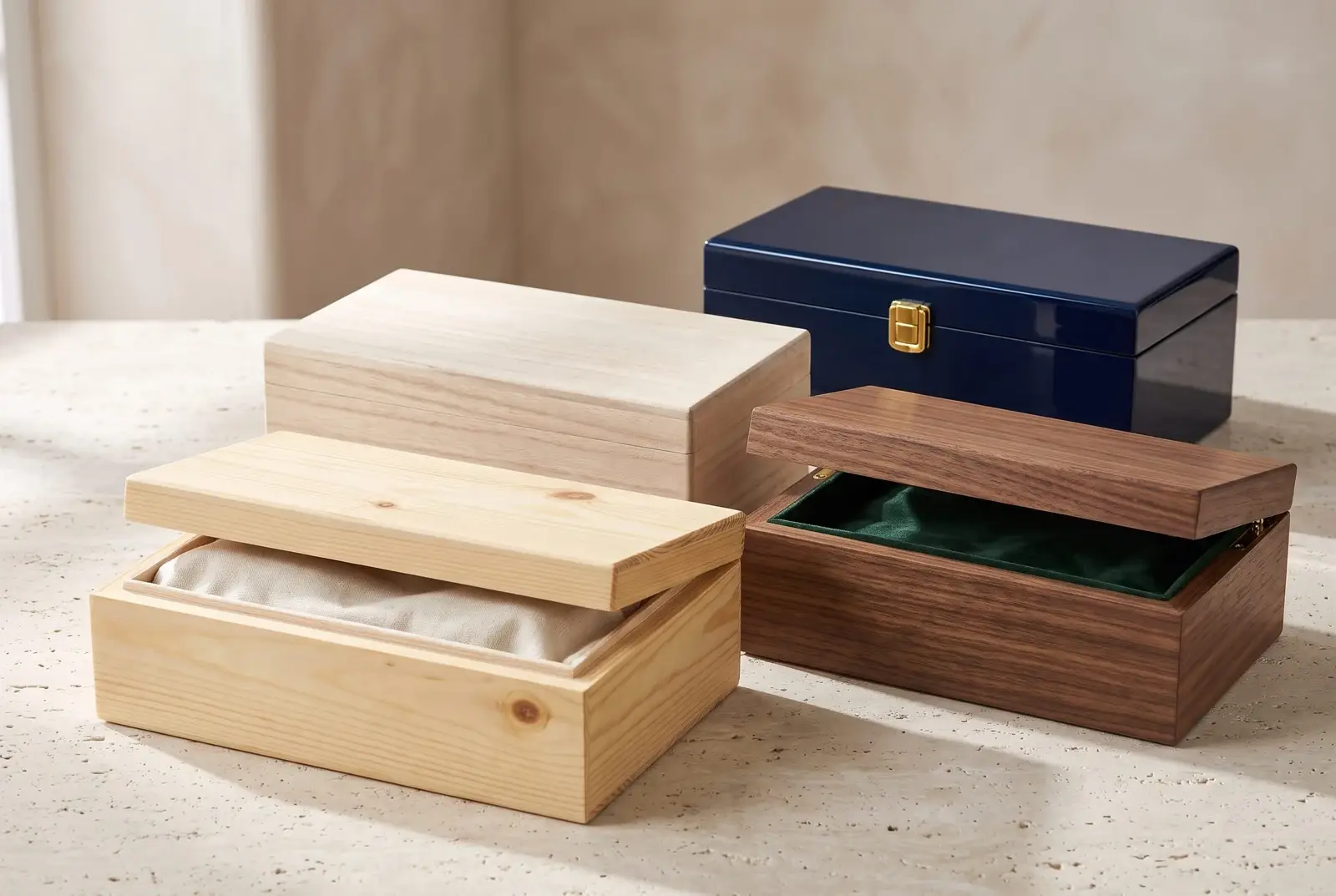
Wooden Box Packaging Materials: What Each Option Really Offers
Start with the job the box must do
A wooden gift box has four jobs: it must protect the product, present it well, carry the brand and survive logistics. Before comparing materials, write down the product weight, how fragile it is, the retail price band, and whether the box will be displayed on a shelf or shipped directly to consumers. A 200 g jewelry piece does not need the same wall thickness as a three-kilogram set of bottles.
Weight deserves special attention because it affects freight cost on every shipment. Finish expectations matter just as much, since a matte natural box suits a tea brand while a high-gloss lacquered box suits a watch or jewelry brand. Once these requirements are on paper, the material choice becomes far easier to narrow down.
Solid wood: pine, paulownia and hardwoods
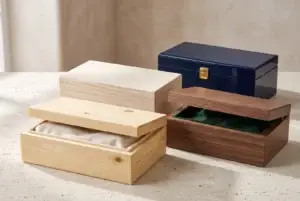
Pine is one of the most common softwoods for wooden box packaging. It is affordable, easy to machine and takes stain well, which makes it popular for wine boxes, food gift boxes and storage crates. Its main drawbacks are visible knots and resin pockets, so buyers should set an acceptable knot standard before production starts.
Paulownia is a very light species that many gift-box makers favor. Reference figures list an average dried weight of about 280 kg/m³ and a Janka hardness of around 300 lbf, which gives a good strength-to-weight ratio for non-structural items such as boxes where low shipping weight matters (Glamorwood). The trade-offs are that it dents easily, screws strip out of it, and it is not waterproof, so predrilling, reinforced hinge points and sealing are important.
Hardwoods such as beech, walnut, oak and maple are heavier and harder, and they show a finer grain. They suit premium collections, limited editions and boxes that customers will keep for years. They also cost more, add weight to every carton and need sharper tooling, so they are usually reserved for higher price tiers.
Engineered panels: plywood, MDF and HDF
Plywood is made from thin veneer layers glued with alternating grain directions. This construction makes it stable and strong in thin sections, which is why it is widely used for lids, bases and larger boxes. Its exposed edges show the layers, so factories either hide them with mitred corners and edge banding or turn them into a design feature.
Medium-density fiberboard (MDF) is made from fine wood fibers and resin pressed into a uniform panel. Its smooth surface takes paint, lacquer, veneer and wrapping materials extremely well, which makes it a favorite for high-gloss and color-matched boxes. MDF is heavier than solid paulownia, and its edges absorb moisture and swell if they are left unsealed.
Because panels use resin adhesives, formaldehyde emission rules apply to them. In the United States, the EPA’s TSCA Title VI limits are 0.05 ppm for hardwood plywood, 0.09 ppm for particleboard, 0.11 ppm for MDF and 0.13 ppm for thin MDF of 8 mm or less (US EPA). Our guide to environmental certification and export compliance for wooden box packaging covers the wider rule set in detail, and our EU PPWR compliance checklist explains the packaging rules now taking effect in Europe.
Bamboo as an alternative
Bamboo is a fast-growing grass that is processed into laminated panels or shaped into boxes. It is dense, has a clean modern look and is often chosen by brands that want a renewable story. The finished product depends heavily on the adhesive and lamination quality, so ask for samples and test them for flatness and edge strength.
From a regulatory view, the final EU deforestation regulation product scope places products made from bamboo outside its coverage (Coolset). That does not remove other obligations, so confirm requirements with your customs broker before you rely on it.
Material comparison at a glance
| Material | Weight | Surface and finish | Relative cost | Best suited for | Main watch-out |
|---|---|---|---|---|---|
| Pine | Medium | Visible grain; takes stain well | Low to medium | Wine, food and storage boxes | Knots and resin pockets |
| Paulownia | Very light | Pale, even grain; sands easily | Low to medium | Gift boxes where freight weight matters | Dents easily; screws strip |
| Hardwoods (beech, walnut, oak) | Heavy | Fine grain; premium feel | High | Luxury and collector boxes | Weight and material cost |
| Plywood | Medium | Stable base; veneer-ready | Low to medium | Lids, bases and larger boxes | Layered edges show |
| MDF | Heavy | Very smooth; ideal for lacquer or wrapping | Low | High-gloss and color-matched boxes | Edge swelling; formaldehyde rules |
| Bamboo | Medium | Clean linear grain; modern look | Medium | Eco-positioned brands | Adhesive and lamination quality |
Relative cost levels are typical market tendencies rather than quotes, because price also depends on size, finish, hardware and quantity. Always compare quotations for the same specification and finish. Our guide to choosing wood for wooden box packaging goes deeper on species selection.
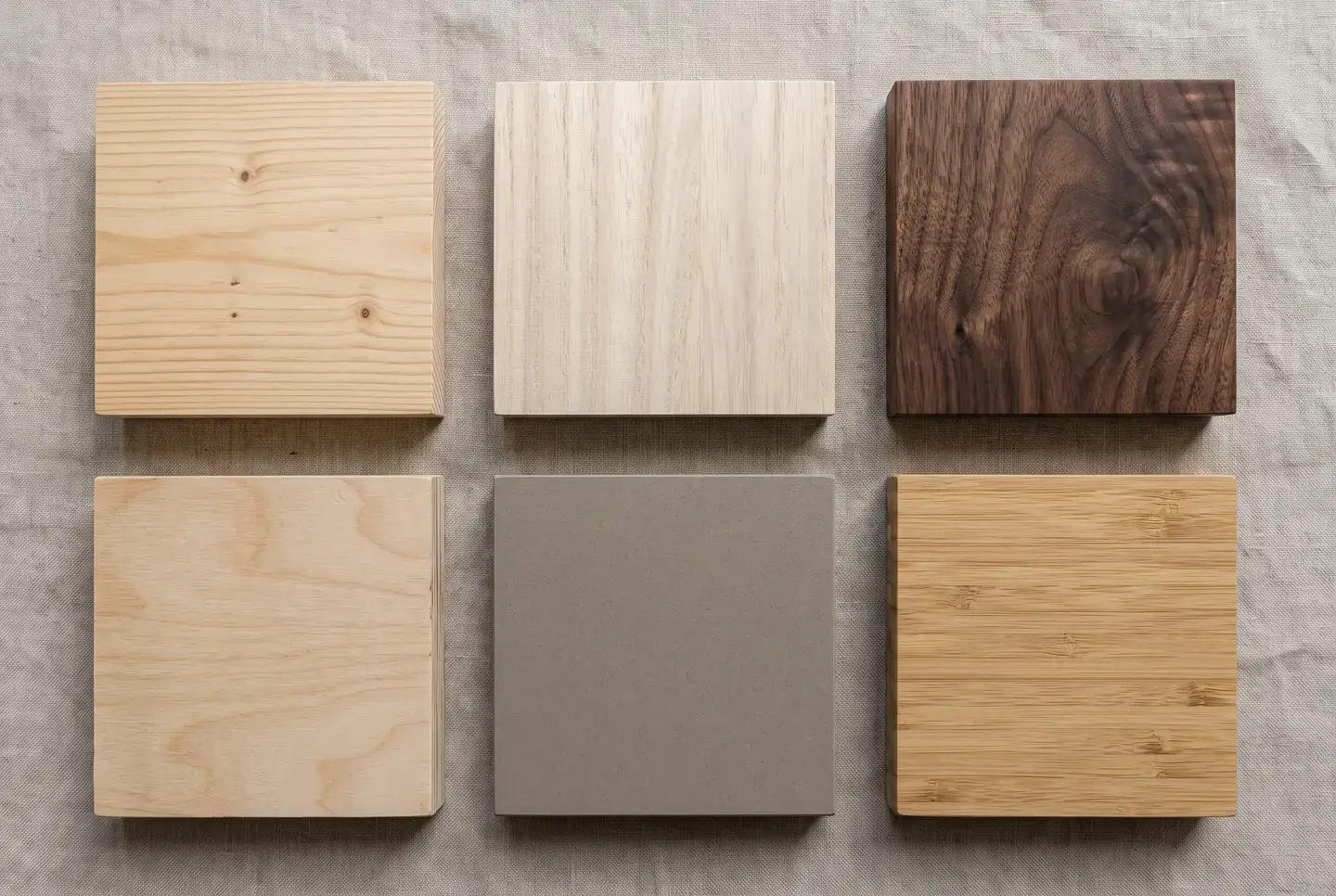
Finishes, Product Fit and a Practical Selection Process
Finishing options and what they do
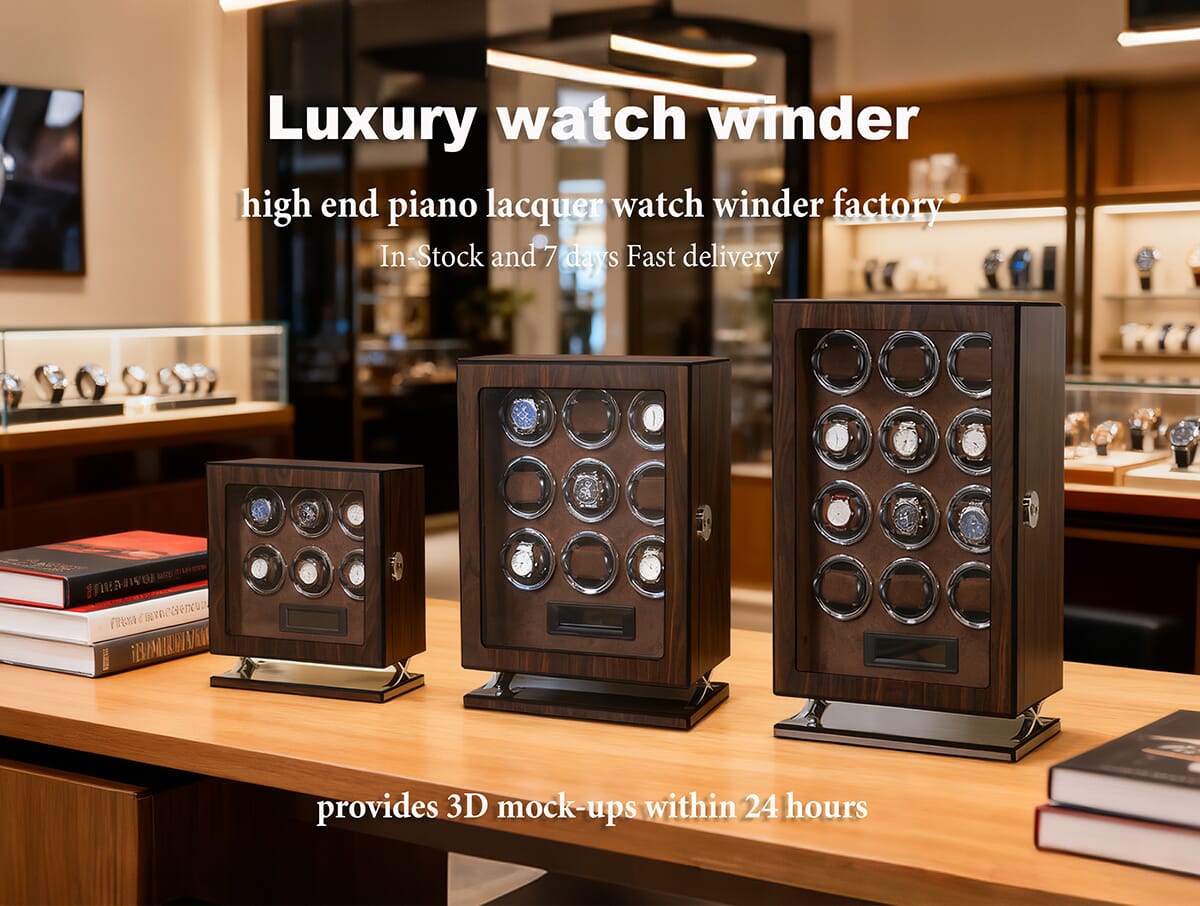
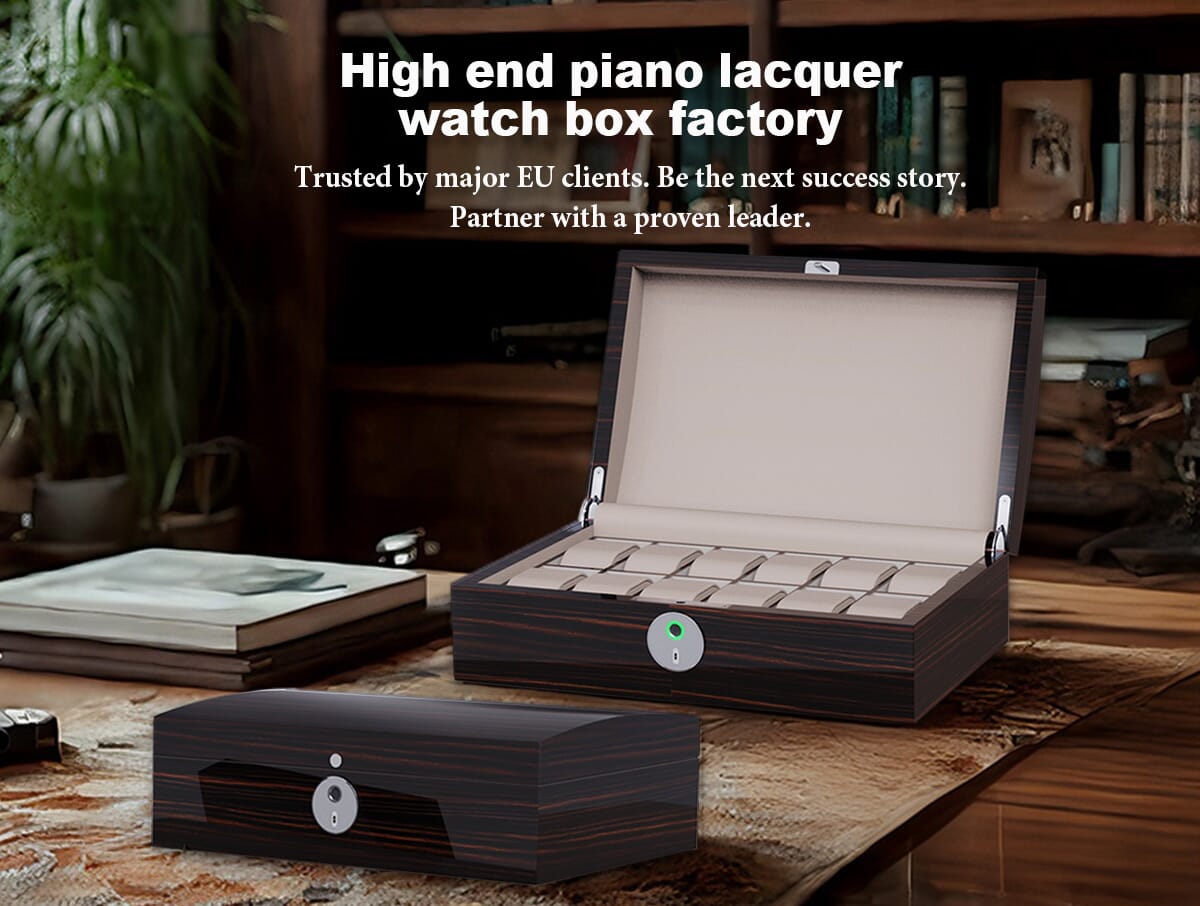
The finish decides how a wooden box looks, feels and ages, and it also protects the surface from moisture and handling. A natural oil or wax shows the grain and has a low sheen, while a matte or satin lacquer adds protection with a quiet look. High-gloss piano lacquer is built from multiple coating and polishing steps and gives the deep shine that watch and jewelry brands often want.
Veneer places a thin slice of real wood on a stable panel, which gives rich grain at a lower material cost than solid hardwood. Stains and solid paint colors give consistent brand colors, and wrapped finishes cover MDF with paper or leatherette to hide the substrate altogether. Each option has its own risks, so the table below lists the strengths and the points buyers should check. For a side-by-side look at substrates, see our solid wood box vs veneer box comparison.
| Finish | Look and feel | Suits | Watch-outs |
|---|---|---|---|
| Natural oil or wax | Visible grain, low sheen | Tea, food, eco-positioned gifts | Less protection from stains and moisture |
| Matte or satin lacquer | Smooth, understated, protective | Gift sets, cosmetics, corporate gifts | Brush marks or uneven sheen if poorly applied |
| High-gloss piano lacquer | Deep mirror shine | Watches, jewelry, premium spirits | Shows dust specks and scratches |
| Wood veneer | Rich real-wood grain on a stable base | Premium gifts at moderate weight | Edge detail and grain matching |
| Stain or solid color | Consistent brand color | Branded collections and seasonal editions | Batch-to-batch color variation |
| Wrapped (paper or leatherette) | Fabric or leather feel | Fashion and beauty packaging | Wrinkles and lifting at corners |
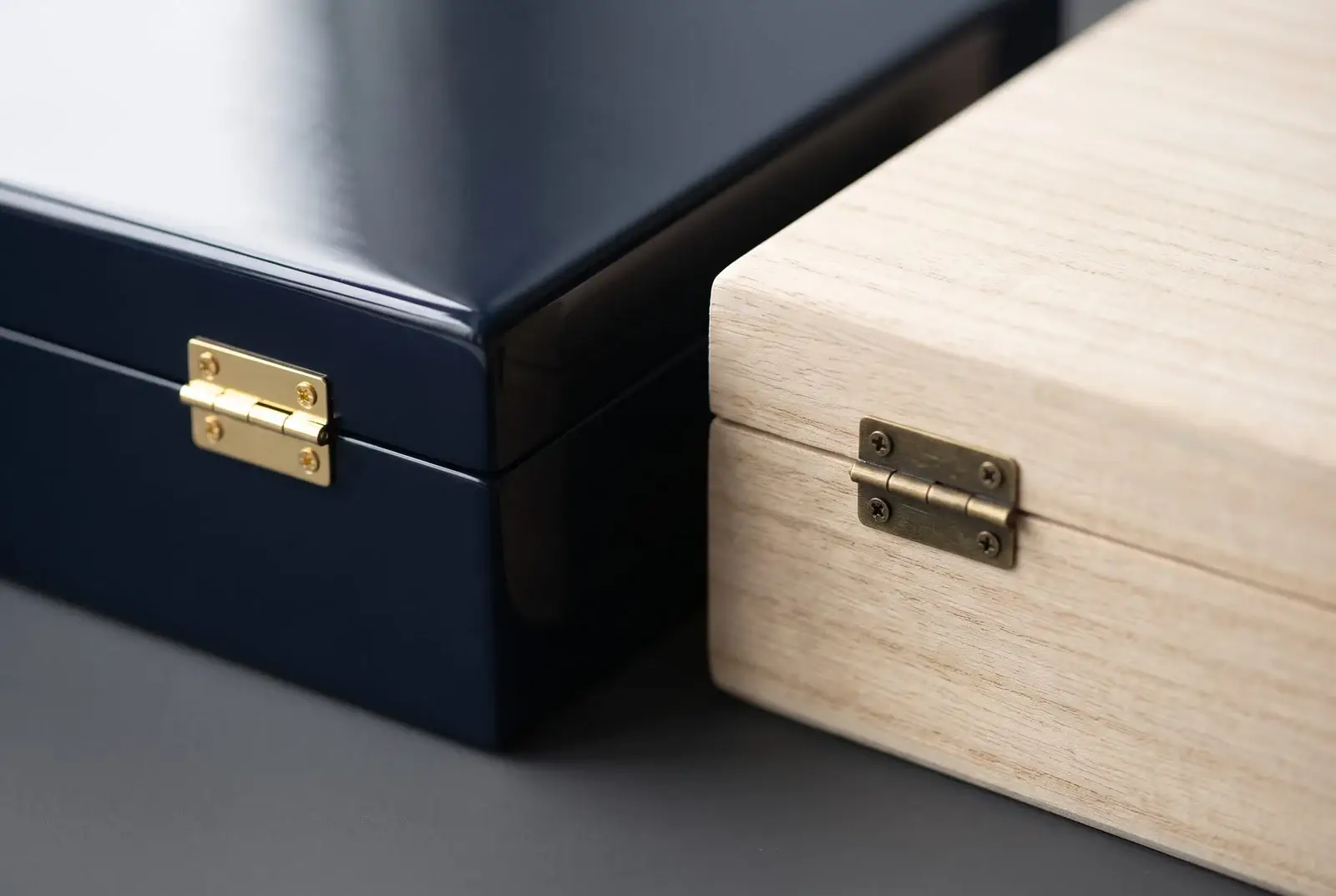
Matching materials to product categories
Different products place different demands on a wooden box. Heavy items need thicker walls and stronger corners, delicate items need precisely cut inserts, and display-led products need finish quality above all. The table below gives common starting points that a factory can refine after reviewing your exact product.
| Product | Common structure | Typical material | Typical interior |
|---|---|---|---|
| Tea gift set | Sliding or hinged lid | Paulownia, pine or bamboo | Paper lining, compartments |
| Wine and spirits | Hinged or sliding lid, reinforced corners | Pine or plywood | Shredded paper, cut foam or dividers |
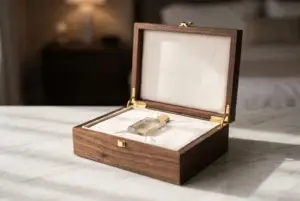
| Watches and jewelry | Hinged lid with a lacquer or veneer finish | MDF with veneer or lacquer, or hardwood | Velvet or PU cushions, fabric lining |
| Cosmetics and perfume | Magnetic or lift-off lid | Paulownia or MDF | EVA foam cut to fit |
| Corporate gifts | Hinged lid with logo plate | Pine, plywood or paulownia | Custom foam or paper inserts |
A five-step process for choosing the material
- Define the product and its weight. Provide exact dimensions, weight and fragility so the factory can size walls and corners correctly.
- Set the target look and finish. Share reference images and state whether the surface should be matte, glossy, natural or colored.
- Confirm the destination market. The United States, the European Union and other markets have different rules for panels, treatments and labeling.
- Compare physical samples. Review wood and finish swatches under daylight and indoor light, because color can shift between the two.
- Approve a prototype. Test lid fit, hinge strength, insert fit and the finished surface with your real product before ordering.
Quality Control and Troubleshooting for Wooden Box Packaging
Why moisture content matters
Wood is a hygroscopic material, so it gradually gains or loses moisture until it reaches balance with the air around it. The Purdue University extension service gives examples of this equilibrium: about 6.9 percent at 70°F (21°C) and 35 percent relative humidity, about 15.7 percent at 80°F (27°C) and 80 percent relative humidity, and about 4.5 percent in a heated room at 20 percent humidity (Purdue Extension). The same guide recommends kiln drying lumber for interior products to 6 to 8 percent moisture content.
When wood moves after it is made into a product, warping and open joints can follow, and thin lumber and veneer react faster than thick stock. This is why a box produced in a humid region can behave differently after months in a dry, air-conditioned interior. Good suppliers dry and condition their material, keep it in controlled storage and avoid rushing it through processing.
Troubleshooting common problems
| Problem | Likely cause | Prevention or fix |
|---|---|---|
| Lid warps or will not sit flush | Moisture change; unbalanced single-board lid | Use plywood or balanced construction; acclimate material; control moisture |
| Corner joints open | Moisture swings; weak glue joint | Use better glue, corner keys or splines; check moisture before assembly |
| Finish bubbles or peels | Moisture or dust under the coating; short curing time | Seal evenly on all sides; allow full curing; inspect adhesion on samples |
| Rough or raised grain | Insufficient sanding between coats | Apply sanding sealer; set a surface smoothness standard |
| Dust specks in gloss finish | Dirty coating environment | Require a clean coating area; inspect under bright, angled light |
| Color differs between boxes | Natural variation; different material lots | Approve a color range; finish each batch from the same lot |
| Hinge screws loosen | Soft wood strips; no predrilling | Predrill, use reinforcing blocks or plywood backing at hinge points |
| Musty smell or mold spots | Boxes packed damp or stored in high humidity | Dry fully before packing; use desiccant and moisture-resistant liners |
| Chipped MDF edges | Poor edge profiling or impact in transit | Round and seal edges; add corner protection in packaging |
An incoming inspection checklist
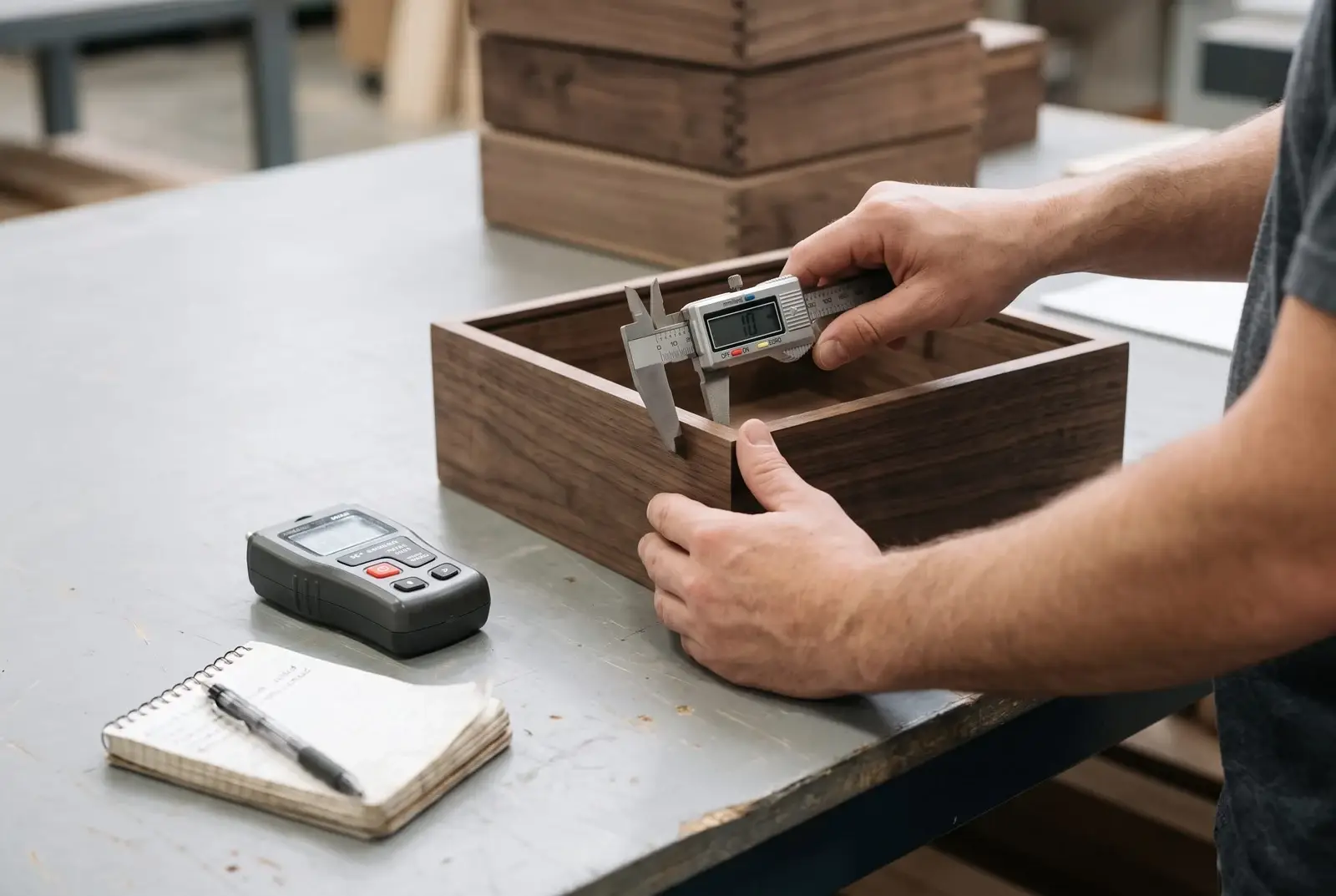
- Measure outside and inside dimensions with calipers and compare them with the approved drawing.
- Take moisture meter readings on several boxes and record them.
- Check the lid gap all the way around and confirm that the lid closes without force.
- Inspect the finish under bright, angled light for specks, runs, scratches and color differences.
- Open and close the hinges repeatedly and confirm that they stay aligned.
- Smell the boxes after opening a sealed carton to detect strong adhesive or coating odors.
- Test the packed carton by lifting, stacking and dropping it according to your agreed standard.
Summary and Frequently Asked Questions
The right material for wooden box packaging depends on weight, finish, market and price tier. Paulownia and pine suit light and economical boxes, hardwoods suit premium editions, plywood and MDF give stability and a flawless base for finishing, and bamboo offers a distinctive renewable look. Whichever you choose, control moisture, test real samples and agree on inspection standards in writing before production begins. Our OEM/ODM wooden packaging guide covers the full path from concept to delivery.
Need help specifying materials for your next wooden box? Send Guangzhou T.wing-Pak Mfg Co., Ltd. your product dimensions, weight, finish reference and destination market. Our team will recommend a substrate, a lining and an inspection plan, then build a physical sample for approval. See our OEM/ODM wooden packaging guide for the full process.
- OEM minimum order quantity: 50 to 100 pieces per design
- 3D rendering: within 8 hours of a confirmed brief
- Sample lead time: 7 days from confirmed specification
- Bulk production lead time: 20 to 30 days from sample approval
Contact us with your reference images and target market to receive a tailored specification and quotation.
1. What is the best wood for wooden box packaging?
There is no single best wood. Paulownia is very light and suits shipping-sensitive gift boxes, pine is economical and easy to stain, and hardwoods such as walnut or oak provide a premium feel at higher cost. Choose by product weight, finish and price tier.
2. Is MDF suitable for wooden gift boxes?
Yes, especially when the box will be lacquered, veneered or wrapped, because its surface is smooth and consistent. It is heavier than paulownia, its edges absorb moisture if left unsealed, and it must meet the formaldehyde rules of the destination market.
3. How do I prevent wooden boxes from warping?
Use wood dried to a suitable moisture content, choose balanced constructions such as plywood lids, and seal all surfaces evenly. For long journeys, pack the boxes with moisture protection and avoid storing them in damp areas.
4. Which finish gives a wooden box a premium look?
High-gloss piano lacquer and fine wood veneer are the most common premium choices. Matte or satin lacquer and natural oil suit brands that prefer a quieter, more natural appearance.
5. How can a buyer check that wood is dry enough?
Ask the supplier for moisture meter readings on incoming material and finished boxes, and measure a sample yourself. Purdue Extension guidance suggests drying wood for interior products to 6 to 8 percent moisture content.
Sources
- Glamorwood – Paulownia wood
- US EPA – Small Entity Compliance Guide for Mills (TSCA Title VI formaldehyde standards)
- Purdue Extension – Wood moisture and equilibrium moisture content (FNR-403-W)
- Coolset – EUDR product scope changes (July 2026 delegated regulation)