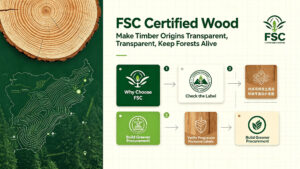
Supplier Spotlight: Guangzhou T.WING-PAK Mfg Co., Ltd
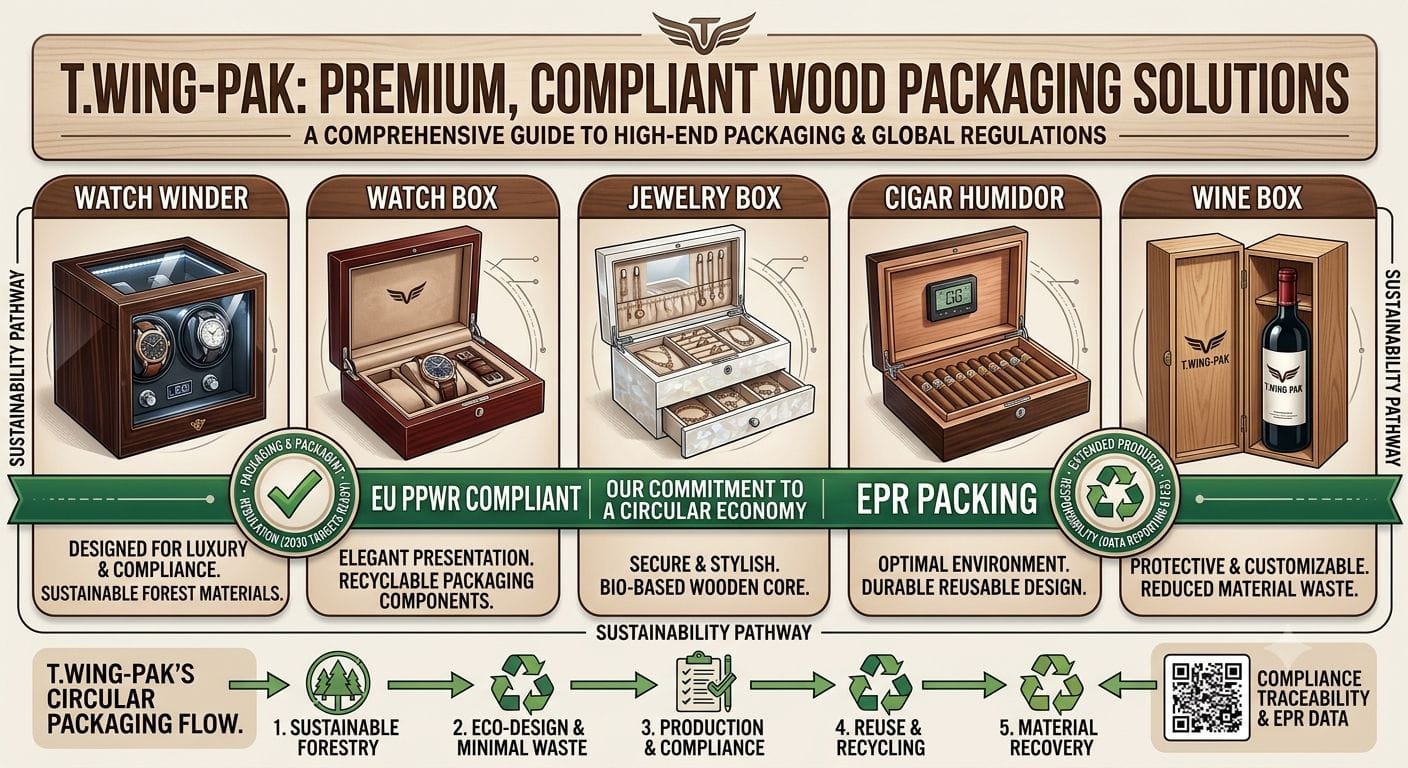
For brands seeking a packaging partner already aligned with the latest European environmental standards, Guangzhou T.WING-PAK Mfg Co., Ltd offers a compelling example. This Guangzhou-based manufacturer has proactively adapted its product lines to comply with the EU PPWR framework, ensuring that clients importing into Europe can meet recyclability, material restriction, and design-for-recycling criteria from the source.
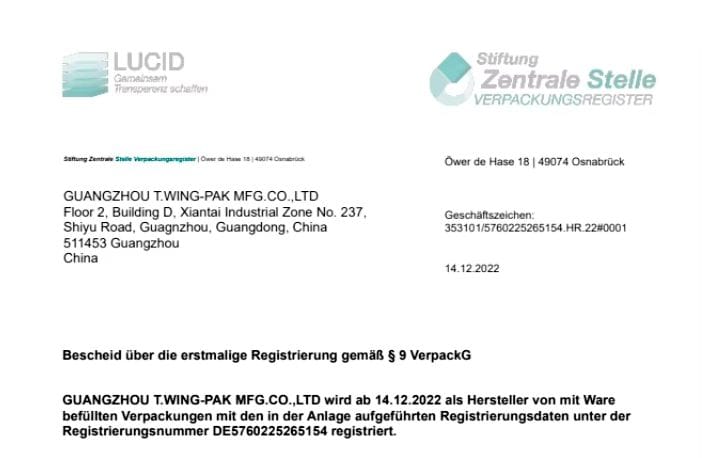
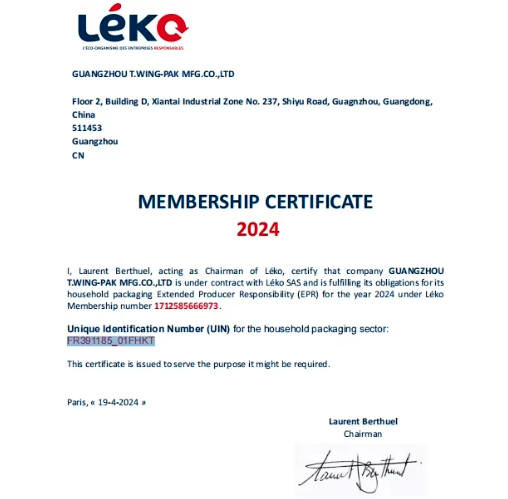
Notably, T.WING-PAK has obtained both French packaging law compliance (aligned with Citeo’s EPR registration requirements) and German packaging act (VerpackG) certification, meaning their products are pre-qualified for two of Europe’s most demanding producer responsibility systems. For cross-border sellers, working with a supplier that already holds these credentials significantly reduces the administrative burden of multi-country EPR registration and fee optimization.
By partnering with manufacturers that build regulatory compliance into their production processes, brands can avoid costly redesigns downstream and ensure uninterrupted market access as enforcement intensifies through 2026 and beyond.
Understanding the New European Packaging and Packaging Waste Regulation
If you sell products into the European market, one question is likely dominating your compliance conversations: does your packaging meet the requirements of the EU’s landmark regulation on packaging sustainability? The EU PPWR — formally adopted in late 2024 and now entering its phased implementation — represents the most significant overhaul of packaging rules in the bloc’s history. As someone who has spent over fifteen years advising brands on regulatory readiness, I can tell you this regulation demands immediate attention.
This article breaks down what the regulation requires, how it affects exporters and domestic producers alike, and what concrete steps you should take to ensure your products remain compliant and competitive in Europe.
What the Regulation Actually Requires
The Packaging and Packaging Waste Regulation replaces the older 1994 Directive with a directly applicable regulation — meaning it applies uniformly across all 27 member states without the need for national transposition. This is a critical distinction. Previously, each country interpreted packaging directives differently, creating a patchwork of obligations.
The new framework introduces binding targets across several dimensions:
- Recyclability: All packaging placed on the EU market must be recyclable by 2030, with “design for recycling” criteria applying from 2025 onward.
- Recycled content minimums: Contact-sensitive plastic packaging must contain at least 10% recycled content by 2030, rising to 50% by 2040.
- Reduction targets: Member states must reduce packaging waste per capita by 5% by 2030 and 15% by 2040 (relative to 2018 baselines).
- Reuse obligations: Specific sectors — including e-commerce, beverages, and transport packaging — face mandatory reuse quotas.
Substances of Concern
The regulation also restricts intentionally added PFAS (per- and polyfluoroalkyl substances) in food-contact packaging. Brands relying on grease-resistant coatings will need to reformulate or switch materials entirely. This restriction takes effect in 2026, making it an immediate priority for food and beverage companies.
Who Is Affected and When
Any company that places packaged goods on the European market — whether you manufacture domestically or import from third countries — falls within scope. This includes brand owners, importers, distributors, and e-commerce sellers fulfilling orders into the EU.
| Obligation | Effective Date | Applies To |
|---|---|---|
| Design for recycling criteria | 2025 | All packaging producers |
| PFAS restriction in food packaging | 2026 | Food-contact packaging |
| Minimum recycled content (plastics) | 2030 | Plastic packaging producers |
| Full recyclability requirement | 2030 | All packaging on EU market |
| Reuse targets (beverages, transport) | 2030 | Sector-specific producers |
| Enhanced recycled content targets | 2040 | All plastic packaging |
The phased timeline may seem generous, but the 2025 and 2026 milestones are already upon us. Companies that have not begun adapting their packaging portfolios are already behind schedule.
The Connection to Extended Producer Responsibility
The regulation strengthens and harmonizes extended producer responsibility schemes across Europe. Under the new rules, EPR fees will be modulated based on environmental performance — meaning packaging that is easier to recycle, contains recycled content, or uses mono-materials will attract lower fees.
This eco-modulation principle is already active in several markets. For example, EPR France packing fees and costs for importers are calculated based on material type, weight, and recyclability score through the Citeo system. Brands using non-recyclable multi-layer laminates pay significantly more than those using mono-material alternatives.
In Germany, the VerpackG system similarly penalizes hard-to-recycle formats. Understanding how EPR Germany Packing obligations interact with the broader European framework is essential for companies selling across multiple member states.
What This Means for Cross-Border Sellers
Amazon announced in early 2025 that sellers on its European marketplaces must provide proof of EPR registration for each country where they sell. Non-compliant listings face removal. This enforcement mechanism means the regulation’s impact extends well beyond traditional retail channels. The EPR France extended producer responsibility packaging obligations now apply equally to marketplace sellers and traditional importers.
Real-World Compliance: A Case Study
Consider a mid-sized Chinese electronics brand selling consumer devices across Europe via both Amazon and independent distributors. Prior to the regulation, their packaging consisted of printed cardboard boxes with expanded polystyrene (EPS) inserts, plastic film wrapping, and a multi-layer foil pouch for accessories.
To meet the new recyclability standards, they undertook the following changes:
- Replaced EPS inserts with molded paper pulp (fully recyclable in paper streams)
- Switched plastic film to a certified home-compostable cellulose wrap
- Redesigned the accessory pouch as a mono-material PE pouch with clear recycling labeling
- Registered with PRO schemes in France, Germany, Spain, and Italy
The result: a 34% reduction in EPR fees across their European markets and full compliance with the 2025 design-for-recycling criteria. Their packaging cost per unit increased by €0.08, but the fee savings and avoided de-listing risk more than offset this investment.
How to Assess Your Current Compliance Status
Based on my experience guiding brands through this transition, here is a practical framework for evaluating where you stand relative to the PPWR packaging regulation compliance requirements 2026 milestones:
Step 1: Audit Your Packaging Portfolio
Document every packaging component — primary, secondary, and tertiary — for each SKU sold into Europe. Identify materials, weights, and whether each component is currently recyclable in practice (not just in theory) within EU waste infrastructure.
Step 2: Map Your EPR Registrations
Confirm you hold valid registrations with Producer Responsibility Organizations in every member state where your products are sold. Verify that your declared data (material types, weights, volumes) is accurate and up to date.
Step 3: Evaluate Against Design-for-Recycling Criteria
The European Commission has published delegated acts specifying what constitutes “recyclable” packaging. Cross-reference your materials against these criteria. Pay particular attention to adhesives, inks, coatings, and multi-material combinations that may disqualify otherwise recyclable base materials.
Step 4: Plan for Recycled Content
While the 2030 deadline for minimum recycled content may seem distant, securing reliable supply chains for food-grade recycled plastics requires years of qualification and testing. Begin supplier discussions now.
Common Pitfalls and How to Avoid Them
Through my advisory work, I have observed several recurring mistakes that companies make when approaching sustainable packaging requirements under this framework:
- Assuming “recyclable” means the same thing everywhere. A material that is recyclable in Germany’s advanced sorting infrastructure may not be recyclable in markets with less developed systems. The regulation uses EU-wide benchmarks.
- Ignoring labeling requirements. The regulation mandates harmonized labeling indicating material composition and proper disposal. Non-compliant labels can trigger enforcement even if the packaging itself meets material standards.
- Treating compliance as a one-time project. The regulation’s targets escalate over time. Build a roadmap that addresses 2025, 2026, 2030, and 2040 milestones progressively.
- Overlooking transport and grouped packaging. Many brands focus on consumer-facing primary packaging but neglect secondary and tertiary packaging, which also falls within scope.
The Business Case Beyond Compliance
Meeting these EU packaging regulations is not merely a cost of doing business — it represents a strategic opportunity. Consumer research from Eurobarometer (2024) shows that 82% of European consumers consider packaging sustainability when making purchase decisions. Brands that lead on circular packaging gain measurable market advantage.
Furthermore, eco-modulated EPR fees create a direct financial incentive. Companies achieving the highest compliance scores under the new European packaging waste rules can reduce their annual fee burden by 20-40% compared to non-optimized competitors. Over a product portfolio of thousands of SKUs, this translates to substantial savings.
Frequently Asked Questions
Does the regulation apply to products sold via online marketplaces like Amazon?
Yes. Any product placed on the EU market — regardless of sales channel — must comply. Major marketplaces now require proof of EPR registration and are actively removing non-compliant listings. If you sell into Europe through any channel, you are subject to the same obligations as domestic producers.
What happens if my packaging is not fully recyclable by the 2030 deadline?
Packaging that fails to meet recyclability criteria after 2030 will be prohibited from the EU market. Before that hard deadline, non-recyclable packaging will face escalating EPR fees through eco-modulation. The financial penalties increase progressively, making early action significantly more cost-effective than last-minute compliance.
How do I determine which EPR schemes I need to register with?
You must register with the Producer Responsibility Organization in each member state where your packaged products are sold to end consumers. For most cross-border sellers, this means registering in multiple countries simultaneously. Each country has designated PROs — Citeo in France, Lucid/dual systems in Germany, CONAI in Italy, and Ecoembes in Spain are among the largest.
Can working with a PPWR-compliant supplier simplify my obligations?
Absolutely. Partnering with manufacturers like Guangzhou T.WING-PAK that have already secured French and German packaging law certifications means your packaging arrives pre-aligned with key regulatory criteria. While you still need your own EPR registrations as the entity placing goods on the market, compliant source materials dramatically reduce redesign costs and accelerate your path to full conformity.
Taking Action: Your Next Steps
The regulatory landscape for packaging in Europe has fundamentally shifted. Whether you are a multinational brand or a growing e-commerce seller, the time to act is now — not when enforcement penalties arrive.
Here is what I recommend: Begin with a comprehensive packaging audit this quarter. Engage a qualified compliance consultant or certification body familiar with the regulation’s delegated acts. Register or verify your EPR status in all relevant markets. And start conversations with your packaging suppliers — including PPWR-ready manufacturers such as T.WING-PAK — about material transitions that will serve you through 2030 and beyond.
If you need guidance on whether your specific products meet current requirements, reach out to our compliance team for a detailed assessment. We have helped hundreds of brands navigate this transition successfully — and the earlier you start, the more options you retain.