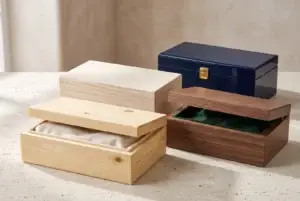
Exporting wooden box packaging involves more than a good design and a competitive price. Phytosanitary marks, panel emission limits, deforestation due diligence and certification claims can each delay a shipment or block a product launch if they are handled too late. This guide from Guangzhou T.wing-Pak Mfg Co., Ltd. explains the main rules that affect wooden gift boxes and wooden shipping packaging, shows how to build a document checklist, and offers a troubleshooting table for common problems. It is written for importers, brand owners and sourcing managers who want to ask suppliers the right questions before they place an order. For material basics, see our guide to choosing wood for wooden box packaging.

Which Rules Apply to Wooden Box Packaging in International Trade
Shipping crate or retail gift box: why the difference matters
Authorities treat a wooden box differently depending on what it is for. A solid wood crate or pallet used to move goods is wood packaging material, while a finished gift box that is sold with its contents is normally treated as part of the product or its retail packaging. The same factory may make both, so the compliance questions you ask must match the use.
Start by writing down three facts for every box: the material (solid wood, plywood, MDF, bamboo), the thickness of the wood, and whether the box is a shipping container, a retail box or a product sold on its own. These three facts decide which of the rules below are relevant. They also decide which documents your supplier should be able to provide. Our environmental certification guide for wooden box packaging exports lists the documents to request for each market.
ISPM 15 and wood packaging material
ISPM 15 is the international standard that sets phytosanitary treatments for wood packaging material, which reduces the spread of pests in international trade. In the UK government’s guidance, wood packaging material includes packing cases, boxes, crates, drums, pallets, box pallets, load boards and dunnage. The guidance lists several exemptions: processed, non-solid material such as plywood, raw wood that is 6 mm thick or less, and gift boxes made from processed wood (GOV.UK).
For wood that does need treatment, the approved methods include heat treatment, where the wood is heated to at least 56°C for at least 30 continuous minutes throughout the whole profile including the core, and fumigation as an alternative. Every piece of treated packaging must carry a legible ISPM 15 mark showing the two-letter ISO country code, the producer and the treatment used, and a certificate cannot replace the mark (GOV.UK). Wood must also be debarked, with only small bark remnants allowed.
| Item | Typical ISPM 15 position (per UK guidance) | What to confirm |
|---|---|---|
| Solid wood crate or pallet used for shipping | Treatment and mark required | Heat-treatment (HT) mark with country code and producer number |
| Plywood or other processed wood packaging | Exempt as processed, non-solid material | Confirm the material is genuinely processed panel |
| Raw wood 6 mm thick or less | Exempt | Measure the thickness of all parts |
| Gift box made from processed wood | Exempt | Confirm with the destination authority |
| Solid wood gift box thicker than 6 mm | Depends on the destination country’s interpretation | Ask your broker; consider HT marking to avoid delays |
The table follows UK wording, and other countries may interpret the scope differently. Where there is doubt, a heat-treated and marked box or a panel-based design is often the simplest way to avoid border delays. The OEM/ODM wooden packaging complete guide shows where these decisions sit in a production project.
Formaldehyde limits for wood-based panels
Plywood, MDF and particleboard are bonded with resins, so many markets limit the formaldehyde they release. In the United States, TSCA Title VI sets emission limits of 0.05 ppm for hardwood plywood, 0.09 ppm for particleboard, 0.11 ppm for MDF and 0.13 ppm for thin MDF, which is MDF of 8 mm or less. Panels must be certified by an EPA-recognized third-party certifier unless a limited exemption applies, and labels must show the producer, lot number, certifier identification and a TSCA Title VI statement (US EPA).
The European Union has also tightened its rules. Under REACH Annex XVII Entry 77, the emission limit is 0.062 mg/m³ for furniture and wood-based articles and 0.080 mg/m³ for other articles, with enforcement beginning on 6 August 2026. Compliance is shown with chamber testing, and EN 717-1 is described as the most straightforward route for furniture (Eurofins). Whether a given wooden box counts as a wood-based article or an other article depends on how it is classified, so ask an accredited laboratory to confirm before you order. Our UL / CE / RoHS / FSC market-access overview explains how coating and material test reports fit together.
| Market | Rule | Key figures | What to request from the supplier |
|---|---|---|---|
| United States | TSCA Title VI (EPA) | 0.05 ppm plywood; 0.09 ppm particleboard; 0.11 ppm MDF; 0.13 ppm thin MDF | Panel certification and labeling details from a third-party certifier |
| European Union | REACH Annex XVII, Entry 77 | 0.062 mg/m³ wood-based articles; 0.080 mg/m³ other articles; from 6 August 2026 | Chamber test report (for example EN 717-1) on the finished box or panel |
| Other markets | National rules vary | Check local requirements | Test reports and material declarations |
EUDR and FSC: Legality and Sustainability Claims
The EU deforestation regulation
The EU deforestation regulation (EUDR) covers seven commodities, and wood is one of them. It applies from 30 December 2026, and operators placing relevant products on the EU market must show that they are deforestation-free and legally produced, usually through traceability data and a due diligence statement (Baker McKenzie). The Commission adopted a delegated regulation on 13 July 2026 that clarified the product scope, and Delegated Regulation (EU) 2026/2102 entered into force on 18 September 2026 (Coolset).
The clarified scope matters for packaging. Single-use packing is out of scope regardless of material when it is used only to support, protect or carry another product, while reusable packing stays in scope until it is actually used for that purpose. Products made from bamboo also fall outside the scope entirely (Coolset). By contrast, a new wooden item placed on the market as a standalone product, such as a pallet, can be in scope (Baker McKenzie).
For wooden gift boxes, the practical question is whether the box is single-use packing for a product or a reusable item sold in its own right. The answer can depend on the customs classification and the way the box is marketed, so confirm it with your broker before the first EU shipment. Packaging that is exempt from EUDR may still face packaging rules, since the main obligations of the EU packaging regulation (PPWR) apply from 12 August 2026 (Baker McKenzie). Our EU PPWR compliance checklist sets out the practical steps for brand owners.
FSC certification and label claims
FSC certification is a voluntary scheme, and it is one of the most practical ways to show responsible sourcing to customers. The FSC 100 percent label means all forest-based material comes from FSC-certified forests, FSC Mix allows certified, recycled and controlled wood, and FSC Recycled covers verified recycled material. Under the percentage system for FSC Mix, at least 70 percent of the input must be FSC-certified or recycled (FSC).
A label can only be used under a valid FSC certificate and with the approval of the certificate holder’s certification body. In practice, this means a brand cannot add the FSC logo to a wooden box just because the factory buys some certified wood. Ask for the certificate number, the scope of the certificate and the claim that applies to your order, and keep these records with your launch documents. Our guide to FSC-certified wood and how to verify it shows how to check a certificate number and an approved claim.
FSC certification supports the legality evidence that EUDR customers ask for, but it does not by itself replace a due diligence statement. Treat it as one part of the evidence file, alongside supplier declarations, species information and origin records.

Document checklist for wooden box shipments
| Document | Purpose | Usually provided by |
|---|---|---|
| Commercial invoice and packing list | Customs clearance and valuation | Supplier |
| Material specification sheet | Species or panel type, thickness, finish | Supplier |
| ISPM 15 mark or exemption statement | Phytosanitary compliance for solid wood packaging | Supplier or treatment provider |
| Formaldehyde test report or panel certificate | Emission compliance for plywood, MDF and particleboard | Supplier or panel maker; accredited laboratory |
| FSC certificate details and claim | Support for certified sourcing claims | Supplier |
| Origin and species information | Traceability and due diligence evidence | Supplier, with your own verification |
| Product safety or coating test report, if requested | Support for finish or surface requirements of the destination market | Accredited laboratory |

Practical Export Checklist, Moisture Control and Troubleshooting
A seven-step compliance workflow
- Classify the box. Decide whether it is a shipping crate, a retail gift box or a standalone product, and record the HS code with your broker.
- Define the materials. Fix the species or panel type, thickness and finish in the specification.
- Identify destination rules. List the phytosanitary, emission, legality and labeling requirements for each market.
- Request supplier documents early. Ask for certificates, test reports and material declarations before you approve the sample.
- Test where needed. Send a finished sample to an accredited laboratory for emission or coating tests if the rules require it.
- Approve labels and claims. Check every sustainability claim and mark against the documents you hold.
- Keep records. Store the specification, certificates and reports for each production lot so you can respond to inspections.
Controlling moisture, mold and warping in transit
Compliance paperwork does not protect a box from damp air. Wood reaches balance with its surroundings, and Purdue Extension gives examples of roughly 6.9 percent moisture content at 70°F (21°C) and 35 percent relative humidity but about 15.7 percent at 80°F (27°C) and 80 percent relative humidity. Lumber that gains or loses moisture after drying can warp and open its joints, and thin lumber and veneer respond faster than thick stock (Purdue Extension).
Long sea journeys expose cartons to temperature swings and humid air inside the container. To reduce the risk, dry boxes fully before packing and wrap them in moisture-barrier bags or liners. Add desiccant where appropriate, keep cartons off damp floors, and avoid loading when the products or cartons are wet. A short pre-shipment check with a moisture meter gives you a record if a dispute arises later. Our wood selection guide covers drying and conditioning in more detail.
Troubleshooting common export problems
| Problem | Likely cause | How to resolve or prevent it |
|---|---|---|
| Shipment held for a missing ISPM 15 mark | Solid wood packaging shipped without treatment mark | Use treated and marked wood, or switch to exempt materials such as plywood; check the exemption with the destination authority |
| Formaldehyde test failure | Panel emissions above the limit; wrong test method | Use panels with documented low-emission classes; test the finished box with the method required by the market |
| Mold or musty smell on arrival | Damp boxes, sealed humid cartons or container condensation | Dry fully before packing; add moisture barriers and desiccant; keep cartons off wet floors |
| Warped lids after shipping | Large moisture change between origin and destination | Use balanced or panel lids; condition the wood; control moisture before packing |
| Questions about FSC wording on packaging | Label used without a valid certificate or claim | Confirm the certificate scope and the approved claim before printing |
| Customs query on origin or species | Incomplete traceability information | Collect origin and species data from the supplier and keep records for each lot |
| Document mismatch | Invoice, packing list and specification differ | Cross-check all documents before shipment and correct them at source |
Packing for transit
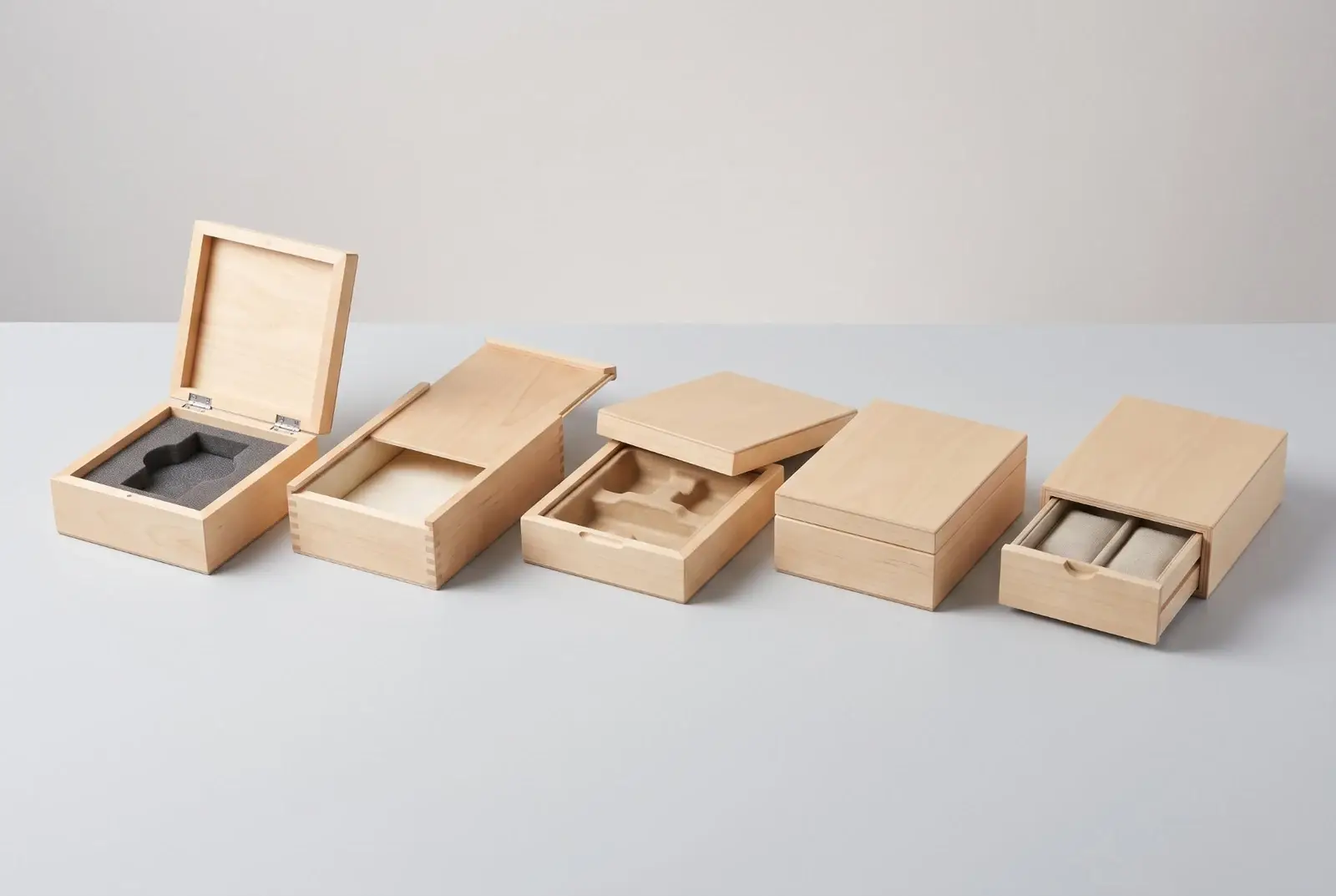
Good packing is part of compliance, because damaged or damp goods create disputes and returns. Use a master carton that matches the box size, add corner protection for lacquered surfaces and avoid empty space that allows movement. Label cartons clearly, show the handling instructions and record the carton weights on the packing list. Our guide to wooden box suppliers for European and US brands covers market-specific packaging expectations.
Summary and Frequently Asked Questions
Exporting wooden box packaging safely means checking four areas before production starts: phytosanitary treatment under ISPM 15, emission rules for plywood and MDF, legality evidence such as EUDR documentation, and honest certification claims such as FSC. Classify each box, fix its materials in the specification, request documents early and keep records for every lot. Add good moisture control and strong packing, and most delays can be avoided. For the commercial side of a project, see our B2B custom wooden box sourcing playbook.
Preparing to export wooden boxes? Send Guangzhou T.wing-Pak Mfg Co., Ltd. your destination market, box dimensions, material and finish preference. Our team will build a compliant specification, prepare the document file and produce a physical sample for approval. See our environmental certification guide for wooden box exports for the documents we supply.
- OEM minimum order quantity: 50 to 100 pieces per design
- 3D rendering: within 8 hours of a confirmed brief
- Sample lead time: 7 days from confirmed specification
- Bulk production lead time: 20 to 30 days from sample approval
Contact us with your target market and product details to receive a tailored specification and quotation.
1. Do wooden gift boxes need an ISPM 15 mark?
ISPM 15 applies to solid wood packaging material such as crates, pallets and dunnage. UK government guidance exempts processed wood such as plywood, raw wood 6 mm thick or less, and gift boxes made from processed wood. Rules and interpretations differ by country, so confirm with the destination authority or your broker.
2. What formaldehyde limits apply to MDF boxes sold in the United States?
Under TSCA Title VI, EPA limits are 0.05 ppm for hardwood plywood, 0.09 ppm for particleboard, 0.11 ppm for MDF and 0.13 ppm for thin MDF of 8 mm or less. Panels must generally be certified by an EPA-recognized third-party certifier.
3. Does the EU deforestation regulation apply to wooden box packaging?
The regulation applies from 30 December 2026 and covers wood as one of seven commodities. Single-use packing used only to support, protect or carry another product is out of scope, but standalone or reusable wooden products may be treated differently, so confirm the classification with your customs broker.
4. What does the FSC Mix label mean?
FSC Mix means materials can come from FSC-certified forests, recycled sources or controlled wood. Under the percentage system, at least 70 percent of the input must be FSC-certified or recycled, and the label may only be used under a valid FSC certificate.
5. How can I reduce the risk of mold on wooden boxes during sea shipment?
Dry boxes fully before packing, use moisture-barrier bags or liners and desiccant, avoid packing in damp conditions, and keep cartons off wet floors during storage and loading.
Sources
- GOV.UK – Wood packaging material for import and export
- US EPA – Small Entity Compliance Guide for Mills (TSCA Title VI)
- Eurofins – New EU formaldehyde limits (REACH Entry 77)
- Baker McKenzie – EUDR product scope and information system ahead of December 2026
- Coolset – EUDR product scope changes (July 2026 delegated regulation)
- FSC UK – What do the FSC labels mean?
- Purdue Extension – Wood moisture and equilibrium moisture content (FNR-403-W)