Somewhere between “nice sustainability story” and “hard requirement,” FSC certification quietly crossed a line for wooden goods importers — and a lot of brands sourcing watch winders haven’t noticed yet. If your winder is built from wood with no traceable chain of custody, you’re not just missing a marketing point. You may be looking at customs delays, corporate buyer disqualification, or a shipment held at port while you scramble to prove where the wood came from.
The numbers explain why this shifted so fast. The global eco-friendly furniture and wood products category — which wooden watch winders and packaging sit within — was valued at roughly USD 53.8 billion in 2025 and is projected to reach USD 113.9 billion by 2033, a 10% CAGR, with North America alone accounting for over 42% of demand, driven largely by corporate procurement policies that now require certification as a condition of purchase rather than a preference. (Source: Alibaba.com Seller Blog)
Why This Isn’t Just a Marketing Checkbox Anymore
Uncertified wood shipments into regulated markets can face extended border holds — commonly cited in the 10 to 30 day range — while customs authorities request documentation that a factory without genuine certification simply can’t produce. (Source: Alibaba.com Seller Blog) For a brand with a launch date, retail commitments, or a marketing campaign already scheduled, that delay isn’t an inconvenience — it’s a missed season. Beyond customs risk, an increasing share of corporate and retail buyers now list FSC as a purchasing requirement, not a preference, which means an uncertified supplier can quietly disqualify you from deals you never even knew were conditional on it.
What FSC Certification Actually Verifies
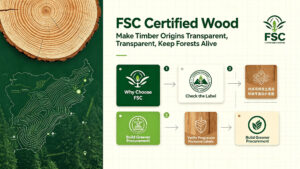
FSC (Forest Stewardship Council) Chain of Custody certification traces wood from a certified, responsibly managed forest through every stage of processing to the finished product — with third-party audits and annual surveillance required to maintain it, and certificates typically valid for five years at a time. (Source: Alibaba.com Seller Blog) It’s not a self-declared claim — it’s an externally audited chain of documentation, which is exactly why it holds weight with customs authorities and corporate procurement teams in a way that a supplier’s own sustainability statement doesn’t.
How to Verify a Supplier’s Claim Instead of Trusting the Logo
The FSC logo on a company profile or slide deck proves nothing on its own. Ask for the actual FSC Chain of Custody certificate number, and cross-check it directly on FSC’s public database at info.fsc.org. A factory with a genuine, current certification will hand this over immediately, because it’s a public record either way. A factory that hesitates, or offers a certificate that doesn’t match the entity actually producing your order, is a red flag worth taking seriously before you commit to a wood-based product line.
How This Plays Out in Practice
T.WING-PAK holds FSC certification alongside UL, CE, and RoHS, which lets our OEM clients move wooden watch winders and packaging into North American and European markets without the compliance question mark hanging over a shipment. It’s one part of a broader sustainable sourcing approach that also covers how wood is selected and processed through our production line — you can see more detail on our sustainable practices page, and the full specification range this applies to on our watch winder product page.
| What to ask for | What it should look like |
|---|---|
| Certificate number | Specific, verifiable, not just a logo |
| Database cross-check | Matches the producing entity on info.fsc.org |
| Certificate validity | Current, typically renewed on a 5-year cycle |
| Chain of custody scope | Covers the specific product line you’re sourcing |
The Cost of Skipping This Step
A supplier who can’t produce a real certificate isn’t automatically acting in bad faith — but the risk lands on you either way, in the form of a customs hold, a disqualified retail bid, or a compliance gap your own customers eventually ask about. Verifying this before you commit costs you one email and a database lookup. Discovering it after a shipment is already at port costs considerably more.
Sourcing Into a Market That Requires FSC?
Tell us which market you’re shipping into and we’ll confirm exactly what documentation you’ll need on hand, plus share our certificate details directly so you can verify them yourself before you commit to an order.