Every year, hundreds of watch brands, retailers, and luxury goods companies reach out to Chinese manufacturers looking for custom watch winders — only to stall at the same two questions: “What’s your MOQ?” and “How much does a sample cost?”
These aren’t minor details. They are the gateway decisions that determine whether a project moves forward or dies in the inquiry stage. Get them wrong, and you either overpay for a prototype that sits in a drawer, or commit to a production run you can’t sell through. Get them right, and you unlock a supply chain partnership that scales with your brand.
After 19 years of manufacturing luxury watch winders and wooden packaging for OEM/ODM clients worldwide, I’ve seen every variation of this conversation. This guide lays out exactly how MOQ and sampling work in the watch winder industry — no vague ranges, no dodging the hard questions.
Why MOQ Exists (And Why It’s Not Arbitrary)
Minimum Order Quantity is not a sales tactic. It is a direct reflection of manufacturing economics. Here’s what drives it:
Raw Material Procurement Thresholds. The MDF boards, solid wood panels, Japanese Mabuchi motors, lacquer coatings, and velvet lining materials that go into a quality watch winder all have their own supplier MOQs upstream. A factory that orders 50 sets of components pays a steep per-unit premium compared to one ordering 500. That cost passes straight to the buyer.
Production Line Setup Costs. CNC routing programs need to be loaded. Spray booths need to be calibrated for a specific lacquer color and finish (our piano lacquer process alone involves 12–13 individual coats). Assembly jigs get configured for specific dimensions. All of this takes time and labor that gets amortized across the order — fewer units means higher per-unit setup cost.
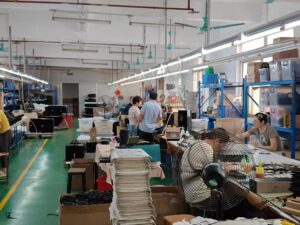
Quality Control Infrastructure. At T.WING-PAK, every single unit goes through full-line inspection — not batch sampling, full inspection. Maintaining a defect rate at or below 2% across a production run requires dedicated QC staffing. That infrastructure has a fixed cost floor regardless of whether you’re producing 100 units or 10,000.
Mold and Tooling Commitments. Custom watch winder projects often require proprietary tooling — hinge molds, motor housing brackets, logo debossing plates. Tooling is a one-time cost that only makes economic sense when spread across a viable production volume.
The bottom line: MOQ is not the factory trying to force you into a bigger order. It’s the minimum threshold at which both sides can achieve acceptable unit economics.
T.WING-PAK’s MOQ Structure: 50 Units and Up
Our standard MOQ starts at 50 units per SKU. That number reflects nearly two decades of operational optimization — we’ve engineered our production lines and supplier relationships to make small-batch manufacturing viable without sacrificing quality.
Here’s how the MOQ tiers break down in practice:
Tier 1: 50–299 Units (Small Batch / Market Test)
This is the entry point for brands launching a new product line, testing a new market, or validating a custom design before committing to volume.
At this tier, you’re getting full OEM/ODM capability — custom dimensions, your choice of wood species and finish, branded packaging, your logo on the product — with no compromise on build quality. The per-unit cost is at its highest because setup costs are distributed across a smaller run, but the total capital outlay is manageable. Production lead time at this volume: approximately 14 days for ~50 units, scaling proportionally as quantity increases.
Best for: New brands entering the watch accessories market. Established brands testing a limited-edition or seasonal SKU. Retailers who want branded exclusives without inventory risk.
Tier 2: 300–999 Units (Growth Volume)
This is where unit economics start getting interesting. Suppliers begin offering better pricing on raw materials, and production line efficiency improves because the run is long enough to stabilize workflows. You’ll typically see a 10–20% per-unit cost reduction compared to Tier 1.
At this volume, it also becomes practical to invest in custom tooling (proprietary hinge designs, unique motor housing configurations) because the tooling cost per unit drops to a level that makes financial sense. Production lead time: approximately 30 days for 300 units.
Best for: Brands with validated demand scaling to wholesale distribution. Corporate gifting programs with multi-location rollouts. Watch retailers building out a permanent accessories category.
Tier 3: 1,000–4,999 Units (Standard Production)
This is the sweet spot for most established brands. Material costs hit favorable breakpoints, the factory can dedicate a production line to your order, and lead times stabilize because there’s enough volume to schedule efficiently.
Per-unit cost reduction at this tier versus Tier 1 typically runs 20–35%, depending on specifications and materials.
Best for: Mid-market watch brands with steady retail distribution. Watch winder brands selling through Amazon, their own e-commerce, or wholesale channels.
Tier 4: 5,000+ Units (Volume Production)
At this level, you’re operating at full-scale manufacturing efficiency. We can negotiate the best upstream material pricing, run continuous production shifts, and optimize logistics for container-load shipments.
Best for: Major retail chains, global watch brands, and large-scale distributors.
Key Point About MOQ Flexibility
Not every project fits neatly into a tier. If you’re a brand with a strong relationship and clear growth trajectory, there’s room to discuss flexible arrangements — for instance, a blanket order commitment for 1,000 units with staggered delivery in batches of 250. This gives you volume pricing without requiring you to warehouse the full order upfront. These arrangements are negotiated case by case.
The Sampling Process: What You’re Actually Paying For
Sampling is where most first-time OEM buyers either overpay or underestimate. Let’s break down what a watch winder sample actually involves.
What Goes Into a Watch Winder Sample
A production-grade sample is not a rough mockup. It is a fully functional unit built to your exact specifications. Here’s what’s included:
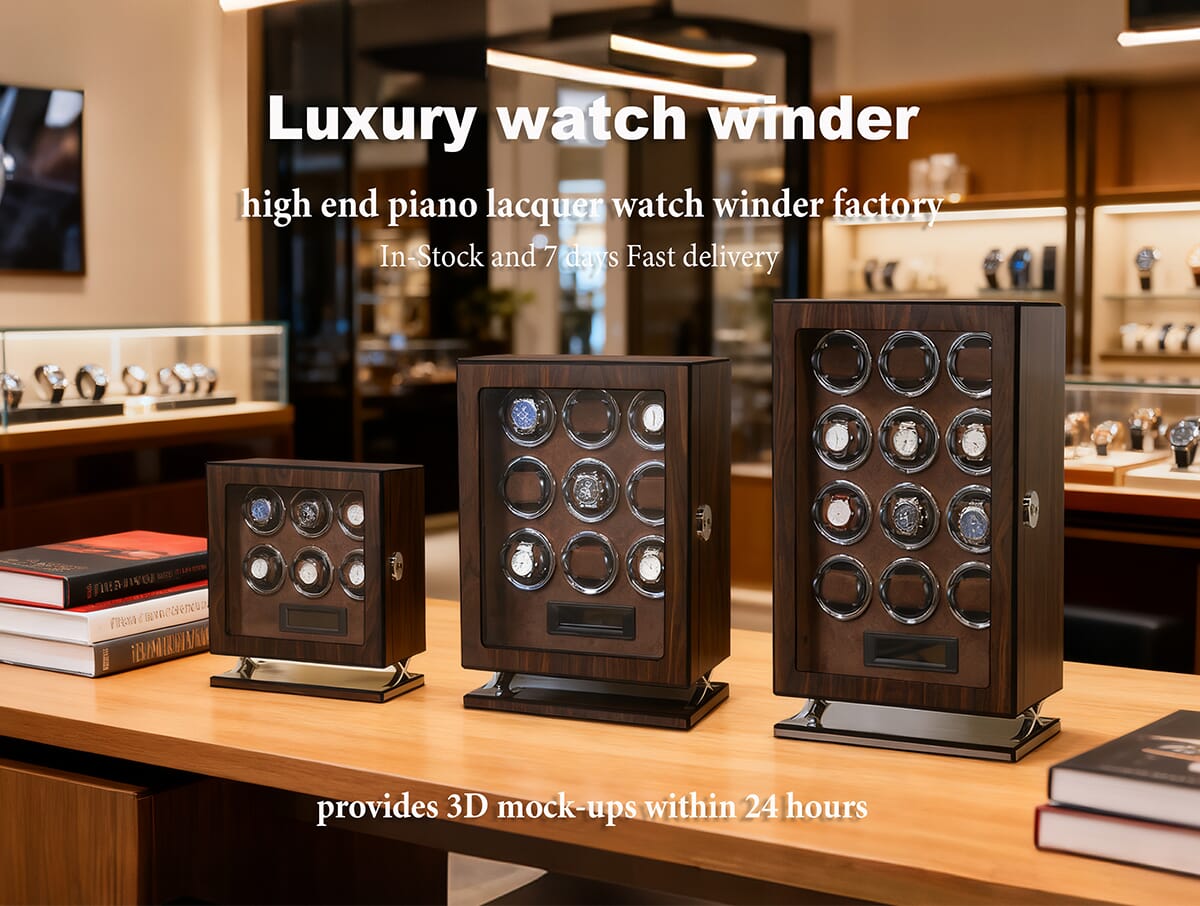
Design Engineering. If you’re coming in with a concept sketch, a reference photo, or just a verbal description, the factory’s design team translates that into production-ready technical drawings. At T.WING-PAK, this includes 3D renderings — we can deliver initial 3D visuals within as little as 8 hours of receiving your brief, so you can validate the design direction before any physical materials get cut.
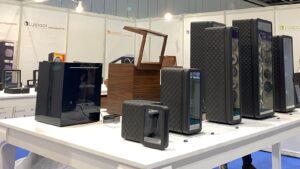
Material Sourcing. Your sample uses the actual production materials — not substitutes. If the final product will feature ebony veneer with a high-gloss piano lacquer finish, the sample uses that same veneer and goes through the same 12–13 coat lacquer process. If it runs on a Japanese Mabuchi motor, the sample has that motor installed and running.
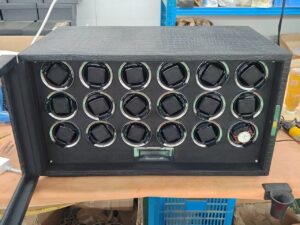
Precision Fabrication. CNC cutting, edge profiling, and dry-fit assembly to ensure dimensional accuracy. For watch winders with multiple rotors, this includes verifying motor mounting positions, winding direction programming, and TPD (Turns Per Day) calibration across the 300–2,200 TPD range.
Finishing. Full surface treatment — sanding, priming, base coats, color coats, clear coats. For piano lacquer finishes, this is where the 12–13 coat process happens. Each coat requires curing time, sanding between coats, and final buffing to achieve the mirror-like surface that stays vibrant for 2–3 years.
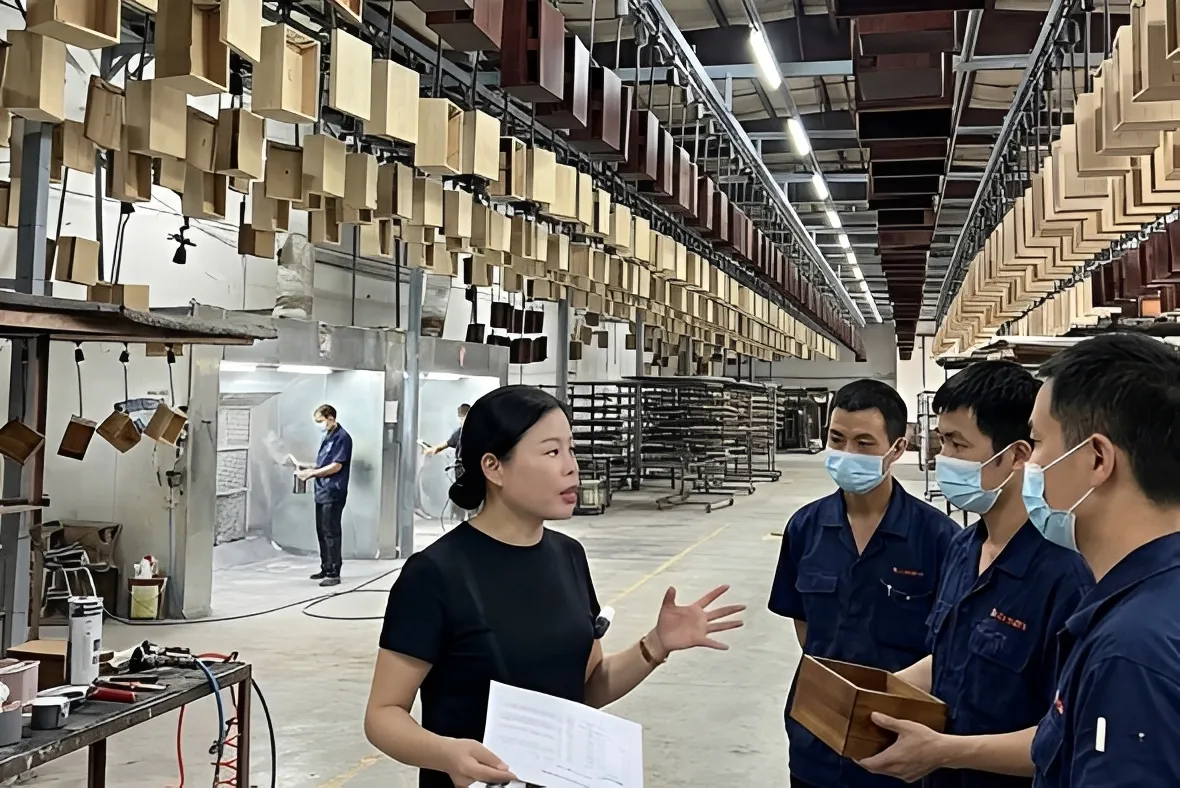
Functional Testing. Motor run-in testing (48–72 hours continuous), noise verification (must be under 10 dB), TPD accuracy validation, lid hinge cycle testing, LED lighting check (if applicable), and power adapter safety verification.
Certification Pre-check. If the final product needs UL, CE, RoHS, or FSC certification (as virtually all products destined for US and EU markets do), the sample build process accounts for compliance requirements — proper wire routing, grounding, material traceability documentation.
Sample Pricing: What Drives the Cost
Sample fees in the watch winder industry cover the actual cost of materials, labor, and machine time required to build a one-off or small batch of units outside of a standard production run. The fee is not profit-driven — it’s cost recovery.
Factors that affect sample pricing:
Complexity of the design. A single-rotor watch winder in a standard rectangular box with a matte finish is a different project from a 12-rotor cabinet with glass display panels, LED interior lighting, biometric lock, and high-gloss piano lacquer. The more complex the design, the more engineering hours, material cost, and finishing labor goes into the sample.
Materials specified. Solid walnut costs more than MDF with walnut veneer. Carbon fiber trim costs more than faux leather. Japanese Mabuchi motors cost more than generic Chinese motors (but they last longer and run quieter — under 10 dB — which is why we use them exclusively).
Finish type. A matte or satin finish requires fewer coats and less curing time than a full piano lacquer finish. The 12–13 coat piano process represents a significant portion of both sample cost and sample lead time.
Number of samples. Ordering 2–3 samples of the same design reduces the per-unit sample cost because setup is done once. If you need samples in multiple colorways or configurations, each variation adds incremental cost.
Typical sample pricing range: Sample fees are calculated at 2–3x the unit production price. This reflects the reality that building a single unit outside of a production run requires the same setup, tooling, and finishing labor as a batch — but without the volume to spread costs across. For example, if the production unit price is $50, expect the sample fee to fall in the $100–$150 range. If the production price is $200 for a complex multi-rotor piano lacquer unit, the sample fee would be $400–$600. The multiplier varies based on complexity, materials, and finish requirements.
The upside: At T.WING-PAK, sample fees are fully creditable against your production order. When you proceed to mass production, the sample fee you paid gets deducted from your production invoice. You’re not paying twice — the sample cost becomes a deposit on your first order.
Sample lead time: 7 days for standard designs, 14 days for complex builds (multi-rotor units, piano lacquer finish, custom hardware, integrated lighting). The piano lacquer process alone — 12–13 coats with curing and sanding between each — accounts for a significant portion of the timeline on complex samples.
The Sample Fee Credit Policy
T.WING-PAK offers a straightforward sample fee credit policy: when you proceed to a production order, your sample fee is fully deducted from the production invoice. No partial credits, no conditions — the full amount comes off your first order.
Shipping and Ancillary Costs
Sample shipping, packaging drop-testing, vibration testing, and other compliance-related testing costs are billed separately from the sample fee. This is standard industry practice — it keeps the sample quote clean and lets the buyer choose their preferred courier and testing scope.
Smart Sampling: How Experienced Buyers Maximize ROI
Not all sampling strategies are equal. Here’s how seasoned OEM buyers approach the process to minimize cost and accelerate time to market.
1. Start With a Clear Brief
The single biggest driver of sample cost overruns is scope creep caused by vague specifications. Before you contact any factory, lock down these decisions:
- Rotor count: Single, dual, quad, 6, 8, 12?
- TPD range and rotation settings required (most high-end watches need 650–1,800 TPD)
- Exterior material and finish: MDF, solid wood, carbon fiber, leather? Matte, satin, high-gloss piano?
- Interior material: Velvet, microfiber, leather?
- Power source: AC adapter, battery, dual?
- Features: LED lighting, lock, glass display, watch cushion size?
- Certifications needed: UL (required for US), CE (required for EU), RoHS, FSC?
Arriving with these answers saves 1–2 rounds of back-and-forth and can cut sample lead time by 30% or more.
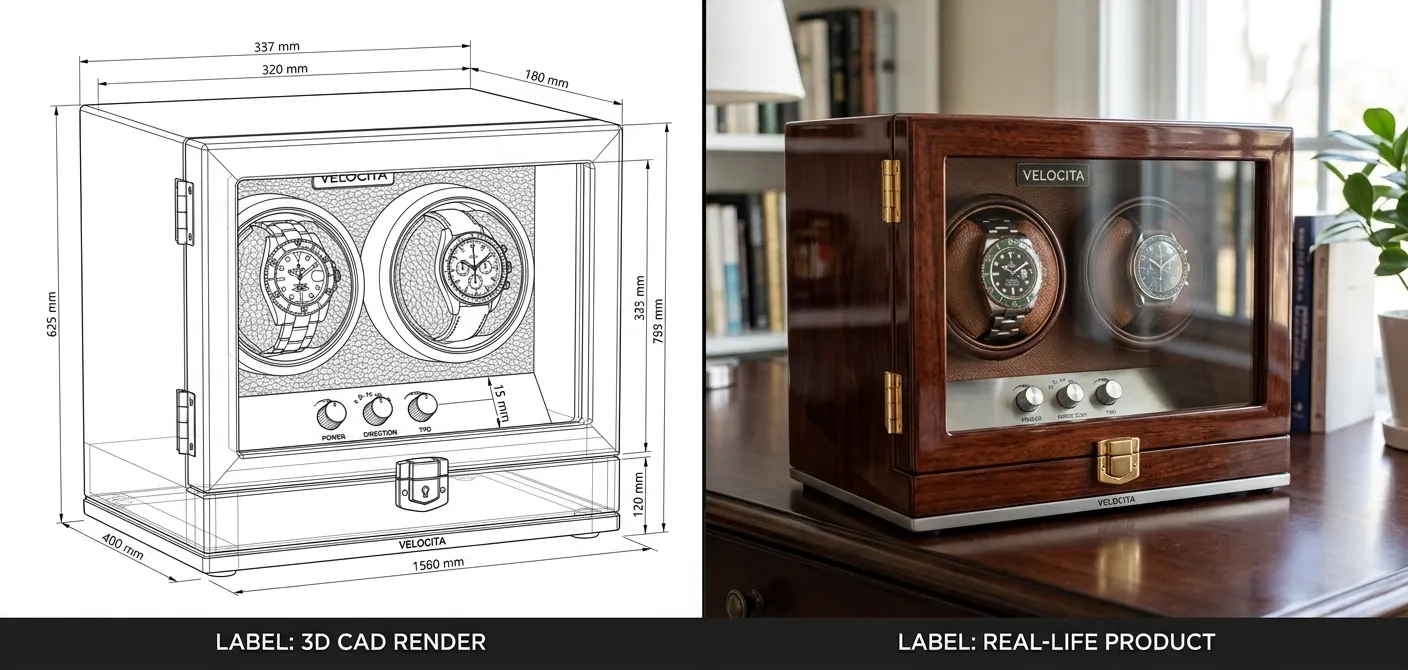
2. Use 3D Rendering Before Physical Sampling
This is where working with a factory that offers rapid 3D visualization pays for itself. At T.WING-PAK, we deliver 3D renderings within 8 hours of receiving your brief. This lets you:
- Validate dimensions, proportions, and aesthetics before any material gets cut
- Share renderings with your internal team or retail partners for feedback
- Iterate on design details (wood grain direction, logo placement, hardware finish) at zero cost
Brands that skip this step and go straight to physical samples typically need 2–3 sample revisions. Brands that use 3D rendering first usually approve the physical sample on the first or second round.
3. Order Multi-Configuration Samples Strategically
If you’re testing multiple finishes (e.g., matte black vs. walnut piano lacquer) or multiple sizes (single vs. dual rotor), order them in the same sample batch. Setup costs are incurred once, and each incremental variant costs less than ordering them separately.
4. Negotiate Volume-Contingent Sample Credits
If you have a clear production intent and can communicate expected annual volume, use that as leverage to negotiate better sample terms. A brand planning to order 2,000 units annually has significantly more negotiating power on sample fees than one placing a speculative inquiry.
Certifications: The Hidden MOQ Consideration
Here’s something many first-time importers overlook: certification costs are a fixed expense that affects your true cost-per-unit calculation at lower MOQs.
Watch winders sold in the US market require UL certification for the electrical components. The EU requires CE marking. Both markets increasingly expect RoHS compliance (restriction of hazardous substances), and sustainability-conscious retailers may require FSC certification for wood sourcing.
T.WING-PAK maintains current UL, CE, RoHS, and FSC certifications, which means our products are pre-qualified for these markets. This is a significant advantage for buyers at lower MOQ tiers — you don’t have to fund the certification process yourself or wait 6–8 weeks for testing lab results. You inherit our existing certifications, which can take months and thousands of dollars to obtain independently.
For buyers sourcing from uncertified factories, the true MOQ calculation needs to include certification costs. A factory quoting a lower price per unit but requiring the buyer to fund UL testing ($5,000–$15,000 depending on product complexity) fundamentally changes the economics at 100–500 unit volumes.
Red Flags: When MOQ and Sample Terms Signal Trouble
After 19 years in this industry, I’ve learned that a factory’s MOQ and sampling policies tell you a lot about their operation. Here are warning signs:
No MOQ or unrealistically low MOQ (under 50 units). If a factory claims they’ll make custom watch winders with no minimum order, they’re either using generic components without customization, cutting corners on quality, or they’ll hit you with hidden surcharges after you’ve committed.
Sample fees that seem too cheap. If a full-featured watch winder sample with piano lacquer finish costs less than $100, ask what shortcuts are being taken. Are they using the actual production motor? Actual production finish process? Or a visual-only mockup that won’t represent final product quality?
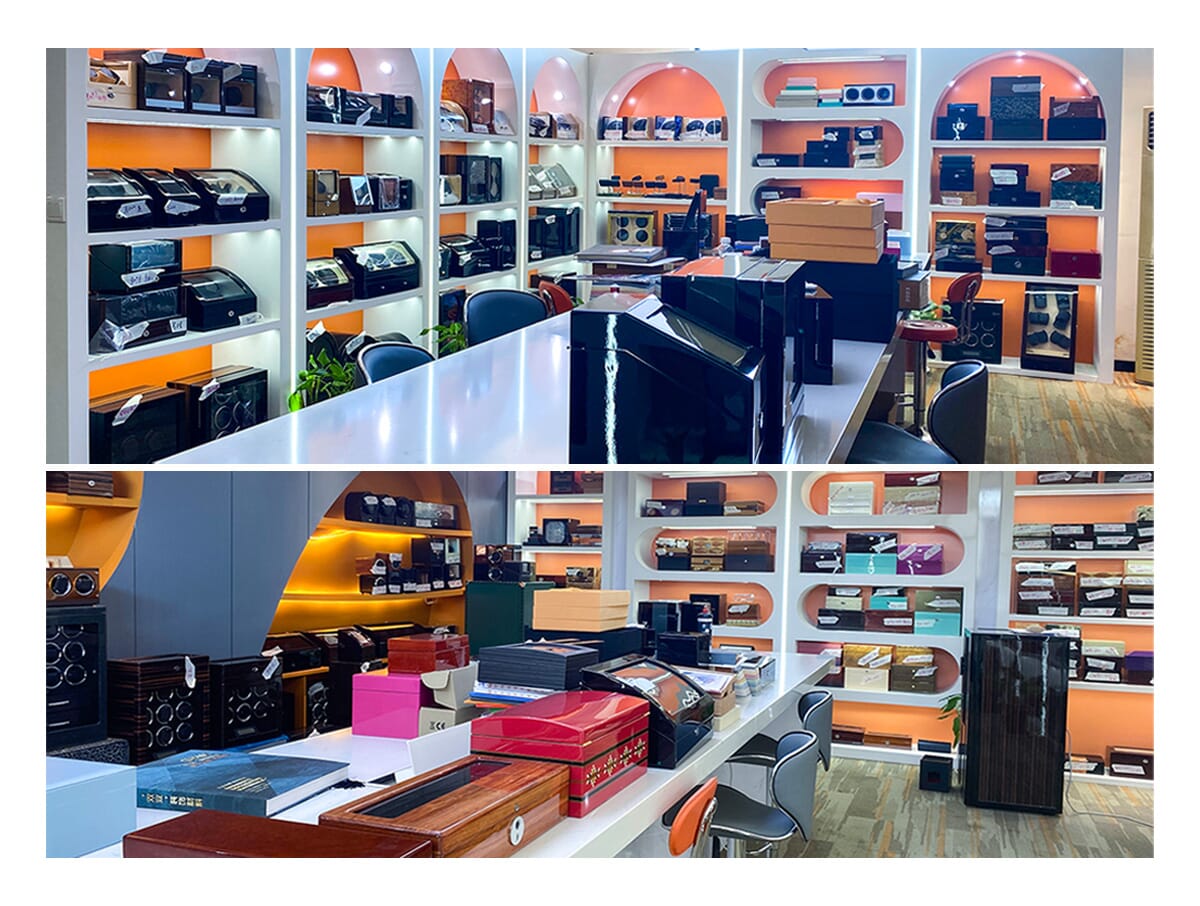
Refusal to show factory or production process. A legitimate manufacturer with nothing to hide will offer factory tours (in person or virtual), share production videos, and provide references from existing clients. If MOQ and sample discussions happen without any transparency into the production operation, proceed with caution.
No certifications on file. If a factory can’t produce current UL, CE, or RoHS certificates upon request, they either don’t have them or they’ve expired. Either way, you’re taking on compliance risk.
The Bottom Line
MOQ and sampling are not obstacles — they’re the foundation of a well-structured manufacturing partnership. The right MOQ protects both buyer and manufacturer from uneconomical production runs. A properly executed sample eliminates guesswork and gives you a production-grade reference that your sales team, retail partners, and end customers can evaluate.
At T.WING-PAK, we’ve built our entire operation around making this process efficient and transparent:
- MOQ from 100 units — low enough for market testing, scalable to millions
- 3D renderings in as fast as 8 hours — validate before you fabricate
- 12–13 coat piano lacquer process — 2–3 years of mirror-finish durability
- Japanese Mabuchi motors — under 10 dB, 300–2,200 TPD adjustable
- Full inspection on every unit — defect rate held at ≤2%
- UL / CE / RoHS / FSC certified — direct market access to US and EU
- One-stop service — design, sampling, mass production, and logistics under one roof
The fastest way to get started is to send us your brief. We’ll have 3D visuals in your inbox within hours, a sample quote within 24 hours, and a production-ready sample in your hands within 7–14 days.
Ready to start your watch winder project?
📧 kathy@twing-pak.com 📱 WhatsApp: +86-13431139311 🌐 www.twing-pak.com
TwingPak — 19 Years Experience of Luxe Watch Winder and Wood Packaging Box Solution