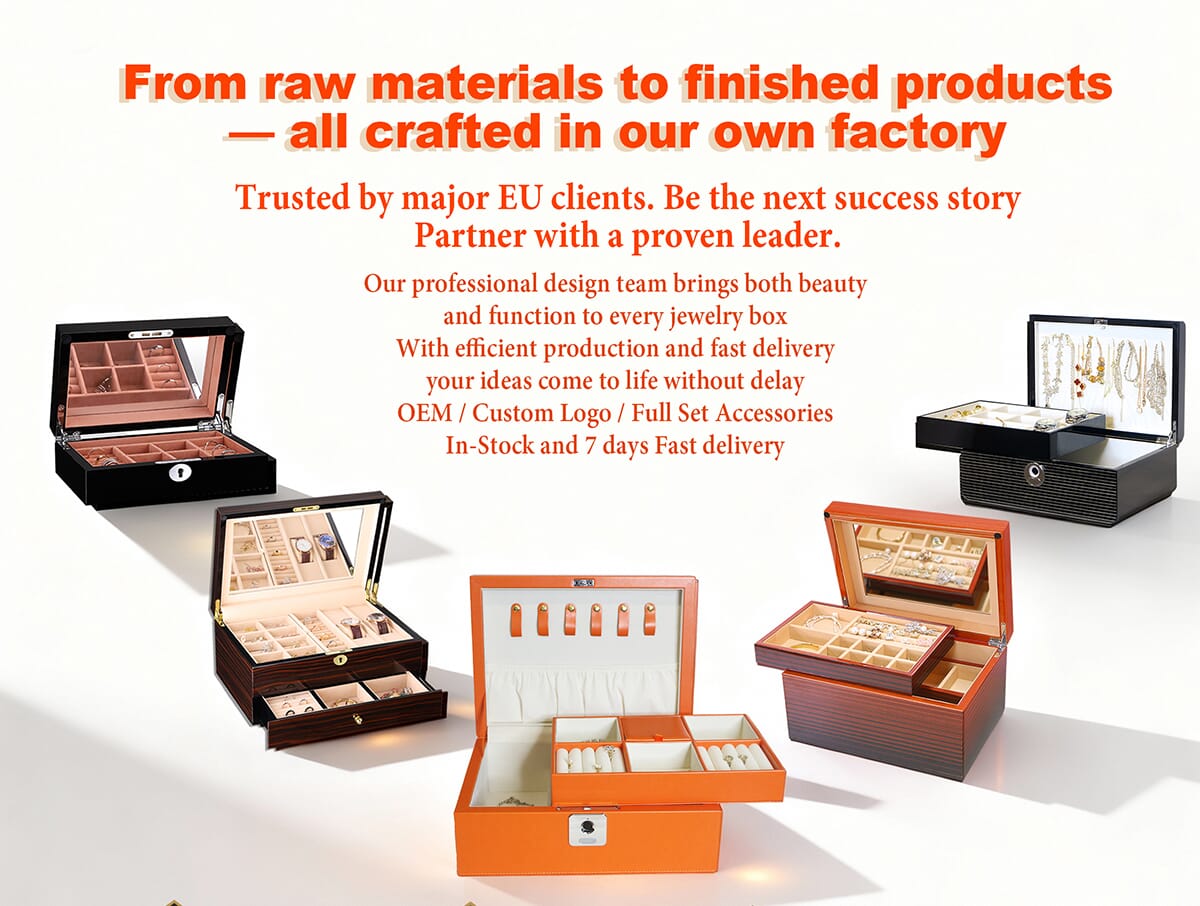
After 19 years in high-end jewelry packaging, I’ve watched countless brands fall into the same trap: assuming “premium” must mean a solid wood body coated in 12 layers of high-gloss piano lacquer. That’s simply not true. PU leather jewelry boxes are winning over buyers in Europe, the US, and the Middle East with lighter weight, more flexible craftsmanship, and a friendlier cost structure. This article uses frontline production experience and industry data to break down exactly how PU leather delivers the kind of premium feel that makes a procurement manager take notice—without relying on solid wood or piano lacquer—and how, as a B2B buyer, you can tell whether a factory can truly make a PU box feel high-end.
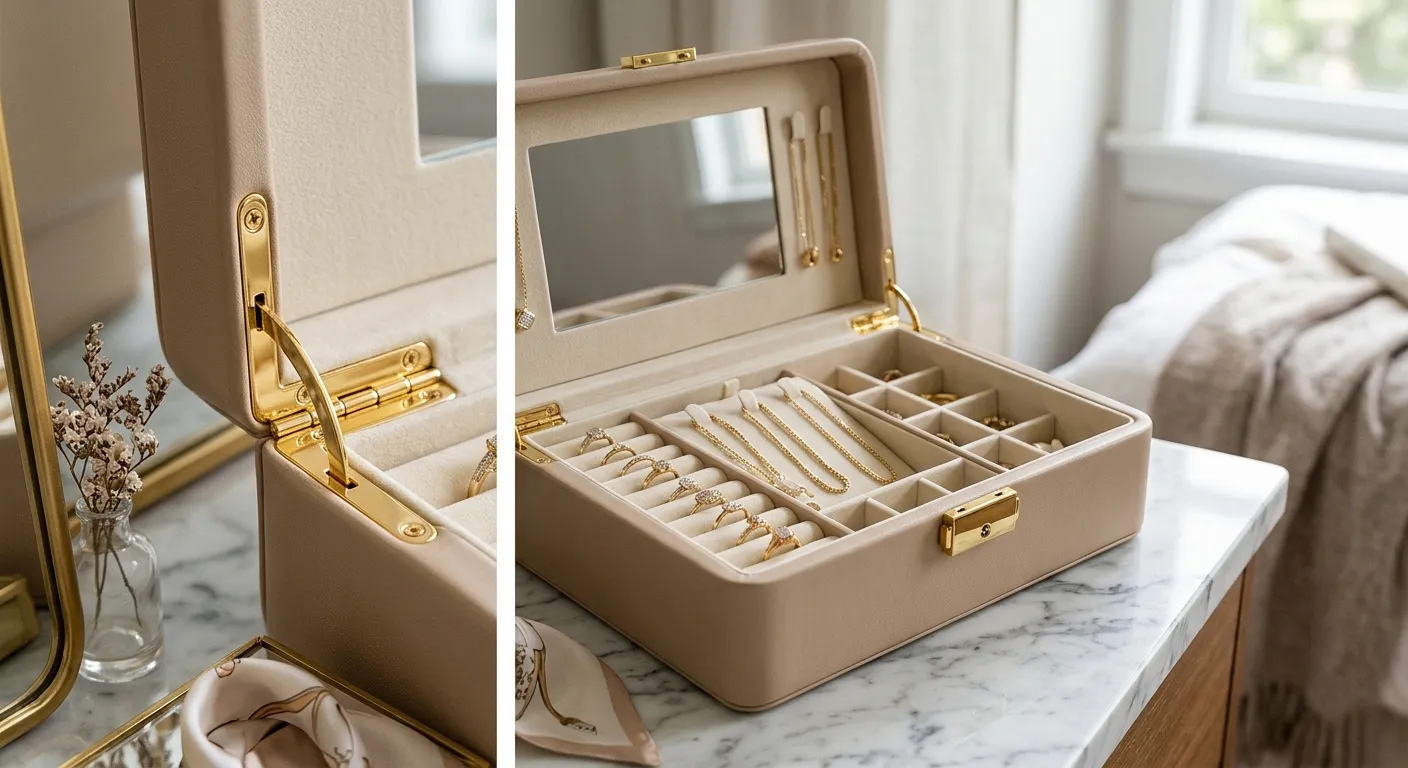
1. The Truth About Premium Feel: It Comes From Craftsmanship, Not Just the Material
Many people default to “solid wood + piano lacquer” as the only formula for luxury. But break it down, and that so-called premium feel is built from a few measurable sensory signals: visual consistency, tactile refinement, the weighted feel of opening and closing, and the precision of corner finishing. PU leather jewelry boxes can deliver every one of these—the key is craftsmanship.
One repeatedly proven fact in this industry: high-quality PU leather (polyurethane) became the mainstream choice for jewelry packaging because its color and texture consistency in mass production far exceeds genuine leather, with none of the color variation or natural flaws of real hides. That means when you order 10,000 boxes, every single one looks identical—and that uniformity is itself a core source of premium feel.
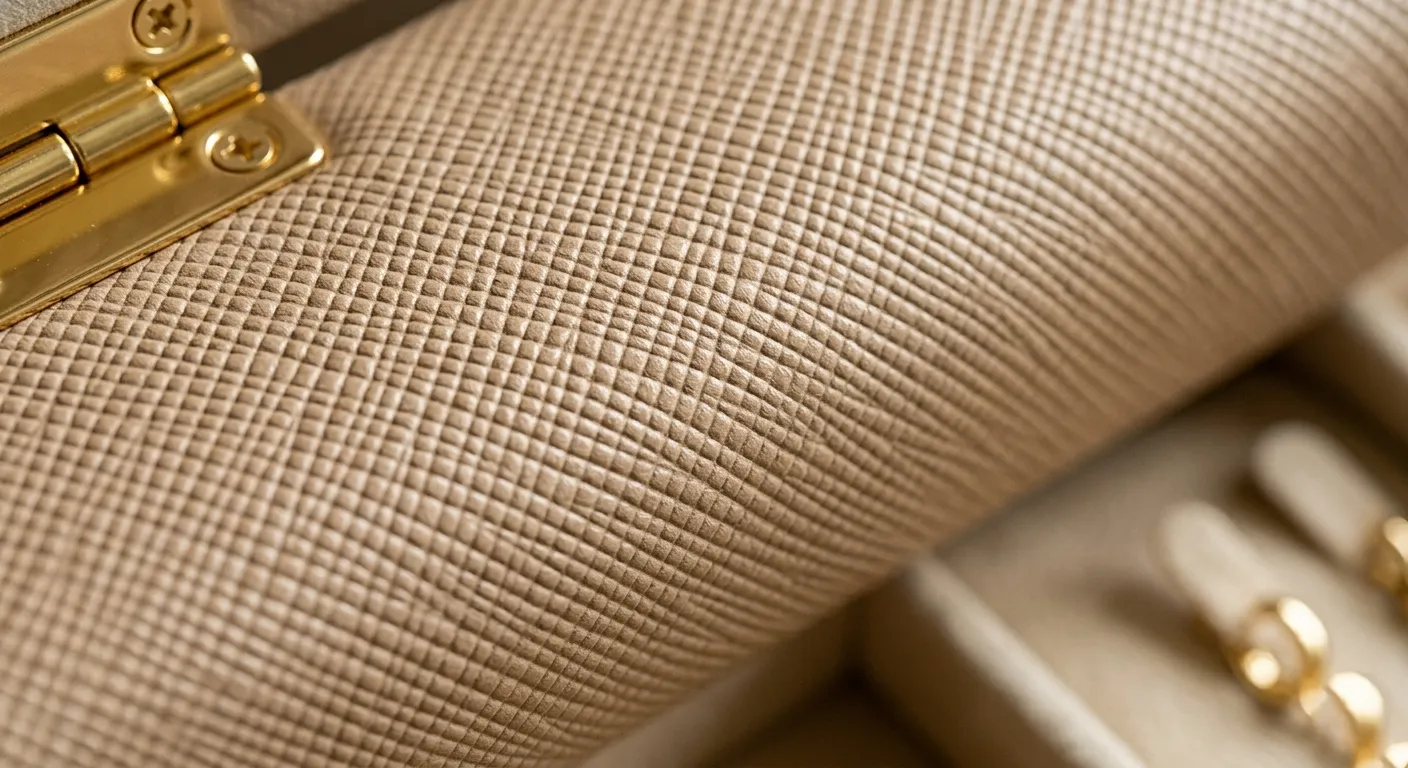
Going further, PU leather supports embossing, foil stamping, printing, UV coating, and more. Saffiano (cross-grain), litchi grain, and matte fine-grain textures can give synthetic leather a refinement more controlled and precise than real leather. In other words, what determines whether something feels “premium” isn’t “is it wood?”—it’s “does this factory’s wrapping precision and surface finishing measure up?”
2. PU Leather vs. Solid Wood with Piano Lacquer: One Table Says It All
As a purchasing decision-maker, you don’t need an emotional verdict on “which is more premium”—you need a rational comparison based on cost, logistics, and lead time. The table below combines common industry data with our frontline production experience:
| Dimension | PU Leather Box (MDF/rigid board core) | Solid Wood + Piano Lacquer |
|---|---|---|
| Source of premium feel | Leather grain, wrapping precision, embossing & foil | Wood grain, lacquer gloss, heavyweight feel |
| Unit weight | Light, lower shipping cost | Heavy, significantly higher sea-freight cost |
| Color consistency | Very high (no variation in mass-produced synthetic leather) | Affected by wood/lacquer batch differences |
| Surface processes | Flexible mix of embossing, foil, printing, UV | 12–13 lacquer coats, stays glossy 2–3 years |
| Impact resistance | Good, resists cracking | Solid wood may crack under impact |
| Best positioning | Modern affordable luxury, gifting, e-commerce, bulk export | Heirloom-grade, collectible, ultra-premium |
| MOQ flexibility | Low MOQ, small-batch friendly | Also supported, but longer process |
Data references: RichPack’s “Leather vs. Wood vs. Velvet” industry guide; Alibaba.com’s “Jewelry Box Material & Design Guide 2026.” Worth noting: these two craft approaches aren’t opposites—they correspond to different brand positioning. If your customers are modern affordable-luxury brands, gifting scenarios, or e-commerce players sensitive to shipping costs, PU leather is often the smarter choice.
One market data point worth adding: according to industry analysis, the leather jewelry box market was valued at around USD 1.45 billion in 2025 and is projected to reach USD 1.58 billion in 2026. Leather (including PU) sits in a steady growth lane—one reason more European and US buyers are adding PU boxes to their core sourcing lists. Alibaba
3. Why “No Solid Wood” Is Actually an Advantage: The MDF Core + PU Leather Logic
This is a technical point many new buyers overlook: a quality PU leather jewelry box has an equally solid structural body. We—and professional factories across the industry—typically use high-density MDF or rigid board for the box body, keeping walls firm and resistant to deformation under pressure. In other words, PU boxes aren’t “flimsy”—their frame can be just as sturdy as a wooden box; the outer layer simply swaps lacquer for leather.
This combination delivers three benefits that matter directly to export businesses. First, lighter weight cuts your sea and air freight costs, a difference that’s especially visible on large bulk exports to Europe and the US. Second, crack resistance—once corners are wrapped, PU leather outperforms solid wood on impact, lowering cross-border breakage rates. Third, faster turnaround—PU box prototyping and production cycles are usually more controllable than multi-coat lacquered wood.
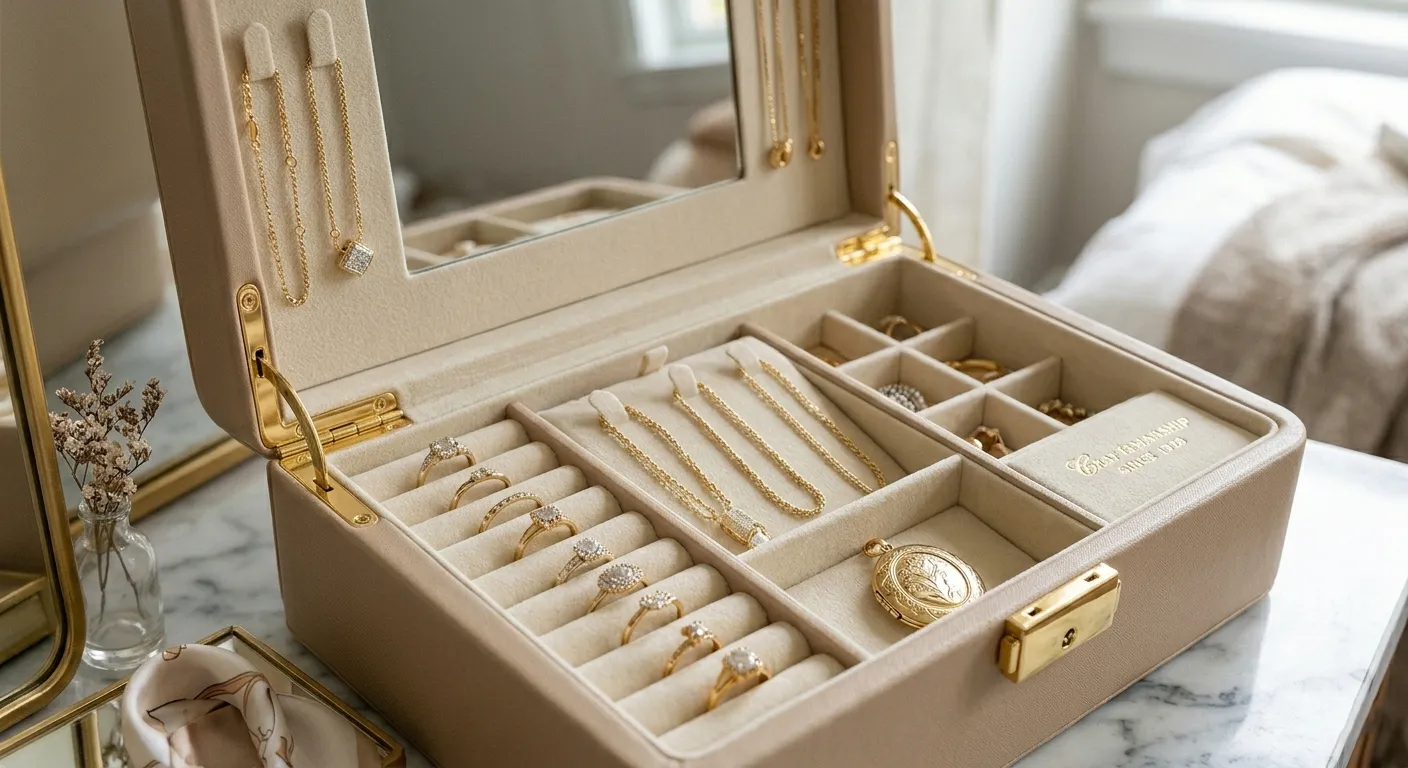
For buyers, judging whether a factory can make a PU box feel premium comes down to a few hard checkpoints: whether the leather lies flat and crease-free at sharp wrapped corners, whether hinges open and close smoothly with a damped feel, and whether the lining (velvet/suede/microfiber) and slots fit the contents with no gaps. These details are exactly what separate a “cheap PU box” from an “affordable-luxury PU box.”
4. Practical Advice for B2B Buyers: How to Vet a PU Box Factory
Bottom line first: when choosing a PU leather jewelry box supplier, verify three things—sample craftsmanship, certifications, and MOQ flexibility.
On sample craftsmanship, always request a pre-production sample and inspect the leather wrapping flatness, embossing clarity, and hinge quality by hand. On certifications, for export to Europe and the US, confirm the factory holds the relevant environmental and safety certifications (such as RoHS and FSC)—this helps you clear customs smoothly and meet brand-side compliance requirements. On MOQ, confirm whether the factory supports tiered pricing and small-batch trial orders—a good factory should flexibly handle anything from a few dozen units to millions.
Summary and Next Steps
A premium feel was never the exclusive domain of “solid wood” or “high-gloss piano lacquer.” With color consistency, flexible surface finishing, a solid MDF core, and stronger logistics economics, PU leather jewelry boxes can absolutely convey the high-end quality clients recognize—across modern affordable-luxury and export scenarios. For B2B buyers, the real question isn’t the material label; it’s the factory’s craftsmanship precision and quality control.
If you’re sourcing jewelry packaging that delivers a premium feel while controlling cost and logistics, T.WING-PAK brings 19 years of experience in high-end wooden and luxury packaging manufacturing, offering one-stop service from design and prototyping to mass production and logistics, with flexible MOQs starting at just 50 units. Contact Kathy Mong for a free 3D rendering and a PU leather jewelry box sample proposal—email kathy@twingpak.com.cn, website www.twing-pak.com.
Frequently Asked Questions (FAQ)
Q1: Can a PU leather jewelry box really match the premium feel of solid wood with piano lacquer?
Yes—but it depends on craftsmanship. PU leather’s color consistency, embossing and foil options, combined with a high-density MDF body and refined hardware, are enough to convey modern affordable-luxury quality. The two simply serve different positioning: PU suits gifting/e-commerce/bulk export, while wood and lacquer suit heirloom collectible grades.
Q2: What’s the difference between PU leather and genuine leather jewelry boxes, and how do I choose?
Genuine leather has natural grain but comes with color variation and higher cost; PU leather offers better mass-production consistency, easier cleaning, more scratch resistance, and controllable cost. For large B2B orders, high-quality PU leather is usually the optimal balance of value and quality control.
Q3: What material is inside a PU jewelry box—is it sturdy?
Professional factories typically use high-density MDF or rigid board for the body, keeping walls firm and resistant to deformation. Impact resistance can even exceed solid wood (less prone to cracking), so there’s no “flimsiness” concern.
Q4: What’s the minimum order quantity (MOQ) for PU leather jewelry boxes?
It depends on the factory. T.WING-PAK supports MOQs starting at 50 units, flexibly handling everything from small trial orders to million-unit production runs, with tiered pricing.
Q5: What certifications are needed to export PU jewelry boxes to Europe and the US?
Confirm the factory holds environmental and safety certifications such as RoHS and FSC to meet customs clearance and brand compliance requirements in European and US markets. Request the certification document list from the factory before ordering.