
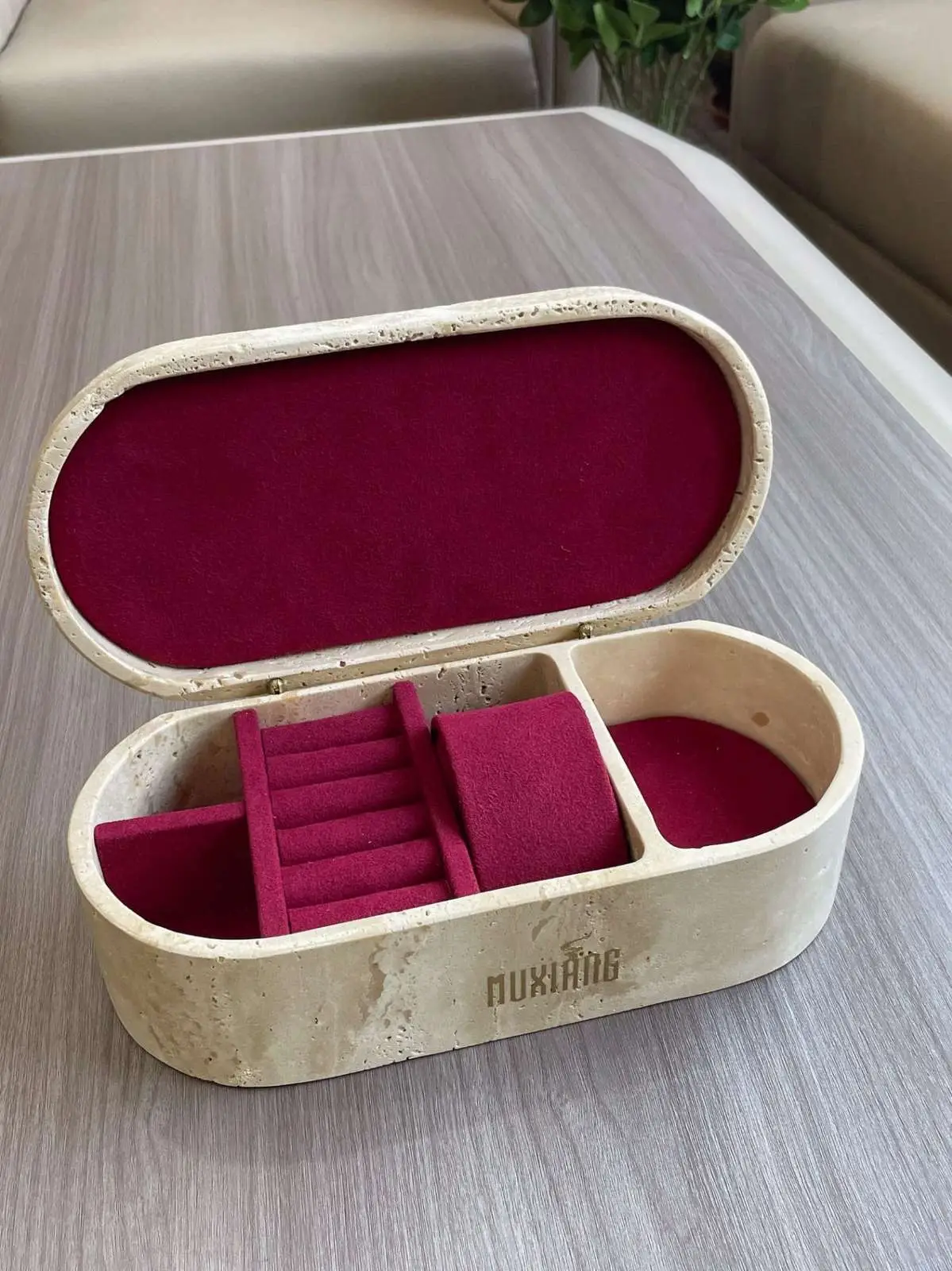
The marble jewelry box is a natural stone storage case designed for fine watches and light-luxury jewellery, carved from solid marble and travertine into a smooth oval silhouette and finished with a suede-lined, multi-compartment interior. It is produced by T.WING-PAK, a wooden and stone packaging manufacturer in Nansha, Guangzhou, with more than 19 years of export experience, and it is available for OEM and ODM programmes from 50 to 100 pieces. For jewellery brands, watch retailers and gift distributors, it solves a specific commercial problem: premium products increasingly arrive in packaging that looks like every other premium box, and a genuine stone case gives the unboxing moment a material difference that customers can see and feel immediately.
Key selling points at a glance
- Genuine marble and travertine shell – each box is cut from natural stone, so the veining is unique to the individual piece and the weight signals quality before the lid is even opened.
- Zoned interior for watches, rings and small jewellery – two watch cushions, a ring roll section and divided compartments keep every piece separated, so nothing scratches against anything else.
- Fine suede lining throughout – the lid interior, cushions and compartment bases are all lined in soft suede that protects watch crystals, polished metal and gemstones from wear.
- Metal-hinged lid with a clean closure – the top opens smoothly on metal hinges and closes into a fitted stone rim, keeping dust and ambient moisture away from the contents.
- OEM-ready with your own branding – stone finish, lining colour, cushion configuration and logo application (laser engraving or gold foil) can all be specified from MOQ 50-100 pieces.
Why natural stone changes what a jewellery box says about your brand
Most jewellery packaging on the market is built from the same short list of materials: lacquered wood, PU leather, cardboard with fancy paper. A customer who buys jewellery regularly owns three or four of these boxes already, and none of them gives a reason to keep the packaging in view on a dresser. That is a lost opportunity, because a box that stays visible keeps the brand visible every day.
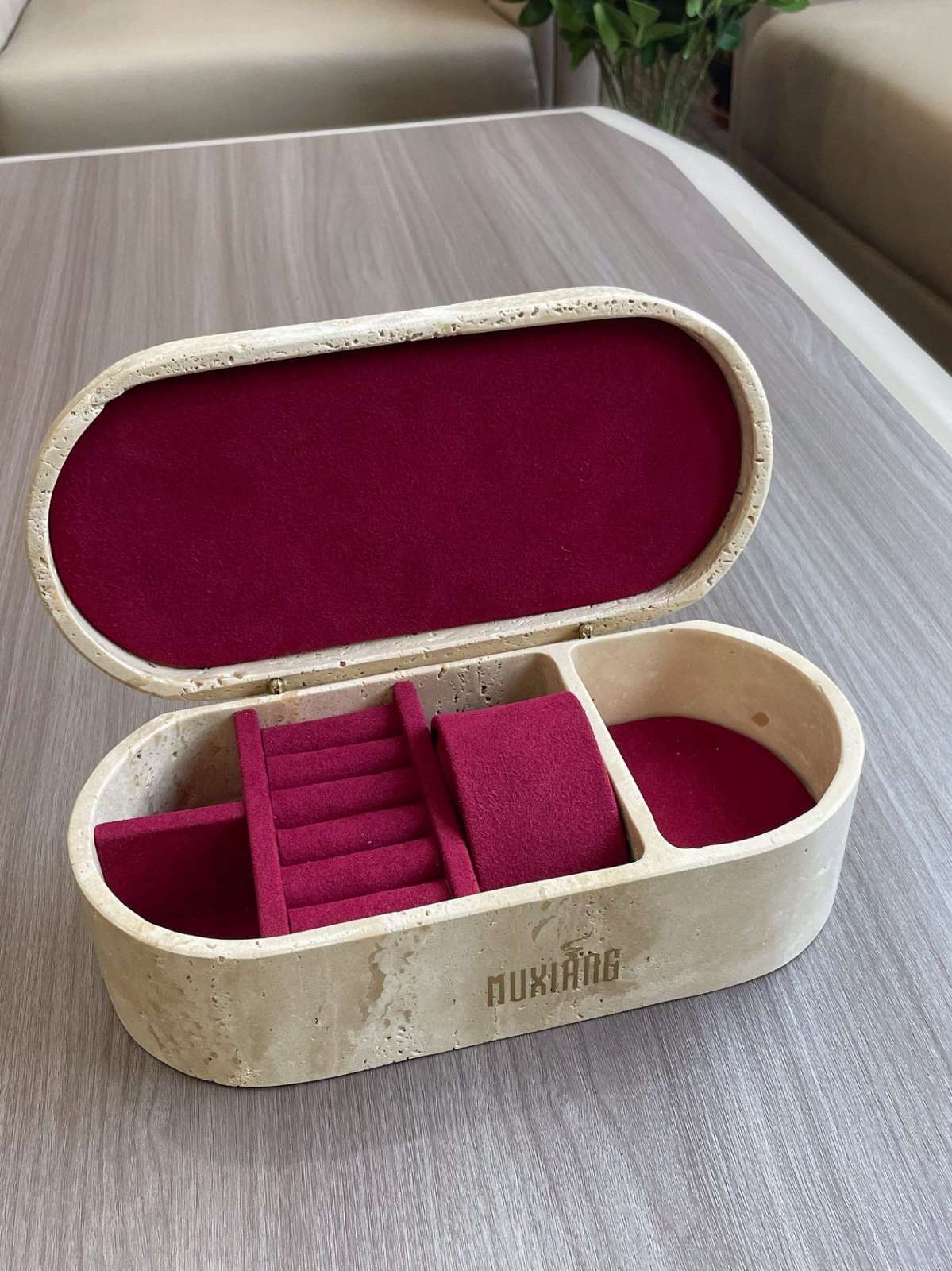
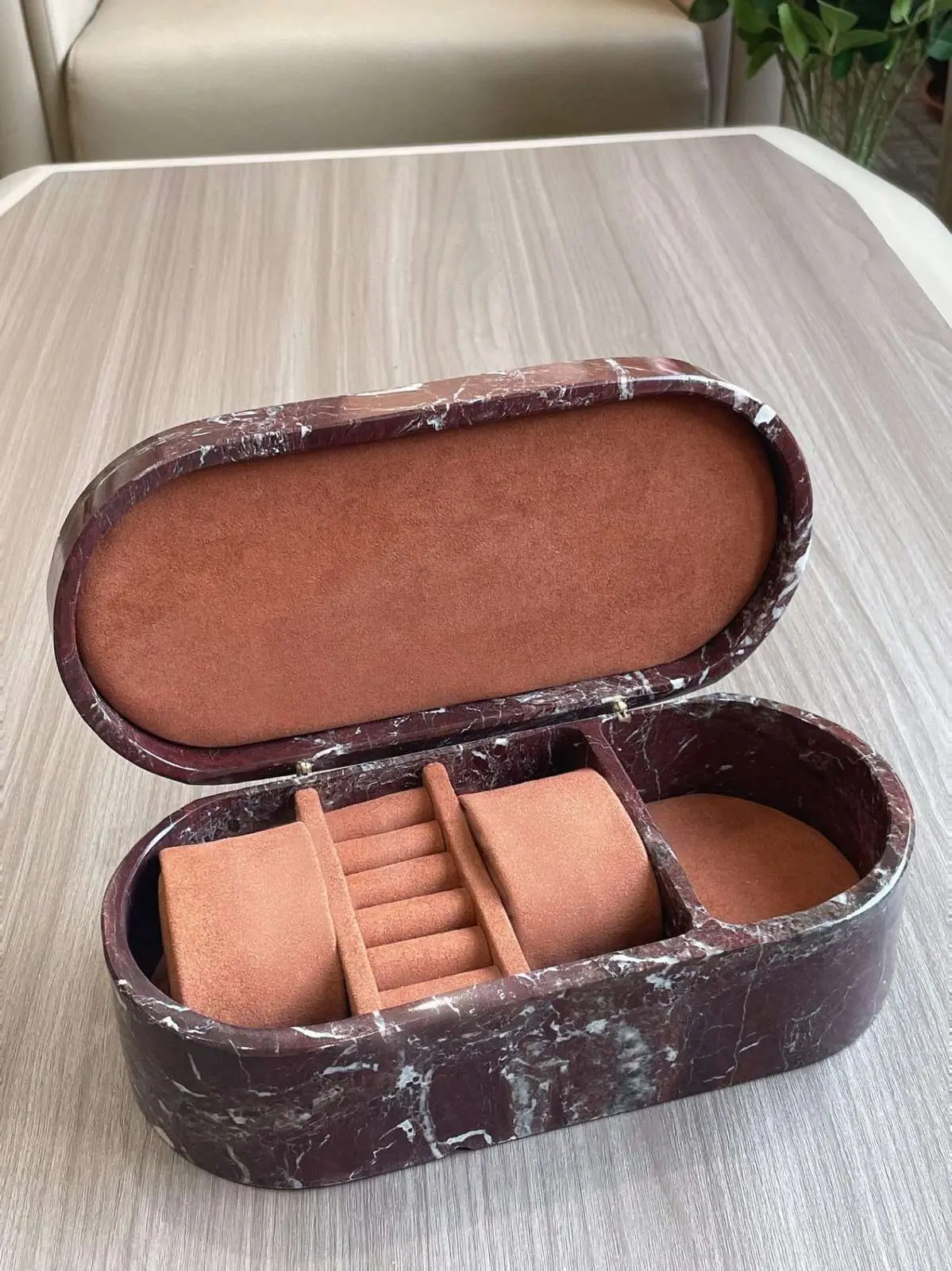
A marble jewelry box works differently. The shell is cut from solid natural stone – polished marble in red-purple and green tones, or cream travertine with its characteristic porous texture – and then shaped into a rounded oval with no hard edges. Because the pattern comes from the stone itself, no two boxes are identical: the white veining across a red-purple marble lid runs differently on every piece, which turns each box into a one-off rather than a mass-produced item. The material also carries real weight. When a customer lifts the lid, the solidity of stone communicates substance in a way that printed surfaces cannot imitate, and the box reads as a decorative object on a dressing table, a console or a retail display shelf – not as a container to be thrown away.
For B2B buyers this matters commercially. Jewellery and watches are among the categories where packaging directly shapes perceived value: the global jewellery market reached approximately USD 388.9 billion in revenue in 2025, with China, India and the United States as the three largest markets (Statista Market Insights). In a market of that size, presentation is one of the few levers a brand fully controls, and stone is still rare enough in jewellery storage to be a genuine differentiator on the shelf and in product photography.
A zoned interior that ends scratched and tangled jewellery
The most common complaint about flat jewellery trays is organisation: rings pile onto rings, a necklace catches a bracelet, and a watch face sits directly against a metal clasp. Over months of storage, that contact is exactly how fine pieces pick up their first scratches – not from wear, but from storage.
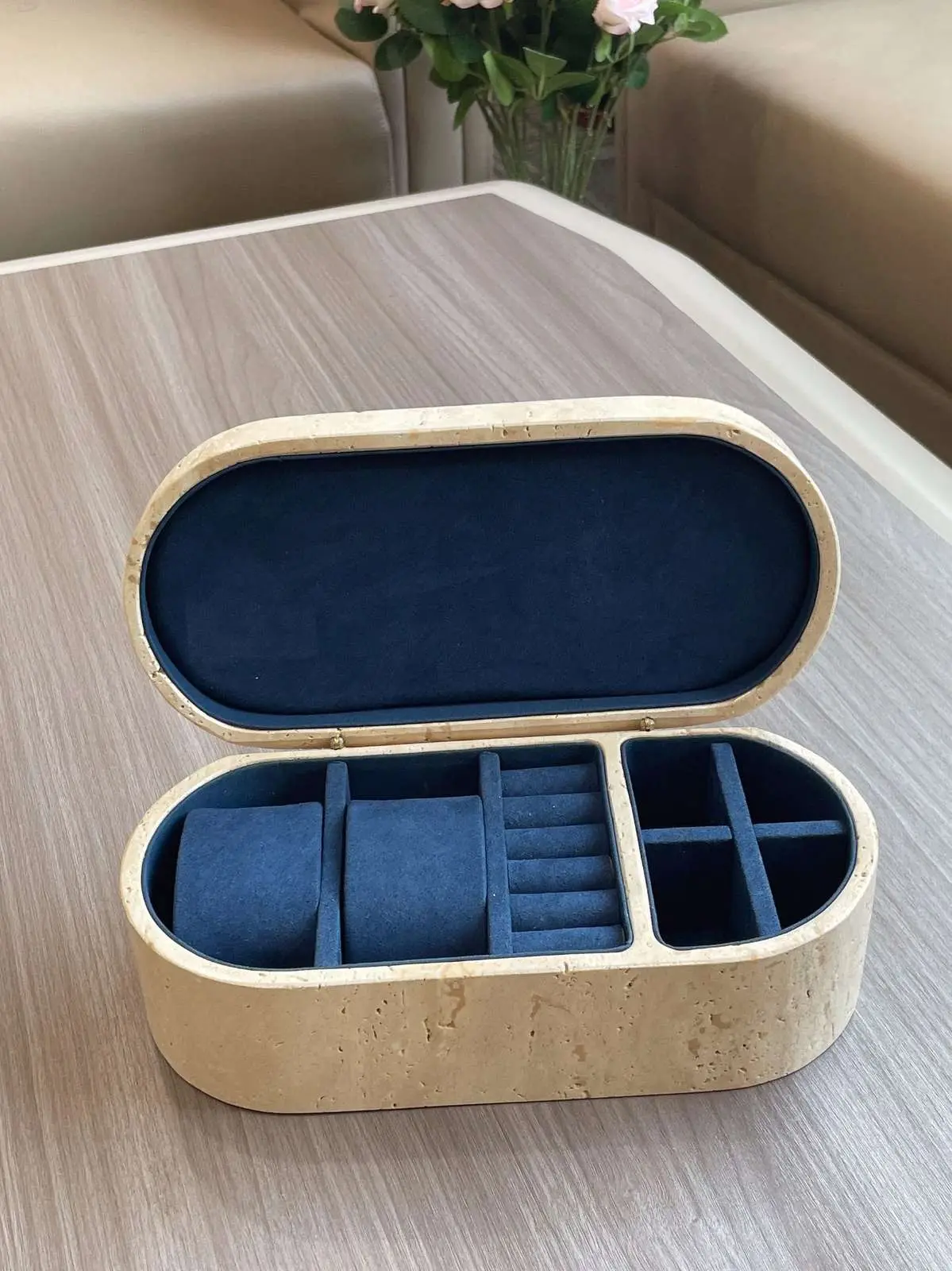
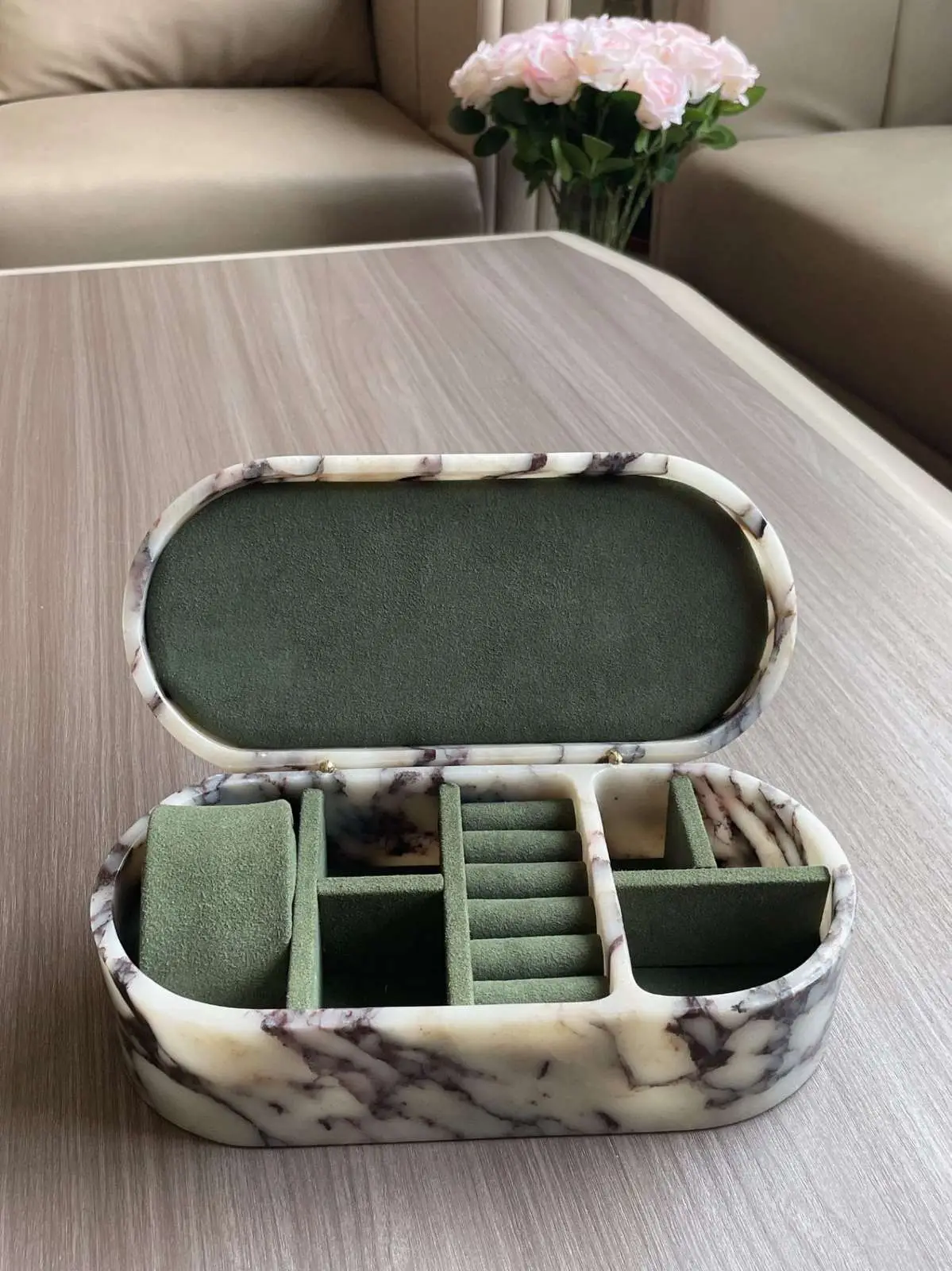
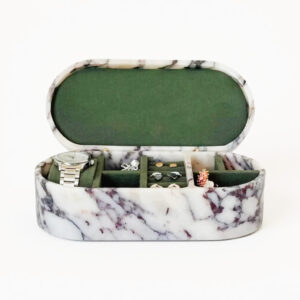
This box is laid out to prevent it. The interior is divided into three functional zones:
- Two watch cushion positions on one side, each shaped to hold a wristwatch upright with the strap wrapped naturally, so dials stay protected and presentable.
- A ring roll section in the centre, with individual suede rolls that separate rings into their own slots instead of letting them touch.
- Divided storage compartments on the other side, sized for earrings, pendants, brooches and small chains, with enough depth that necklaces can be laid out without folding.
The zoning does two jobs at once. For the end customer, every piece has an obvious home, which means the box actually gets used rather than abandoned. For the retailer, the same layout works as a counter presentation unit: watches on the cushions, rings on the rolls, and the compartments holding display stock or packaging inserts. One product therefore serves as storage, display and gift case, which simplifies the buying decision for shops that do not want three separate items.
Suede lining that protects crystals, metal and stone-equivalent surfaces
A hard exterior only protects jewellery if the interior is soft, and this is where cheap cases fail: their lining flattens, pills, or sheds fibres onto watch dials. The interior of this box is fully lined in fine suede – the lid inner face, the watch cushions, the ring rolls and the base of every compartment. The nap is dense and short, so it holds pieces gently without catching on clasps, and it does not transfer lint to a polished crystal or a mirror-finished case.
The lining colour is matched to the stone finish: deep red suede inside the travertine version, terracotta inside red-purple marble, sage green inside green marble, and navy inside the cream travertine variant. For OEM orders the lining colour can be changed to a brand’s own palette, which turns the interior into part of the brand identity rather than an afterthought. Because the suede is bonded to the compartment walls as well as the bases, pieces stay protected even when the box is moved or carried.
A hinged lid that keeps dust and moisture out at home or in transit
Jewellery that sits open on a dresser collects dust in weeks, and in humid climates bare metal tarnishes faster than most owners expect. The lid on this box closes onto the stone rim with a close fit and opens on metal hinges that hold the lid at a stable angle while pieces are being selected – no propping it against a wall, no lid flopping back. The closure keeps airborne dust and ambient moisture away from the contents whether the box sits on a bedroom dresser, inside a drawer, or on a retail shelf.
Because the stone shell is rigid, the box also tolerates short-distance travel well: wrapped in the supplied packaging and placed in luggage, it protects its contents better than a soft pouch or a folding travel tray ever could. This makes the same product usable in two scenarios brands frequently have to choose between – the permanent dresser box and the weekend travel case.
Four natural finishes, one product line
The marble jewelry box is produced in four stone finishes, each with a matched suede interior:
| Finish | Stone character | Lining colour | Best suited to |
|---|---|---|---|
| Cream travertine | Warm beige with natural open pores and soft banding | Deep red or navy | Classic jewellery brands, gift programmes |
| Red-purple marble | Deep burgundy stone with white veining | Terracotta | High-end watches, statement jewellery |
| Green marble | Cream base with dramatic grey-green veining | Sage green | Contemporary and designer labels |
| Custom stone | Sample-based selection for volume orders | Brand colour (OEM) | Brand-specific programmes |
No dye or print is involved in the exterior: the pattern is the stone. That has a practical consequence for buyers – within one order, veining will vary from piece to piece, and this natural variation is a selling point to communicate rather than a defect to apologise for.
Specifications
| Specification | Detail |
|---|---|
| Product type | Marble / travertine jewellery and watch storage box |
| Shell material | Solid natural marble or travertine, polished and edge-rounded |
| Interior | Multi-zone: 2 watch cushions, ring roll section, divided compartments |
| Lining | Fine suede (lid, cushions, rolls and compartment bases) |
| Lid | Metal hinges, close-fitting stone rim closure |
| Available finishes | Cream travertine, red-purple marble, green marble; custom stone on request |
| Logo options | Laser engraving or gold foil application |
| OEM minimum order quantity | 50 to 100 pieces, depending on finish and level of customisation |
| Sample lead time | 7 days |
| Bulk production lead time | 20 to 30 days from sample approval |
| Packaging | Individual protective packing; gift or mailer box available on OEM orders |
Who this box is for
For jewellery and watch brands, the box works as primary or secondary packaging for light-luxury product lines – pieces at a price point where a wooden lacquer box feels generic but a full leather case overshoots the budget. The stone construction sits precisely in that gap.
For retailers and boutiques, it doubles as counter presentation: stock stays wound, arranged and visible, and the unit itself sells the storage category to customers who came in for a watch.
For gift and corporate programmes, the weight and permanence of stone make the box a keepsake in its own right, which extends brand exposure long after the jewellery inside has been worn.
Frequently asked questions
Is a marble jewelry box too heavy for everyday use?
The stone shell gives the box deliberate, stable weight – heavy enough to feel substantial and stay planted when the lid is opened, but sized for a dresser or counter rather than a safe. For daily handling the weight is an advantage: the box does not slide or tip, and the solidity is part of what makes it read as a luxury object rather than a container.
Will the stone pattern on my order look exactly like the photos?
No, and that is intentional. Marble and travertine are natural materials, so veining, pore distribution and tone vary between pieces and between production batches. We photograph representative pieces, and each box in an order is unique. Brands that need tighter visual consistency can approve a stone slab or a reference sample before bulk production.
Can the interior be reconfigured for our product range?
Yes. The cushion count, ring roll layout and compartment divisions can be adjusted at OEM quantities – for example, three watch positions instead of two, deeper compartments for pendant sets, or a fully open tray. Changes are confirmed on a 7-day sample before mass production begins.
What branding methods work on a stone surface?
Laser engraving produces a clean, permanent mark directly in the stone, and gold foil application gives a metallic logo effect for a more decorative finish. Both are shown in product samples, and the branding position, size and colour are confirmed on the pre-production sample.
What are the commercial terms for a custom order?
Minimum order quantity is 50 to 100 pieces depending on the finish and the level of customisation. A sample is produced in 7 days, and bulk production takes 20 to 30 days from sample approval. Stone finish, lining colour, interior layout and branding are all specified before the sample stage.
Bottom line
A marble jewelry box earns its place in a product line for one reason: it is made of a material customers do not already own three of. Natural stone with unique veining, a suede-lined zoned interior that genuinely protects watches and jewellery, and a closed lid that keeps dust out – built to stay on the dresser and keep the brand in view. If you are planning a light-luxury jewellery or watch programme and want packaging that photographs differently and lasts longer than lacquered wood, request a sample from T.WING-PAK today: MOQ from 50 pieces, samples in 7 days, and delivery in 20 to 30 days from sample approval. Custom stone, lining colours and logo branding are all available – send your specification and we will return a quote and a physical sample for evaluation.
Sources: Statista Market Insights, global jewellery market revenue 2025 (approx. USD 388.9 billion; China USD 119.9bn, India USD 93bn, USA USD 78.9bn).



Reviews
There are no reviews yet.