In the jewelry industry, private label businesses compete not only through product design and pricing, but also through presentation, perceived quality, and brand coherence. Packaging plays a decisive role in this equation. For emerging direct-to-consumer labels, boutique retailers, and small-scale wholesalers, the question is no longer whether custom packaging matters, but whether a jewelry box supplier can truly support the operational and branding needs of a private label business. The answer is yes, provided the supplier offers the right combination of customization capability, production flexibility, quality consistency, and development support.
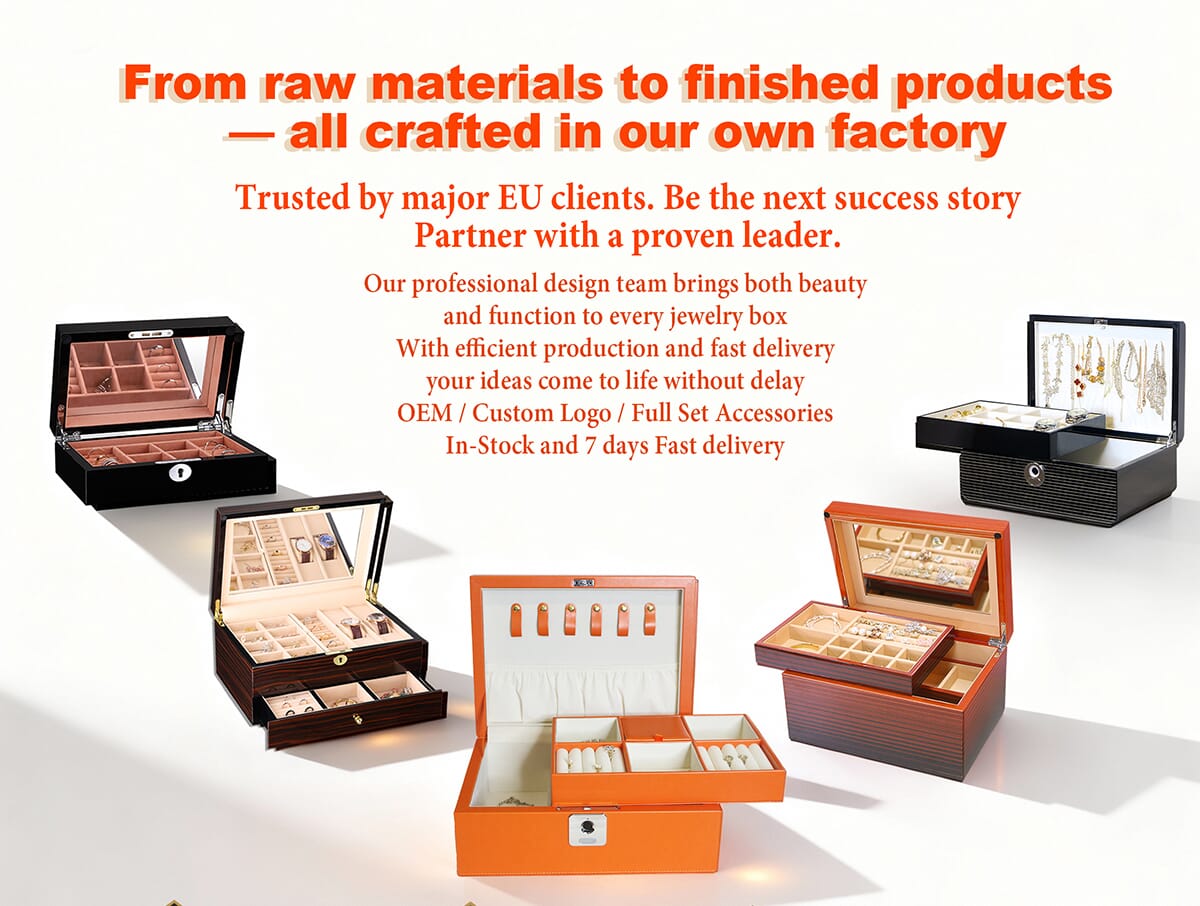
A capable supplier does far more than manufacture containers. It helps private label brands translate product positioning into physical presentation through tailored Jewelry Boxes, premium material selections such as Jewelry Box-Leather, and complementary merchandising tools such as a Jewelry Stand. For smaller or fast-evolving brands, cooperation with a Small batch processing custom jewelry box factory can be especially valuable because it allows packaging to evolve alongside the brand without excessive inventory risk.
This article examines how a jewelry box supplier can support private label businesses, what capabilities matter most, how niche brands have used custom packaging successfully, and what implementation steps professionals should follow when selecting a packaging partner. It also includes a comparison table, real-world style application scenarios, and niche-brand cooperation examples to clarify how packaging can become an active driver of private label growth rather than a passive cost item.
Why Packaging Is Critical in the Private Label Jewelry Business Model
Private label jewelry businesses rely heavily on differentiation. Unlike vertically integrated heritage brands with long-established reputations, private label operators often build trust through visual consistency, product curation, and the customer experience surrounding the product. Packaging therefore serves multiple business functions simultaneously: it protects the jewelry, communicates brand positioning, supports gifting behavior, enhances retail display, and influences customer perception during unboxing.
In practical terms, well-designed Jewelry Boxes can improve perceived value and support price realization. A ring presented in a generic stock box may appear ordinary even if its craftsmanship is strong, whereas a carefully engineered and branded package can reinforce quality cues before the customer even touches the product. For private label businesses, where repeat purchase and referral often depend on the total experience, this difference is commercially significant.
Packaging also contributes to channel performance. In e-commerce, it shapes unboxing impressions and social-media shareability. In wholesale or boutique retail, it influences shelf presence and buyer confidence. In events and trade shows, a matching Jewelry Stand can create a more coherent merchandising environment. This is why many private label operators now evaluate suppliers not only by cost per unit, but by their ability to support broader brand execution.
What Support a Jewelry Box Supplier Can Provide to Private Label Businesses
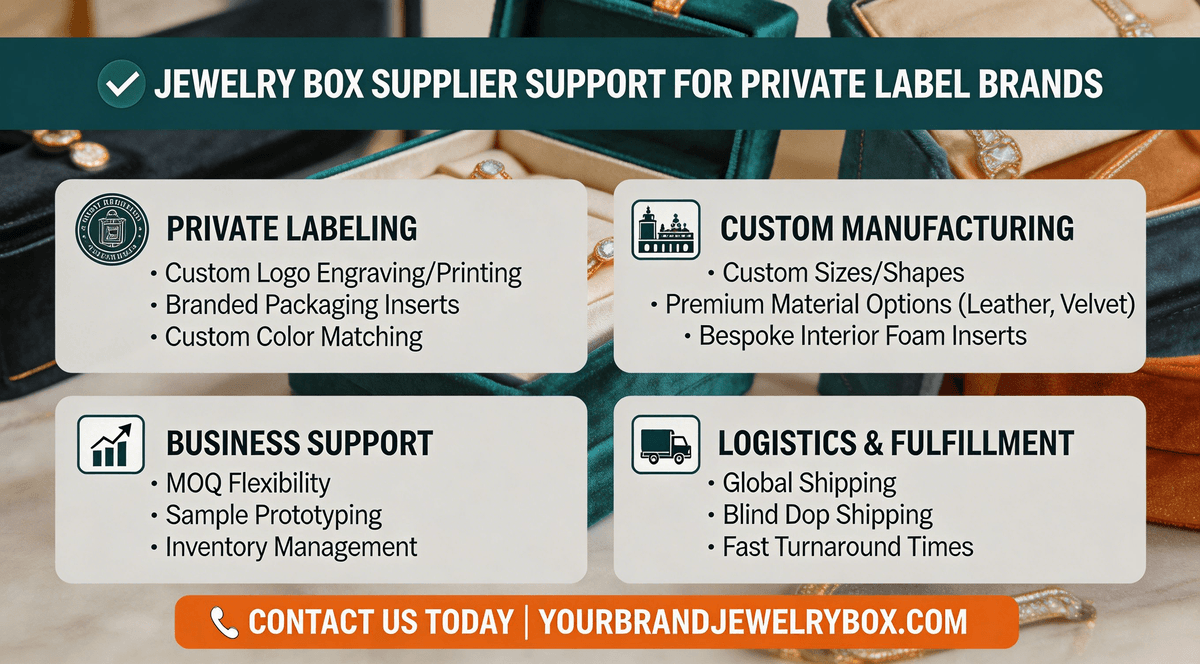
A high-quality jewelry box supplier can support private label businesses across four key dimensions: product customization, operational flexibility, brand consistency, and growth scalability. The supplier’s value lies not only in manufacturing output, but in its ability to participate in packaging development as a technical and strategic collaborator.
Customization for Brand Identity
Private label brands need packaging that reflects their market position, customer profile, and product category. A supplier should therefore offer more than generic templates. It should be capable of customizing dimensions, inserts, logo application, materials, color schemes, and closure structures. Premium product lines may benefit from Jewelry Box-Leather, while minimalist brands may prefer paper-based finishes with subtle embossing or foil treatment.
Customization is especially important when the private label business spans multiple product types. Rings, earrings, pendants, bracelets, and gift sets all require different insert engineering and protection logic. A supplier that understands jewelry-specific structural requirements can help ensure that aesthetics and functionality remain aligned.
Low-Volume Flexibility for Emerging Brands
Many private label businesses start with limited volumes, test new collections regularly, or operate through seasonal campaigns. Under these conditions, large-scale packaging commitments can create unnecessary inventory and cash-flow pressure. Cooperation with a Small batch processing custom jewelry box factory enables brands to order at lower minimum quantities while still accessing OEM-style customization. This is particularly useful for new product launches, influencer collaborations, limited-edition collections, and pilot market entry.
Low-volume flexibility also supports packaging iteration. If the brand wants to adjust a logo finish, interior insert, or external sleeve after the first launch, a flexible supplier can facilitate refinement without forcing the business to absorb outdated stock.
Consistent Brand Execution Across Channels
Private label businesses often sell across digital storefronts, marketplaces, boutiques, and pop-up environments. Packaging therefore needs to function consistently across multiple touchpoints. A strong supplier can help standardize the visual language of Jewelry Boxes, gift-ready formats, and display tools such as a Jewelry Stand. This consistency improves brand recognition and reduces presentation variance between channels.
Technical Development and Material Guidance
Not all private label teams have in-house packaging expertise. In many cases, the supplier’s advisory role becomes highly valuable. It can recommend more durable materials, suggest scalable structures, optimize insert fit, and identify production methods that align with budget and positioning. For example, when a brand considers premium tactile finishes, the supplier may recommend Jewelry Box-Leather for specific collections rather than the entire assortment, preserving both impact and cost efficiency.
Key Supplier Capabilities Private Label Brands Should Evaluate
Not every jewelry box supplier is equally suitable for private label business models. Buyers should assess technical depth, communication quality, and business fit before entering long-term cooperation.
| Capability Area | Why It Matters for Private Label | What to Evaluate | Typical Risk if Weak |
|---|---|---|---|
| Customization | Supports differentiated brand identity | Material options, logo methods, insert design, size flexibility | Generic presentation and weak market distinction |
| MOQ Flexibility | Reduces inventory and launch risk | Small-run options, pilot orders, revision support | Excess stock and reduced agility |
| Jewelry-Specific Engineering | Protects products and improves usability | Insert precision, anti-tangle design, closure reliability | Damage, poor fit, and customer dissatisfaction |
| Brand Consistency | Strengthens recognition across channels | Color control, repeat-order consistency, finishing accuracy | Inconsistent customer experience |
| Communication and Background | Improves project execution and trust | Sampling clarity, response speed, documentation, about-us information | Project delays and avoidable revisions |
For many buyers, reviewing the supplier’s about-us information is an early step in determining whether the company truly specializes in jewelry packaging or merely offers it as a minor category within broader gift-box manufacturing. This distinction matters because jewelry packaging requires more specialized insert engineering, dimensional precision, and luxury-finish control than many general box applications.
How a Supplier Supports the Private Label Workflow From Concept to Launch
The most effective suppliers support the entire packaging workflow rather than only the production stage. In practice, the process often begins with a development brief covering product size, channel strategy, desired branding, estimated order volume, timeline, and price target. The supplier then converts that brief into structural recommendations, material suggestions, and prototype options.
During sampling, the supplier can test logo visibility, opening mechanics, insert fit, and finish quality. For private label businesses, this stage is critical because packaging must often balance several competing priorities: premium appearance, practical protection, efficient shipping, and commercially viable unit cost. A supplier that can explain these trade-offs clearly adds substantial value.
After sample approval, the supplier’s role shifts toward process discipline. It should be able to maintain consistency across bulk production, communicate quality checkpoints, and support replenishment planning. If the business operates a tiered assortment, the supplier may also help design packaging families that include standard Jewelry Boxes, premium Jewelry Box-Leather formats, and coordinated Jewelry Stand components for retail display.
Actual Application Case: Private Label Launch for an Independent Online Jewelry Brand
A practical application scenario can be seen in the launch of an independent online jewelry business specializing in minimalist sterling silver rings and necklaces. The brand planned to launch with only twelve SKUs and expected modest first-quarter volumes, making large packaging commitments impractical. At the same time, the founders understood that presentation would influence perceived quality, review content, and social-media impressions.
Instead of purchasing stock packaging, the brand worked with a supplier operating as a Small batch processing custom jewelry box factory. Together they developed compact Jewelry Boxes with a low-profile exterior, foil logo, and jewelry-specific inserts sized for both rings and fine chains. For a limited “gift edition” launch, the supplier also produced a small quantity of Jewelry Box-Leather packaging to differentiate premium bundles. A simple foldable Jewelry Stand was added for photography and pop-up use.
The result was a packaging system that aligned with the brand’s minimalist identity while preserving cost discipline. Customer feedback emphasized presentation quality, and the company retained the flexibility to revise details after the first sales cycle. This demonstrates how a jewelry box supplier can directly support a private label business model through packaging scalability and brand alignment.
Niche Brand Cooperation Success Case: Artisan Gemstone Label Expands Into Boutique Retail
A fictional but commercially realistic example involves Solenne Stone, a niche artisan label focused on small-batch gemstone jewelry. The brand had built a following through social media and local craft events, but wholesale buyers perceived its pouch-based packaging as inconsistent with the price point. To enter boutique retail successfully, the brand needed a more structured presentation system without overcommitting inventory.
After reviewing a supplier’s about-us materials and customization approach, Solenne Stone chose to work through a Small batch processing custom jewelry box factory model. The supplier developed a family of Jewelry Boxes in muted mineral-inspired tones, with secure inserts for rings and pendants. For collector-grade pieces, it introduced a more tactile Jewelry Box-Leather version. A portable Jewelry Stand completed the display toolkit for showroom appointments and retail demonstrations.
Over two seasons, the fictional brand improved retailer acceptance and increased average order value because the upgraded packaging better supported premium product narratives. The cooperation succeeded not because the packaging was extravagant, but because it was strategically aligned with the needs of a private label jewelry business in transition.
Niche Brand Cooperation Success Case: Boutique Bridal Label Uses Packaging to Signal Exclusivity
A second fictional case involves Liora Vale, a small bridal jewelry label producing limited collections for appointment-based clients. Because the business emphasized exclusivity and emotional purchasing moments, the packaging needed to feel ceremonial without requiring large-scale production runs. The brand also needed a consistent presentation system for studio consultations and bridal showcases.
Its supplier supported the business with low-MOQ development, functioning effectively as a Small batch processing custom jewelry box factory. Standard bridal accessories were packed in elegant rigid Jewelry Boxes, while bespoke sets were presented in an ivory Jewelry Box-Leather series with subtle metallic branding. A matching Jewelry Stand helped the brand maintain a premium visual system during in-person consultations.
The fictional outcome was improved client perception, stronger premium positioning, and better inventory control because packaging quantities could be aligned with actual bookings. This case shows that a jewelry box supplier can support private label businesses not only through manufacturing, but also through controlled brand theater.
Implementation Recommendations for Private Label Businesses
Private label businesses that want meaningful support from a jewelry box supplier should take a structured approach to packaging development. Several implementation principles are especially important:
- Define packaging by business function. Clarify whether the priority is unboxing impact, retail readiness, shipping protection, gifting presentation, or premium price signaling.
- Segment the packaging architecture. Use standard Jewelry Boxes for core products and reserve Jewelry Box-Leather for higher-margin or ceremonial collections.
- Start with a pilot run if demand is uncertain. A Small batch processing custom jewelry box factory model is often the most efficient entry point.
- Evaluate the supplier’s specialization carefully. Review sample work, production logic, and about-us information to confirm relevance to jewelry applications.
- Consider the wider presentation system. If wholesale, retail, or event selling is part of the strategy, develop a coordinated Jewelry Stand alongside the packaging.
- Test packaging in real use conditions. Assess unboxing, protection, stackability, photography, and customer perception before scaling volume.
- Plan for repeatability. The supplier must be able to preserve color, finish, and structure across replenishment orders.
Common Risks and Limitations
Although a jewelry box supplier can support private label businesses effectively, not every supplier is the right fit. One common mistake is focusing only on low price. If the supplier lacks jewelry-specific structural knowledge, the result may be poor insert fit, inadequate protection, or weak presentation. Another mistake is excessive customization too early in the brand lifecycle. Complex packaging may appear impressive at sample stage but create operational burden if demand is still uncertain.
Private label businesses should also avoid treating packaging as a disconnected procurement task. The most successful outcomes occur when the supplier is included in a broader conversation about positioning, channel usage, and customer experience. In that sense, packaging strategy should be integrated into brand strategy rather than managed separately.
Conclusion
A jewelry box supplier can absolutely support private label businesses, but the degree of support depends on the supplier’s ability to function as more than a manufacturer. The right partner contributes customization, technical guidance, production flexibility, and brand-consistent execution. For emerging and niche labels, this support can be decisive, especially when packaging must communicate quality and identity before the brand itself is widely known.
Whether the need involves standard Jewelry Boxes, premium Jewelry Box-Leather, coordinated Jewelry Stand solutions, or phased development through a Small batch processing custom jewelry box factory, the essential requirement is strategic fit. Private label businesses should choose suppliers that understand both packaging mechanics and brand-building logic. When that alignment exists, packaging becomes a commercially productive asset that supports growth, credibility, and long-term customer loyalty.
FAQ
Can a jewelry box supplier really help a new private label business with low volumes?
Yes. A supplier that operates with low minimum order quantities or through a Small batch processing custom jewelry box factory model can help new private label brands launch professionally without taking on excessive packaging inventory.
What packaging type is best for premium private label collections?
For premium collections, Jewelry Box-Leather is often highly effective because it combines tactile sophistication, structural stability, and strong perceived value for ceremonial or gift-oriented products.
Should private label brands develop display items together with packaging?
In many cases, yes. A coordinated Jewelry Stand can strengthen brand consistency across retail, events, and product photography while complementing the visual identity of the packaging.
How can buyers evaluate whether a supplier is suitable?
Buyers should assess jewelry-specific customization ability, MOQ flexibility, communication quality, sample consistency, and background information such as the supplier’s about-us page before entering long-term cooperation.