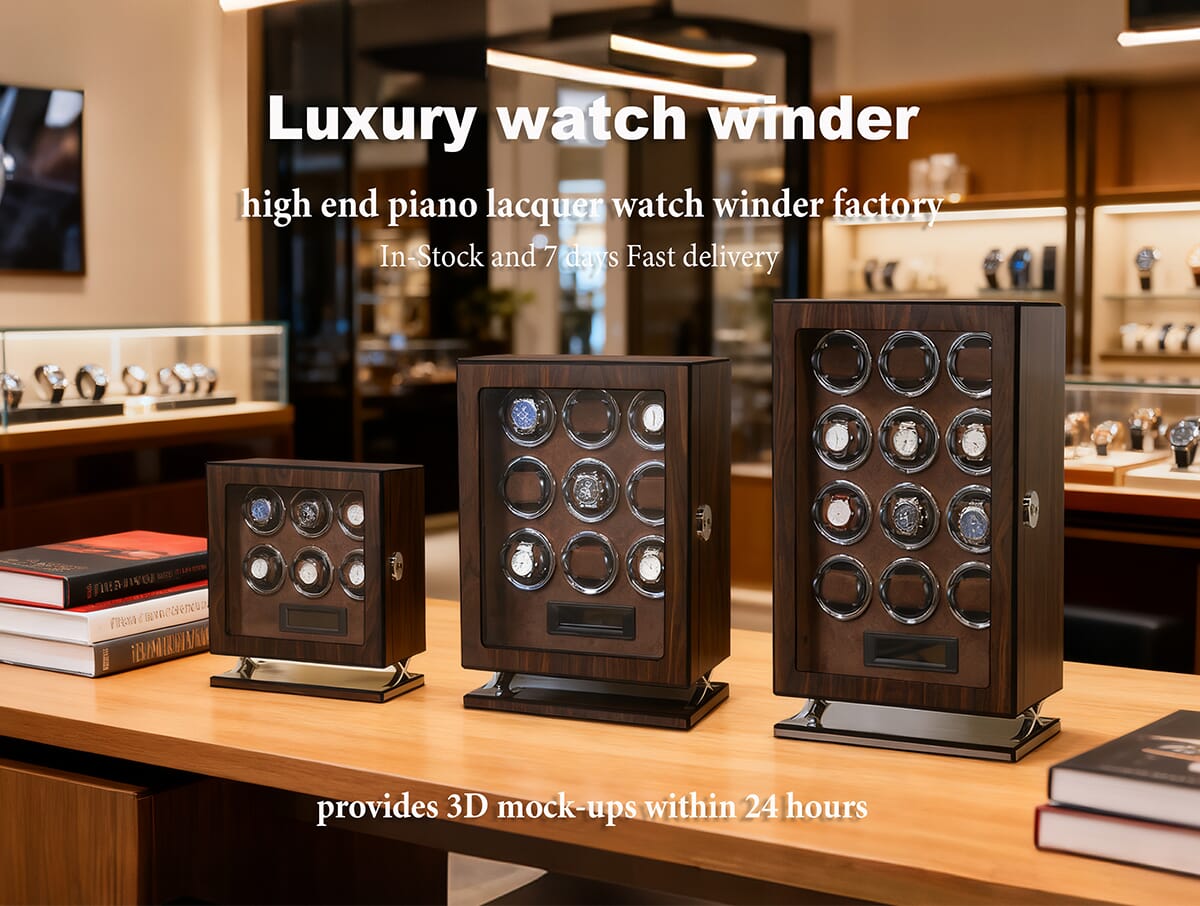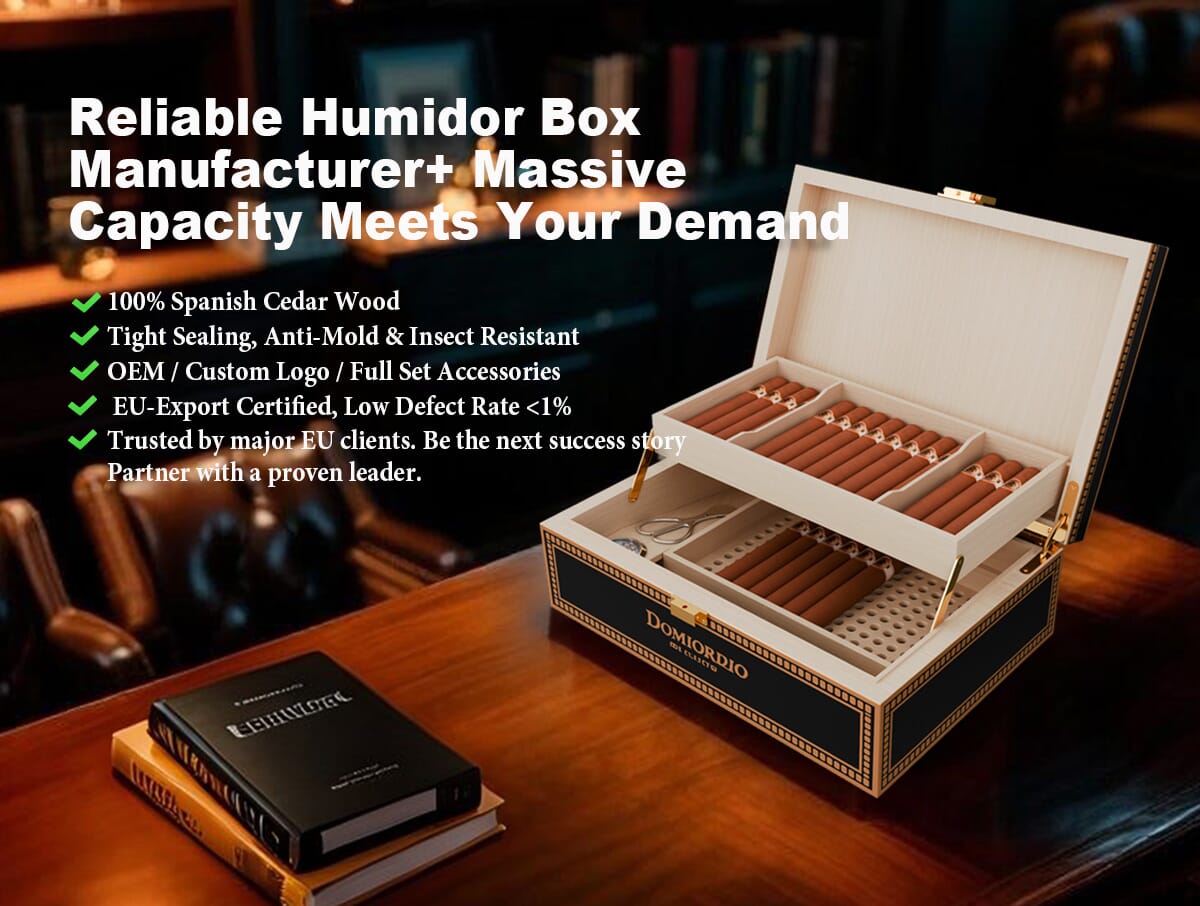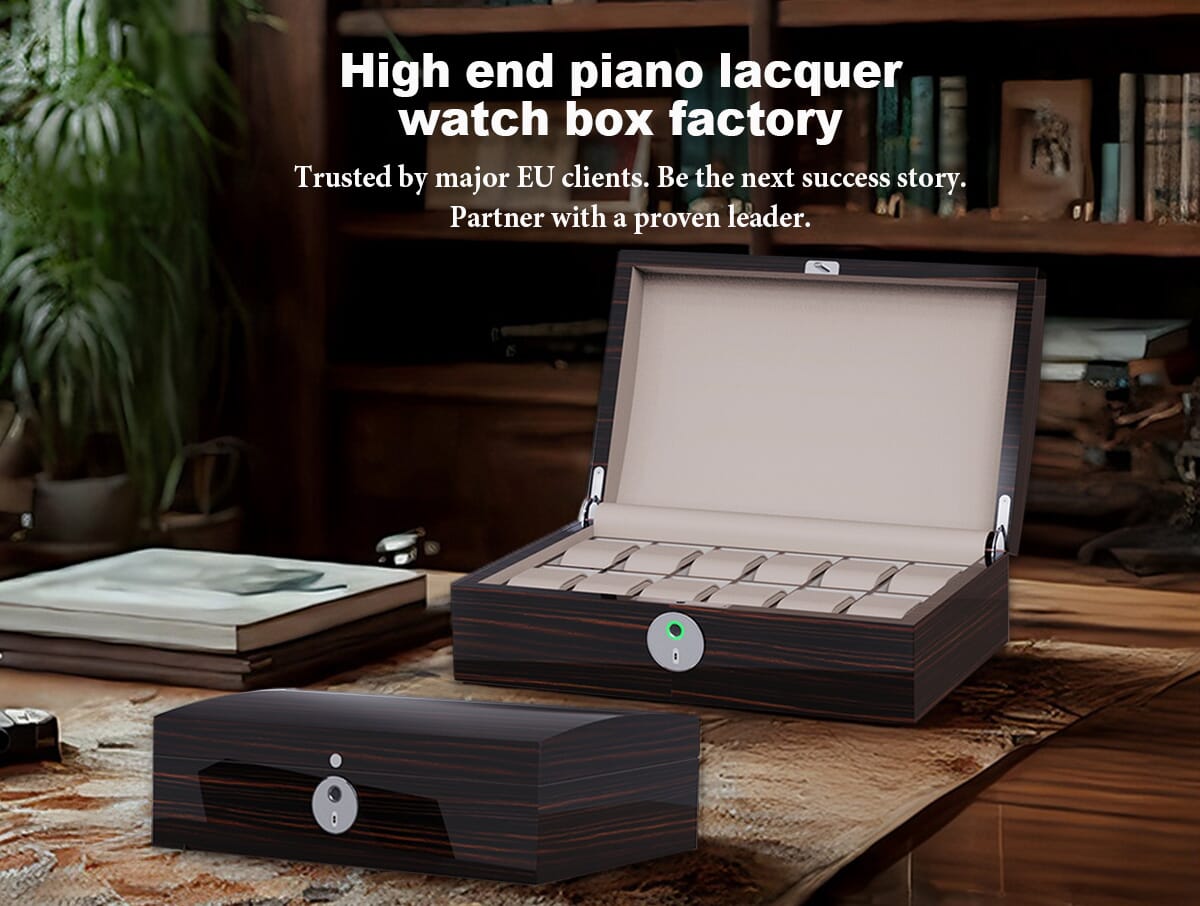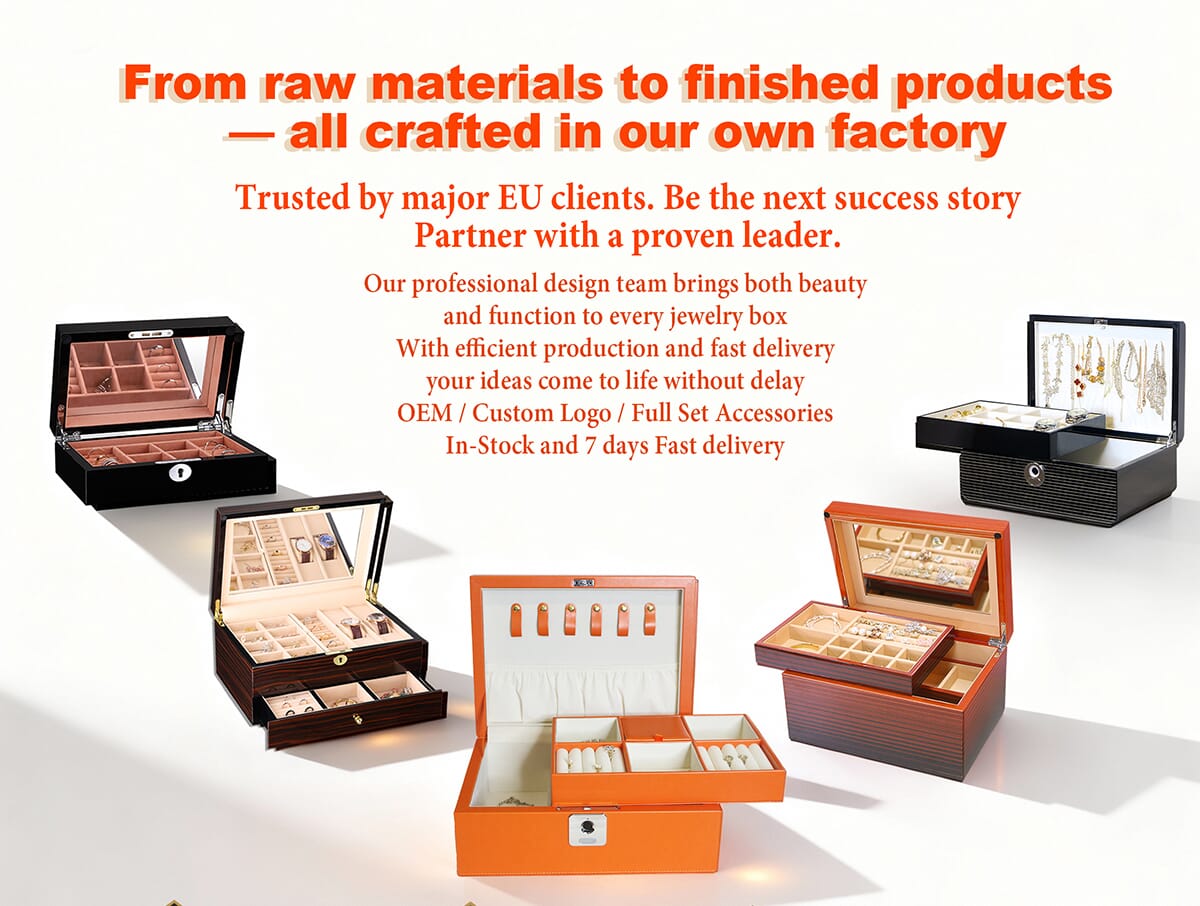
China is the largest manufacturer of watch winders and watch boxes, offering the most cost-effective options, the most reliable delivery, and the most consistent craftsmanship.
Choosing the wrong watch winder supplier costs you more than money. It costs you customers, brand reputation, and months of lost opportunity.The market is projected to hit $910 million in 2025, growing at a 6.9% CAGR through 2033 (Archive Market Research). The stakes are too high for guesswork.
If you are a procurement manager sourcing wholesale inventory, a distributor evaluating OEM partners, or an e-commerce brand building a private-label line, you already know the pain points.Samples look perfect. Bulk orders arrive with misaligned TPD settings. Motors whine after three months. Certification gaps halt customs clearance. Suppliers vanish when defects surface.This guide gives you a structured, repeatable evaluation framework: 10 criteria, a scoring matrix, a technical verification checklist, and a real-world case study.
Use it to make confident sourcing decisions and build a supply chain that scales with your business.
Why a Structured Evaluation Framework Matters
The global B2B watch winder market is expanding rapidly, driven by rising luxury watch ownership and growing demand for premium watch storage solutions. North America accounts for 35% of global demand, Europe 30%, and Asia Pacific 25% (Archive Market Research, 2025). But here’s what the market reports don’t tell you: the gap between a “good” and “great” watch winder supplier can mean the difference between a <1% defect rate and a 12% defect rate—and that gap directly determines whether your product line is profitable or a write-off.
According to industry sourcing data, quality control failures remain the single most underestimated cost when sourcing from China, with hidden rework, replacement, and shipping costs adding 15–30% to the true unit cost of poorly vetted suppliers (Asian Sourcing Group, 2024). A structured framework eliminates these surprises.
The 10-Point B2B Supplier Evaluation Framework
Criterion 1: Manufacturing Experience & Specialization
Why it matters: A factory that has spent 19 years specializing in wooden luxury packaging and watch winders has solved problems a generalist factory hasn’t even encountered yet—humidity warping, motor housing resonance, velvet lining adhesive migration, and hinge alignment on dual-watch configurations.
What to evaluate:
- Years in the specific product category (not just “manufacturing”)
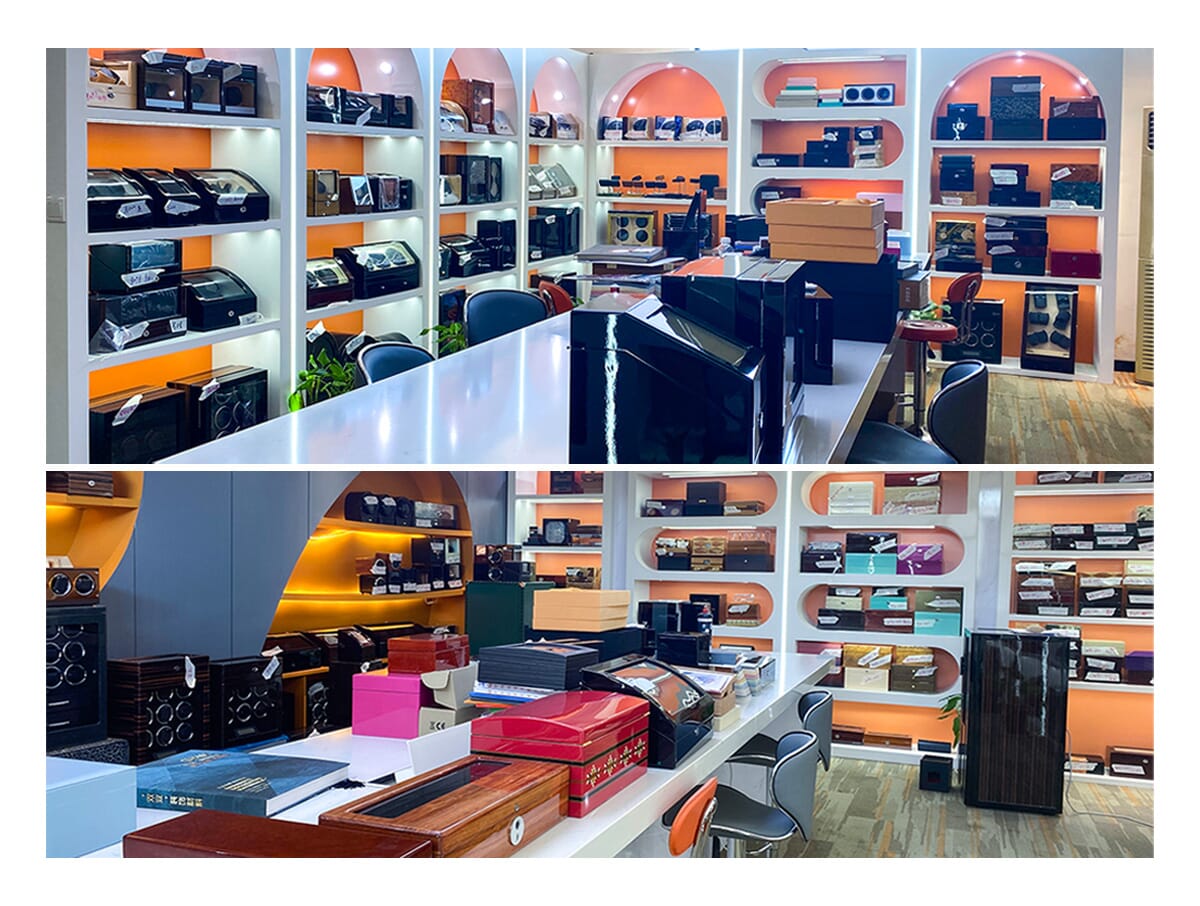
- Depth of product range: Does the factory produce cigar humidors, jewelry boxes, and watch boxes alongside winders? Cross-category expertise in wooden luxury goods indicates mature woodworking and finishing capabilities.
- Track record with export markets (EU, US, Middle East)
Red flag: A factory claims “15 years experience” but has only produced watch winders for 2 years—previously making furniture or promotional items.
Criterion 2: Production Capacity & Scalability
Why it matters: Your first order might be 200 units. Your third order could be 2,000. Can the factory scale without sacrificing quality?
What to evaluate:
- Workshop size (3,000 m² is a strong baseline for a specialized factory)
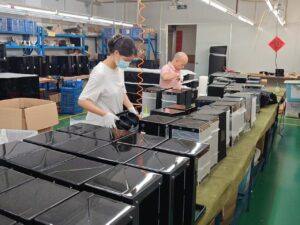
- Workforce size and skill distribution (100+ workers with dedicated QC team)
- Monthly output capacity for watch winders specifically
- Parallel production capability (can they run your order alongside other clients without cross-contamination of parts?)
Scoring tip: Ask for peak-season capacity, not just average. Q4 holiday demand can stretch factories beyond capacity, leading to rushed production and quality drops.
Criterion 3: OEM/ODM Capabilities
Why it matters: Whether you need a custom OEM watch winder with your brand logo or a fully original design (ODM) from concept to shelf, the supplier’s design and engineering depth determines how much of the heavy lifting they can do.
What to evaluate:
- In-house design team (industrial design, structural engineering, electronics)
- 3D rendering and prototyping capabilities
- Custom firmware for TPD programming, LED lighting, and touch controls
- Ability to produce custom inserts, watch pillows, and interior configurations
Benchmark: A top-tier watch winder manufacturer should deliver a physical prototype within 3 days of design confirmation and move to mass production in 15–20 days.
Criterion 4: Motor Quality & Electronics Engineering
Why it matters: The motor is the heart of a watch winder. It determines TPD accuracy, noise level, lifespan, and ultimately your product’s reputation.
Mabuchi vs. Standard Motors — The Data That Should Drive Your Decision:
| Parameter | Japanese Mabuchi Motor | Standard/Budget Motor |
|---|---|---|
| Noise Level | < 10 dB (virtually silent) | 15–25 dB (noticeable hum) |
| Expected Lifespan | 8–10+ years | 2–5 years |
| Rotation Consistency | Precision-engineered; stable under voltage fluctuation | Variable; drift over time |
| Bearing Type | High-grade ball bearings | Sleeve bearings (higher friction) |
| Thermal Management | Engineered heat dissipation | Minimal; risk of overheating |
| Magnetic Shielding | Designed to minimize magnetization risk | Often inadequate |
Source: Daily Accents / SUNYUNG Motor Analysis, 2025–2026
A B2B watch winder that ships with standard motors may save $3–5 per unit at the factory gate, but a 15–25 dB motor in a bedroom environment generates customer complaints, returns, and 1-star reviews that destroy your brand. The math is simple: premium motors pay for themselves in reduced returns and warranty claims.
Criterion 5: TPD (Turns Per Day) Accuracy & Programmability
Why it matters: Different automatic watches require different TPD settings. A Rolex may need 650 TPD, while an IWC could require 900 TPD, and a Patek Philippe might need 800 TPD on a bidirectional rotation. If the winder’s TPD is inaccurate or limited in settings, it either over-winds (stress on the mainspring) or under-winds (watch stops).
What to evaluate:
- Number of TPD settings available (minimum: 650, 720, 800, 900, 1000, 1200)
- Rotation direction options: CW, CCW, bidirectional
- Programmability: Individual head control for multi-watch winders
- Accuracy tolerance: TPD deviation should be < ±5%
Technical standard: Most premium automatic watches require between 650 and 1200 TPD. The winder must offer this full range with bidirectional capability to serve the broadest customer base.
Criterion 6: Noise Level & Acoustic Performance
Why it matters: Watch winders are bedroom products. The industry-accepted standard for premium winders is < 30 dB, but true luxury-grade performance is < 10 dB (Mabuchi motors). For context: 30 dB is a quiet whisper at 1 meter; 10 dB is below the threshold of human perception in most environments.
What to evaluate:
- Decibel rating at 1 meter distance (request lab test report)
- Vibration isolation engineering (rubber mounts, foam dampening, weighted bases)
- Long-term acoustic stability: Does noise increase after 6 months of continuous operation? (Request aging test data.)
Procurement tip: Always request a noise test video with a decibel meter visible in the frame. This is a quick authenticity check that separates serious manufacturers from those quoting theoretical numbers.
Criterion 7: Power Solutions & Safety Certifications
Why it matters: Watch windinder products are sold globally, and each market has mandatory safety and electromagnetic compliance requirements. Missing certifications mean customs seizure, market withdrawal, or legal liability.
Certification Checklist by Market:
| Market | Required Certifications |
|---|---|
| European Union | CE (LVD + EMC), RoHS, REACH. If wireless: RED directive |
| United States | FCC (Part 15 for digital devices), UL/ETL (safety listing recommended) |
| United Kingdom | UKCA marking (post-Brexit equivalent of CE) |
| Middle East / GCC | GCC Conformity Marking, SASO (Saudi Arabia) |
| Australia | RCM (Regulatory Compliance Mark) |
Power configurations to verify:
| Item | Specification |
|---|---|
| AC Adapter Input Range | 100–240V, 50/60Hz (global compatibility) |
| DC Battery Backup Option | AA or built-in lithium battery (for power outage protection) |
| USB-C or DC Barrel Connector Specifications | To be specified (details to be added) |
| Included Adapter Plug Types | EU, UK, US, AU |
Criterion 8: Material Quality & Craftsmanship
Why it matters: A watch winder factory China produces isn’t just an electronic device—it’s a piece of furniture. Wood finishing, velvet lining quality, hinge precision, and exterior coating durability all determine whether your product sells as “premium” or “budget.”
What to evaluate:
- Wood species: MDF vs. solid wood (walnut, mahogany, ebony). MDF is acceptable for mid-range; solid wood commands premium pricing.
- Exterior finish: Piano lacquer (8+ coats hand-polished), matte lacquer, or genuine leather wrapping
- Interior lining: Suede vs. velvet; density and colorfastness
- Hardware: Hinges, clasps, and locks—brass or stainless steel only (no plated iron that rusts)
- Glass: Tempered glass for display models; anti-UV coating available
Criterion 9: Quality Control & Defect Rate
Why it matters: Industry data shows that consumer goods sourced from China without rigorous QC processes average 8–12% defect rates on first production runs (TradeAiders, 2024). A factory with a < 1% defect rate operates an entirely different quality system.
What to evaluate:
- Stated defect rate (ask for documentation, not claims)
- QC process: Incoming material inspection → In-process inspection → Pre-shipment final inspection (AQL 2.5 or better)
- Third-party inspection: Do they accept SGS, Intertek, or Bureau Veritas inspections?
- RMA process: What happens when defects are found? Who pays for replacement production and shipping?
Benchmark: A defect rate below 1% indicates a factory with robust process controls, not just good luck on your specific order.
Criterion 10: Communication, Lead Time & After-Sales Support
Why it matters: The best product in the world is useless if you can’t get answers when a shipment is delayed or a design revision is needed.
What to evaluate:
- Response time: < 4 hours during business hours
- Dedicated account manager (not a shared sales@ inbox)
- Sample lead time: 3 days from design confirmation
- Mass production lead time: 15–20 days from deposit
- After-sales warranty policy: Minimum 1-year factory warranty
- Spare parts availability: Motors, adapters, pillows—can they ship replacements within 5 days?
Supplier Evaluation Scoring Matrix
Use this scoring table to objectively compare suppliers. Rate each criterion from 1 (Poor) to 5 (Excellent). Weight reflects relative impact on business outcomes.
| # | Criterion | Weight | Supplier A | Supplier B | Supplier C |
|---|---|---|---|---|---|
| 1 | Manufacturing Experience | 12% | /5 | /5 | /5 |
| 2 | Production Capacity | 10% | /5 | /5 | /5 |
| 3 | OEM/ODM Capabilities | 12% | /5 | /5 | /5 |
| 4 | Motor Quality & Electronics | 15% | /5 | /5 | /5 |
| 5 | TPD Accuracy & Programmability | 10% | /5 | /5 | /5 |
| 6 | Noise Level & Acoustics | 10% | /5 | /5 | /5 |
| 7 | Power Solutions & Certifications | 10% | /5 | /5 | /5 |
| 8 | Material Quality & Craftsmanship | 8% | /5 | /5 | /5 |
| 9 | QC & Defect Rate | 8% | /5 | /5 | /5 |
| 10 | Communication & Lead Time | 5% | /5 | /5 | /5 |
| Total Weighted Score | 100% | /5 | /5 | /5 |
Interpretation:
- 4.0–5.0: Preferred supplier — proceed to sample order
- 3.0–3.9: Conditional — acceptable with specific improvement requirements
- Below 3.0: High risk — do not proceed without significant due diligence
Technical Parameter Verification Checklist
Before placing a bulk order, verify these specifications against the supplier’s sample unit. Print this checklist and use it during sample evaluation or factory audit.
Motor & Electronics
| Parameter | Specification / Requirement |
|---|---|
| Motor Brand | Mabuchi RS-555PH, RF-500TB, or equivalent Japanese-spec |
| Noise Level (at 1m) | < 10 dB (Mabuchi) or < 30 dB (standard) |
| TPD Settings | 650 / 720 / 800 / 900 / 1000 / 1200 |
| Rotation Direction | CW / CCW / Bidirectional programmable |
| TPD Accuracy | ±5% or better (verified with test watch over 24h) |
| LED Display | Functional and brightness adjustable |
| Touch Control / Button Interface | Responsive and durable (1,000-cycle test) |
Power & Safety
| Requirement | Specification / Action |
|---|---|
| AC Adapter | Input: 100–240V, 50/60Hz; Output: matches motor specifications |
| Battery Backup | Type: AA or built-in Li-ion; Minimum runtime: ≥ 72 hours on battery |
| CE Certification (LVD + EMC) | Certificate on file — verify certificate number and issuing body |
| RoHS Compliance | Certificate on file |
| FCC Part 15 Compliance | Required if selling to US market |
| Adapter Plug Types | EU, UK, US, AU — all included in packaging |
| Wiring Safety | No exposed wiring; all connections soldered and insulated |
Wood & Exterior
| Specification | Requirement |
|---|---|
| Wood Type | Solid walnut / mahogany / MDF (as per specification) |
| Piano Lacquer Finish | ≥ 8 coats, hand-polished, no visible brush marks |
| Interior Velvet / Suede | Evenly glued, no bubbling, colorfast under light exposure |
| Hinges | Brass or stainless steel; open/close cycle tested (minimum 5,000 cycles) |
| Glass | Tempered, no scratches, properly seated in frame |
| Watch Pillow | Firm enough to hold oversized watches (up to 52mm case diameter) |
Packaging & Logistics
| Item | Description |
|---|---|
| Individual Gift Box Packaging | Color box + foam insert |
| Outer Carton Drop-Test Certified | ISTA 1A or equivalent |
| Product Labels and Barcodes | Match specification |
| User Manual | Included, in target market language |
Cost Analysis: Beyond the Unit Price
One of the most common mistakes in wholesale watch winder sourcing is comparing only the FOB unit price. The true cost of a watch winder supplier encompasses multiple factors that don’t appear on a quotation sheet.
Cost Breakdown Comparison
| Cost Component | Low-Cost Supplier (Standard Motor) | Premium Supplier (Mabuchi Motor) |
|---|---|---|
| FOB Unit Price | $38 | $45 |
| Motor Replacement Rate (Year 1) | 8–12% | < 1% |
| Return Shipping Cost (defects) | $12/unit avg | $0.50/unit avg |
| Customer Service Cost (complaints) | $4/unit avg | $0.30/unit avg |
| Reputational Damage (estimated) | $8/unit avg | Negligible |
| Effective First-Year Cost | $62–74/unit | $45.80/unit |
Key insight: The “cheaper” supplier costs 37–64% more in the first year when you account for returns, replacement shipping, customer service overhead, and the reputational cost of negative reviews. Over a 3-year product lifecycle, the gap widens further as standard motors degrade and failure rates accelerate.
Hidden Costs to Ask About Upfront
| Item | Details |
|---|---|
| Tooling fees | Custom mold or jig charges (should be amortized over projected volume) |
| Packaging customization | Color box printing MOQ and per-unit cost |
| Certification costs | Who pays for CE/FCC testing — factory or buyer? |
| Sample shipping | Express shipping for 2–3 sample units (DHL/FedEx: $80–150) |
| Payment terms | 30% deposit + 70% before shipment is standard; negotiate 30/70 against BL copy for better leverage |
Case Study: A European Distributor’s Journey from Screening to Signed Contract
Company: Horologica GmbH (name changed for confidentiality), a Munich-based distributor of luxury watch accessories serving Germany, Austria, and Switzerland.
The Challenge: In 2024, Horologica’s existing watch winder supplier delivered a batch of 500 dual-watch winders where 14% exhibited motor noise exceeding 40 dB after 90 days of use. The German market—where bedrooms are typically small and walls thin—was unforgiving. Return rates hit 11%, and two key retail partners threatened to delist the product line.
Step 1: Rebuilding the Evaluation Framework (Week 1–2) Horologica’s procurement director developed a weighted scoring matrix (similar to the one above) and identified 8 potential suppliers from Alibaba, Canton Fair contacts, and industry referrals. Initial screening—based on factory size, years in business, and certification status—narrowed the list to 4.
Step 2: Sample Evaluation (Week 3–4) Each of the 4 suppliers was asked to produce a dual-watch winder sample with Mabuchi motors, piano lacquer walnut finish, TPD range 650–1200, and CE certification.
| Supplier | Sample Quality | Noise Level | TPD Accuracy | Lead Time |
|---|---|---|---|---|
| Supplier A | Poor (visible glue, uneven lacquer) | 22 dB | ±8% deviation | 14 days |
| Supplier B | Acceptable (minor velvet bubbling) | 18 dB | ±6% deviation | 10 days |
| Twing-Pak | Excellent (flawless finish, precise TPD) | < 10 dB | ±3% deviation | 3 days |
| Supplier D | Good (decent finish) | 15 dB | ±5% deviation | 7 days |
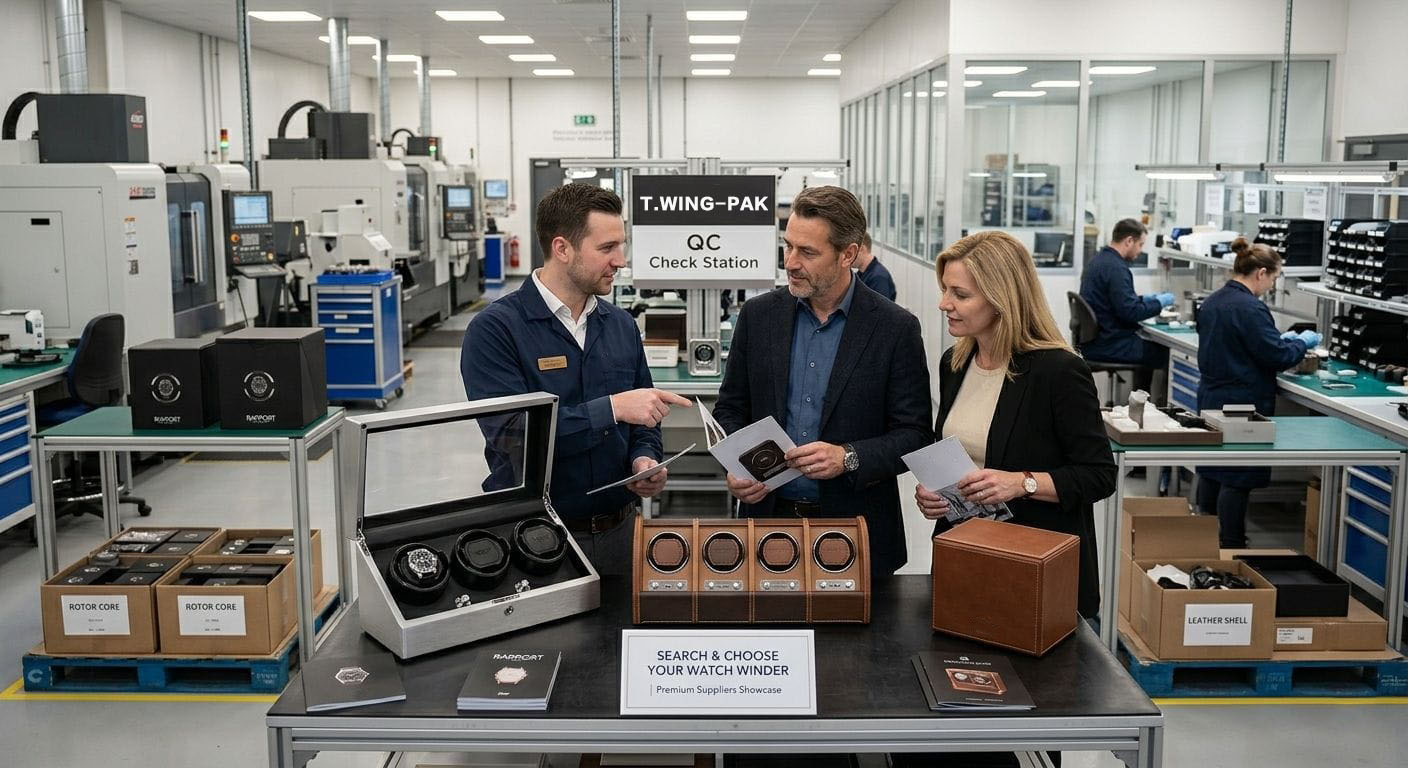
Step 3: Factory Audit (Week 5) Horologica’s quality manager visited the Twing-Pak facility in Guangzhou Nansha. Key observations:
| Category | Details |
|---|---|
| Facility | 3,000 m² workshop with dedicated motor testing room and aging test lab |
| Workforce | 100+ workers, including an 8-person QC team |
| QC Process | Incoming, in-process, and pre-shipment inspections conducted |
| Mabuchi Motor Stock | Verified; original packaging with lot traceability |
| Certifications | CE and RoHS certificates verified with issuing body (TÜV Rheinland) |
| Defect Rate | < 0.8% over the previous 12 months |
Step 4: Pilot Order & Stress Testing (Week 6–8) A pilot order of 100 units was placed. Horologica conducted accelerated aging tests:
| Test Condition | Result |
|---|---|
| 72-hour continuous operation | No noise increase, motor housing temperature remained < 40°C |
| 500 open/close hinge cycles | No loosening or misalignment |
| TPD accuracy over 7 days | Consistent within ±3% |
| Drop test (60 cm, 3 sides) | No interior damage, motor function normal |
Step 5: Contract & Scaling (Week 9–10) Result: Horologica signed a 12-month supply agreement with Twing-Pak covering:
| Parameter | Details |
|---|---|
| Initial Order | 300 units (3 SKUs: single, dual, and 6-watch winder) |
| Reorder Schedule | Quarterly reorder with 15-day production lead time |
| Warranty | 1-year factory warranty with 5-day spare parts shipping |
| Market Exclusivity | Exclusive design for German market (custom walnut Burl finish) |
| Defect Rate Guarantee | < 1%, with full replacement at factory cost if exceeded |
Outcome (6 months post-launch): Return rate dropped from 11% to 0.6%. Two new retail partners onboarded. Horologica’s wholesale watch winder revenue grew 42% year-over-year.
FAQ: Watch Winder Supplier Evaluation
1. What is the minimum order quantity (MOQ) for OEM watch winders?
MOQ varies by supplier and complexity. For standard models with minor customization (logo, color), expect MOQ of 100–200 units. For fully custom ODM designs with new tooling, MOQ typically starts at 300–500 units. At Twing-Pak, we offer flexible MOQ starting from 100 units for standard OEM configurations.
2. How do I verify that a supplier actually uses Mabuchi motors and not counterfeits?
Request the motor purchase invoice or supply agreement from Mabuchi Corporation. Legitimate Mabuchi motors have laser-etched branding and lot numbers. During factory audit, photograph the motor and compare markings against Mabuchi’s official catalog. You can also send a sample motor to an independent testing lab for verification.
3. What TPD settings should a quality watch winder offer?
A minimum of 5–6 TPD settings covering the range of 650–1200 TPD. The most commonly needed settings are 650 (Rolex), 800 (Patek Philippe, Audemars Piguet), 900 (IWC, Panerai), and 1000–1200 (Omega, Breitling). Bidirectional rotation capability is essential for versatility.
4. Why is the < 30 dB noise standard important for B2B watch winder products?
Watch winders are designed to keep automatic watches running when not worn—typically overnight in bedrooms or on nightstands. At 30 dB, the sound is comparable to a soft whisper, which is the upper threshold for comfortable sleep. Premium products using Mabuchi motors achieve < 10 dB, which is effectively inaudible. Products exceeding 30 dB generate disproportionate customer complaints and returns.
5. What certifications are absolutely non-negotiable for selling watch winders in the EU?
Three certifications are mandatory: CE (covering Low Voltage Directive LVD and Electromagnetic Compatibility Directive EMC), RoHS (Restriction of Hazardous Substances), and REACH (chemical safety). If your winder includes wireless features like Bluetooth or Wi-Fi for app control, you also need RED (Radio Equipment Directive) compliance. Without these, your product will be refused entry at EU customs.
6. How can I reduce lead times when working with a China-based watch winder factory?
Three strategies: (1) Pre-approve designs and materials during your first order so reorders require no design review; (2) Establish a buffer stock agreement where the factory holds semi-finished inventory for your SKUs; (3) Work with a factory that has in-house motor testing and QC—outsourced testing adds 3–5 days to lead times. Twing-Pak’s 3-day sampling and 15–20 day mass production lead time is achieved through vertical integration of all processes.
7. What’s the realistic defect rate I should expect from a quality supplier?
For a well-managed watch winder manufacturer, a defect rate below 1% is achievable and should be your benchmark. Industry averages for consumer electronics sourced from China range from 5–12% without robust QC, but factories with dedicated QC teams, incoming material inspection, and pre-shipment AQL testing consistently deliver < 1%. Always require the defect rate in your contract with a replacement-at-factory-cost clause.
8. Should I choose a trading company or a direct factory?
For B2B watch winder sourcing, a direct factory is almost always superior. Trading companies add 10–20% markup, cannot control production schedules, and have limited ability to customize motor specifications or TPD programming. A direct factory like Twing-Pak offers lower unit costs, faster communication, full customization control, and direct accountability for quality issues. The one exception: if your order volume is below 50 units and no factory will accept it, a trading company may be your only option—but you’ll pay for it in margin and flexibility.
Your Next Step: From Framework to First Order
You now have a complete evaluation framework—10 weighted criteria, a scoring matrix, a technical verification checklist, cost analysis, and a real-world case study proving that the right supplier selection transforms a product line from a loss leader into a growth engine.
The global watch winder market is growing at 6.9% CAGR. Every month you spend evaluating suppliers without placing an order is market share your competitors are capturing.
At Twing-Pak, we’ve spent 19 years building the manufacturing systems, QC processes, and OEM/ODM capabilities that this framework demands:
| Feature | Details |
|---|---|
| Specialization | 19 years of specialization in luxury wooden packaging and watch winders |
| Workshop | 3,000 m² workshop in Guangzhou Nansha with 100+ skilled workers |
| Motors | Mabuchi motors standard on all winder models — < 10 dB, 8–10+ year lifespan |
| TPD Range | Full TPD range (650–1200) with CW/CCW/Bidirectional programming |
| Certifications | CE, RoHS, FCC certified for EU, US, and global markets |
| Quality Control | < 1% defect rate with 8-person dedicated QC team |
| Lead Times | 3-day sampling, 15–20 day mass production |
| Customization | OEM/ODM from logo engraving to fully custom product design |
Ready to evaluate Twing-Pak for your next watch winder project?
📧 Email: contact@twing-pak.com 🌐 Website: www.twing-pak.com 📍 Factory Address: Nansha District, Guangzhou, China
Request a free sample, schedule a virtual factory tour, or send us your product specifications—we’ll return a detailed quotation with motor specs, TPD configuration options, and certification documentation within 24 hours.
Your customers demand premium. Your supply chain should deliver it.
*Last updated: 2025. Data sources: Archive Market Research (2025), Daily Accents Motor Analysis (2025), SUNYUNG Technical Report (2026), Asian Sourcing Group (2024), TradeAiders China Sourcing Report (2024).