1. High-Saturation Piano Lacquer and Mother-of-Pearl Inlay Engineering
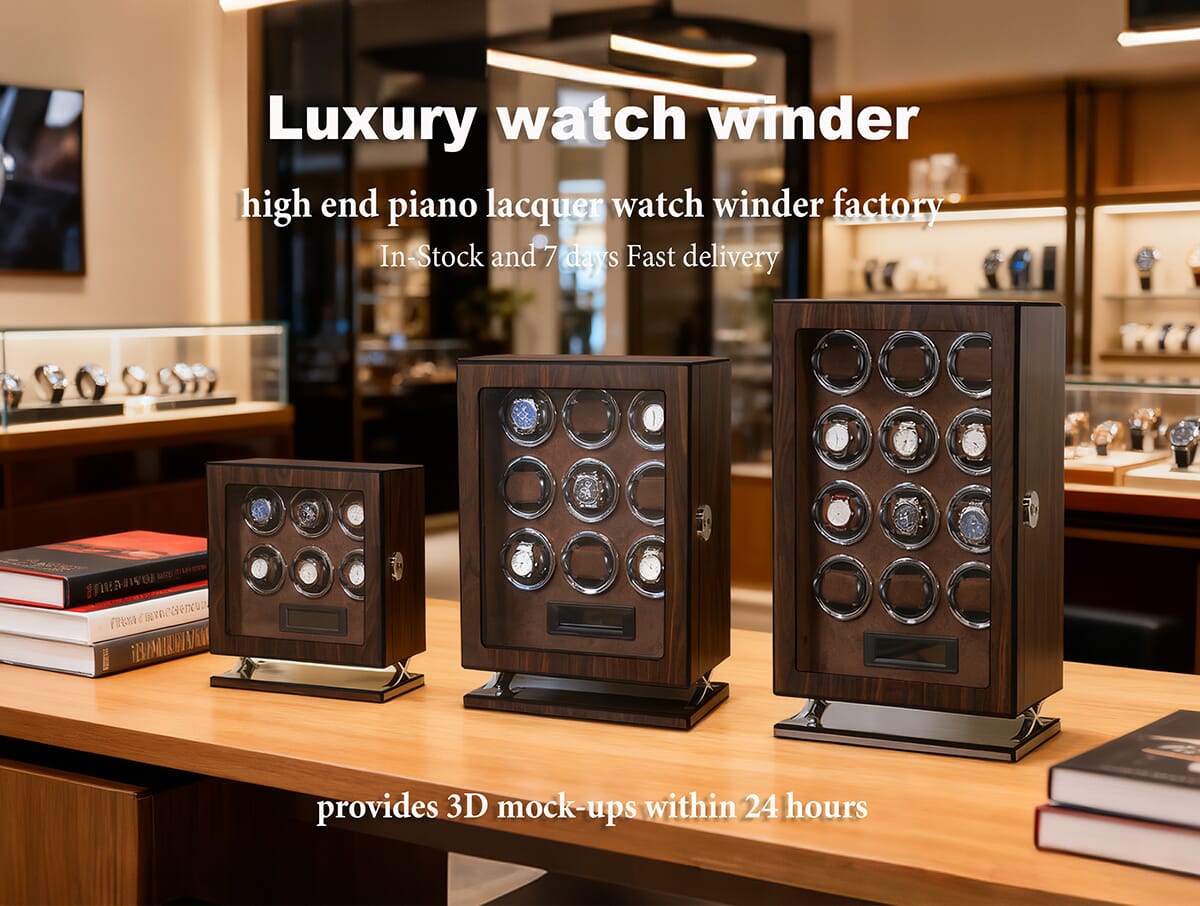
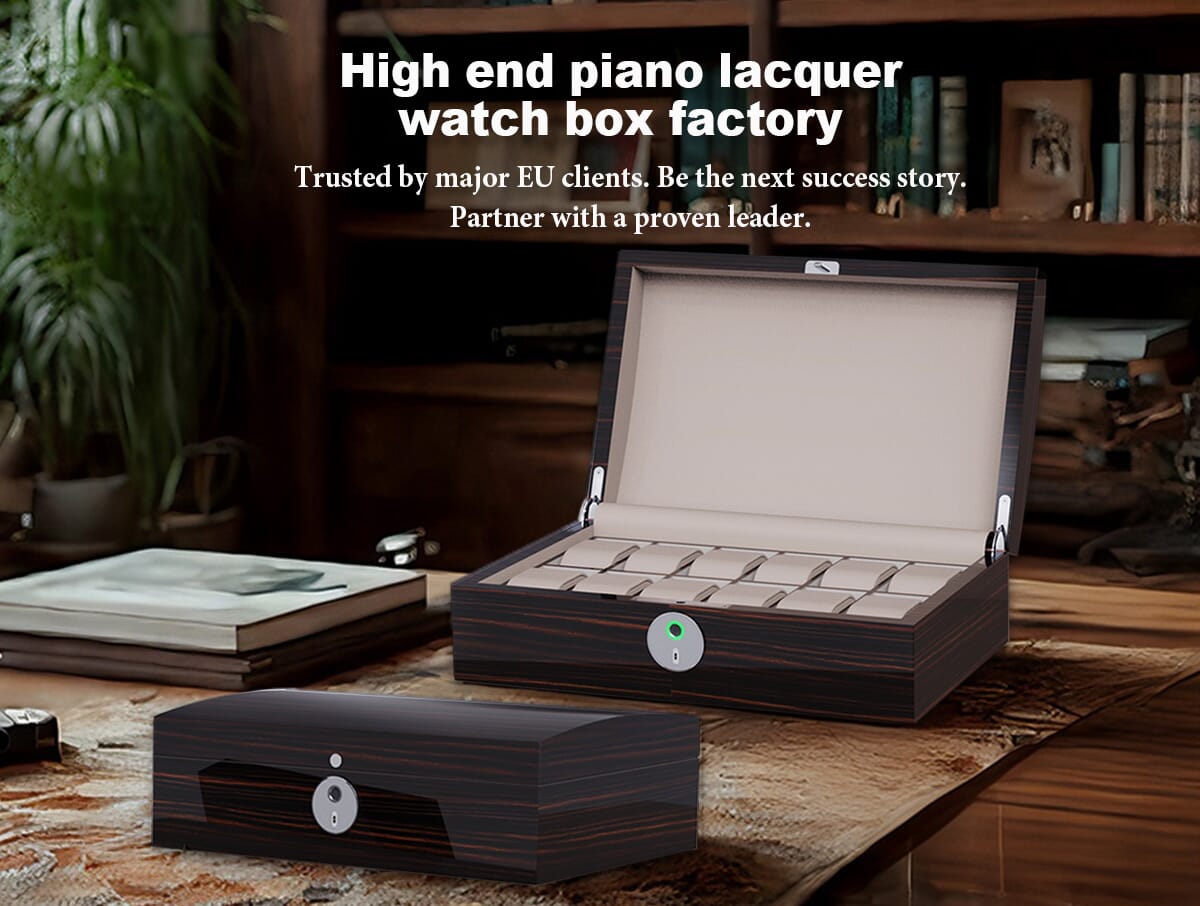
True high-gloss piano lacquer on a luxury watch winder requires a dust-free, climate-controlled curing chamber and 12 to 16 sequential layers of polyurethane (PU) and unsaturated polyester (PE) coatings. According to the ASTM D3363 pencil hardness test standard, premium cured piano lacquer achieves a surface hardness rating of 2H to 3H, delivering exceptional scratch resistance and mirror-level optical depth exceeding 95 Gloss Units (GU). When integrating genuine mother-of-pearl (shell) inlay into a piano lacquer SKU, artisans hand-cut 0.2mm shell veneers and embed them beneath clear lacquer coats so the surface remains completely flush. Guangzhou T.wing-Pak Mfg Co., Ltd. executes micro-arc edge finishing on every corner to prevent coating pull-back and edge chipping during retail handling.
2. Natural Wood Veneer Selection and Humidity Stabilization
Positioned as a completely independent SKU category from high-gloss piano lacquer, a natural wood veneer watch winder highlights organic grain textures such as Macassar ebony, burl walnut, rosewood, and bird’s-eye maple. To prevent solid wood splitting under fluctuating winter heating or tropical humidity, engineers bond 0.6mmFSC-certified natural wood veneers onto high-density E1-grade fiberboard cores stabilized at an 8% to 10% equilibrium moisture content. Open-pore or semi-matte protective sealers preserve the tactile warmth of real timber while resisting UV-induced color fading in brightly lit jewelry showrooms. Separating natural wood veneer lines from piano finish lacquer SKUs allows B2B distributors to target both classic heritage collectors and modern high-gloss aficionados without cannibalizing sales.
| Cabinet Attribute | High-Gloss Piano Lacquer SKU | Natural Wood Veneer SKU (Matte / Satin) | Recommended B2B Market Segment |
|---|---|---|---|
| Coating & Polishing Cycles | 12–16 Coats + 6-Stage Mirror Buffing | 5–7 Coats Open/Closed Pore UV Sealer | Piano: Flagship Boutiques | Veneer: Heritage Retail |
| Specular Gloss Level (60° Meter) | 95+ GU (High-Saturation Mirror Finish) | 15–35 GU (Natural Tactile Wood Grain) | Distinct visual merchandising tiers |
| Decorative Inlay Compatibility | Mother-of-Pearl (螺钿) & Metallic Brass Lines | Book-Matched Burl & Marquetry Wood Borders | Supports tiered retail pricing ($46 – $400+ FOB) |
| Surface Hardness (ASTM D3363) | 2H – 3H Scratch-Resistant Shield | 1H – 2H Wear-Resistant Protective Film | High durability during showroom demonstrations |
3. Hardware Durability Standards and Surface Defect Inspection Steps
Even the finest cabinet finish will fail in the luxury market if paired with inferior metal hinges, locks, or acrylic viewing windows. Guangzhou T.wing-Pak Mfg Co., Ltd. enforces a strict hardware validation protocol demanding 50,000-cycle hinge opening/closing fatigue tests and 24-hour neutral salt-spray testing (ASTM B117) on all electroplated brass quadrants and keylocks. Before approving a pre-shipment batch of watch winder cabinets, B2B quality inspectors should execute the following 4-step surface inspection procedure under a 1,000-lux daylight lamp.
- Step 1: Oblique Light Reflection Check (30-Degree Angle): Inspect piano lacquer panels at a 30-degree angle under a 1,000-lux light source to verify zero orange-peel texture, pinholes, or buffing swirl marks.
- Step 2: Micro-Arc Corner & Seam Verification: Run a gloved finger along all mitered joints and micro-arc edges to confirm uniform coating thickness and zero sharp burrs.
- Step 3: Cross-Cut Adhesion & Scratch Audit: Test sample test-plaques from the same curing batch under ISO 2409 cross-hatch tape standards to confirm 5B (0% flaking) lacquer adhesion.
- Step 4: Hinge Torque & Salt-Spray Verification: Open and close the lid 20 times to confirm smooth damping resistance and inspect plated hardware for zero oxidation spots.
Conclusion & B2B Procurement Summary:
Treating high-saturation piano lacquer (including mother-of-pearl inlay editions) and natural wood veneer cabinets as distinct, specialized SKUs enables watch brands to build a structured, high-margin product matrix. Backed by 19 years of luxury wooden packaging mastery, 50,000-cycle hardware durability standards, and a sub-2% defect rate across 30,000 monthly units, Guangzhou T.wing-Pak Mfg Co., Ltd. is your trusted OEM/ODM factory partner.
Call to Action:
Reach out to Guangzhou T.wing-Pak Mfg Co., Ltd. today to request physical finish swatches comparing our scratch-resistant piano lacquer and natural wood veneer SKUs.
Frequently Asked Questions (B2B FAQ)
High-gloss piano lacquer and natural matte wood veneer require different chemical coating formulations, polishing workflows, and visual positioning; separating them prevents buyer confusion and establishes clear retail price tiers.
We kiln-dry and acclimatize our engineered MDF and solid wood cores to a strict 8%–10% moisture content before sealing all six internal and external faces of every panel against humidity exchange.
Our 12-to-16-layer PU/PE curing cycle reaches a 2H–3H pencil hardness rating, creating a dense cross-linked polymer surface that resists everyday wiping and retail display handling.
Every hardware batch undergoes a 50,000-cycle mechanical opening/closing endurance test and a 24-hour salt-spray corrosion test to guarantee tarnish-free operation in coastal or humid regions.
Yes. We apply laser-etched metal plates, silk-screened gold foil, or mother-of-pearl inlays prior to the final clear piano lacquer coats so your brand emblem sits permanently encapsulated beneath a mirror-flat finish.