The luxury watch box has evolved from a simple protective container into a brand statement. For retailers, e-commerce operators, and watch brand owners, the box that holds the timepiece is the customer’s first tactile encounter with your brand identity. A poorly made box undermines even the finest watch inside it — while a premium watch box elevates perceived value and justifies higher retail pricing.
This article examines the manufacturing processes, material choices, and quality benchmarks that separate a genuine luxury watch box from mass-market alternatives. Whether you are sourcing your first private-label collection or upgrading an existing product line, these standards should inform every factory conversation and sample evaluation.
1. Wood Species and Structural Engineering
A high-quality wooden watch box starts with the right substrate. The choice of wood species affects weight, dimensional stability, lacquer adhesion, and long-term durability in varying climates — particularly relevant for products that ship globally from manufacturing hubs in Southern China to end users in Scandinavia, the Gulf States, or tropical Southeast Asia.
Rubberwood — the Professional Standard
Rubberwood (Hevea brasiliensis) has emerged as the dominant material for premium wooden watch box production. Sourced from rubber plantations after latex production ends, it offers an excellent sustainability profile — an increasingly important factor for European and North American buyers with FSC compliance requirements. Its tight grain structure accepts multi-coat lacquer finishes without visible pores, and its density provides satisfying heft without excessive weight.
MDF vs. Solid Wood Considerations
Medium-density fiberboard reduces unit cost by 25 to 40 percent but introduces trade-offs in perceived quality. MDF edges require veneer wrapping that can delaminate in high-humidity environments, and the material does not absorb or release moisture naturally, which can create condensation issues inside closed boxes. For premium watch box programs targeting retail price points above $80, solid wood construction delivers measurably better customer satisfaction scores and lower return rates.
2. The 12-Coat Piano Lacquer Process
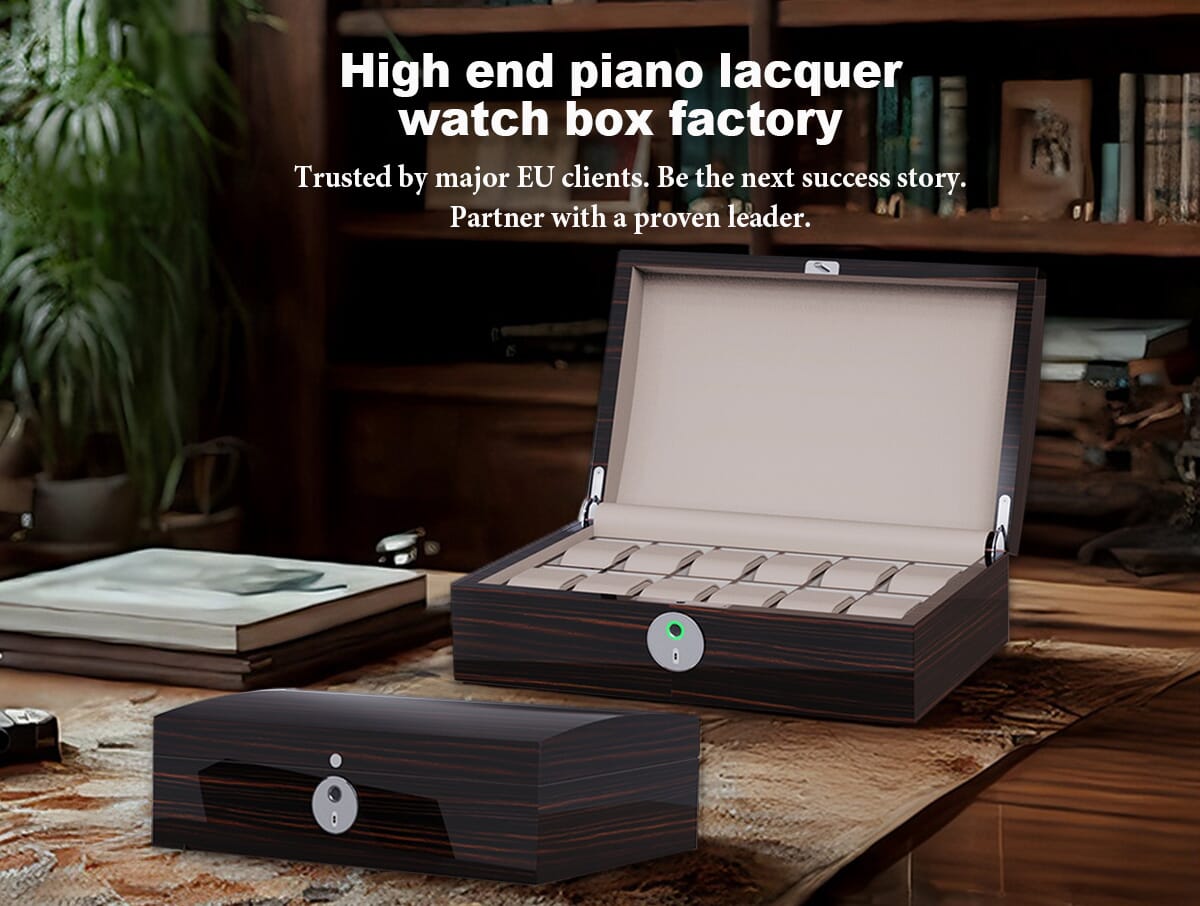
Surface finish quality is the single most visible differentiator between a luxury watch box and a commodity product. The piano lacquer process used by top-tier manufacturers involves 12 to 13 sequential coats of polyester or polyurethane paint, with wet sanding at 400, 800, and 1200 grit between application stages. The final coat is machine-polished to achieve a mirror-depth reflectivity that remains stable for two to three years.
Budget manufacturers compress this to three to five coats, skipping intermediate sanding stages. The result is a surface that appears glossy on arrival but develops orange-peel texture, micro-scratches, and yellowing within months. For any designer watch box program positioned above the entry level, the lacquer specification should be explicitly stated in the purchase contract and verified through sample testing before production commitment.
3. Interior Construction and Material Quality
The interior of a luxury watch box receives as much engineering attention as the exterior in professional-grade manufacturing. Pillow cushions must accommodate watch diameters from 36mm to 46mm without compression marks. The fabric covering — typically microfiber suede, genuine suede, or PU leather — must resist pilling, color transfer, and static buildup that attracts dust.
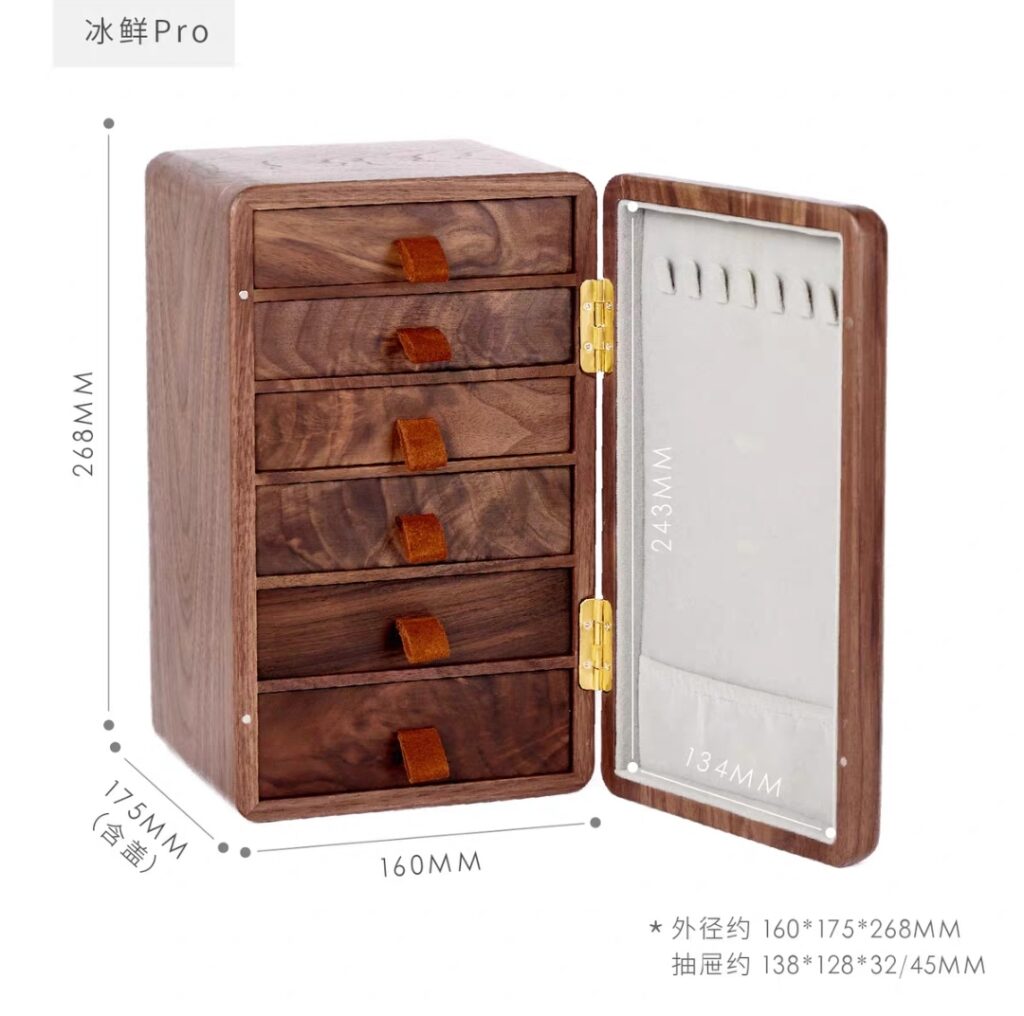
Watch box with drawer configurations: Multi-tier designs featuring a watch box with drawer provide storage for straps, tools, links, and accessories. The drawer mechanism requires precision rail systems — not simple friction-fit channels — to ensure smooth operation under load. Soft-close dampeners add a premium feel that matches the expectations of buyers paying $120 or more at retail. Drawer interiors should use the same material grade as the main compartment; cost-cutting on hidden surfaces is immediately apparent to discerning end users.
4. Hardware, Hinges, and Closure Systems
Metal hardware is the third element that communicates quality upon first touch. Zinc-alloy hinges with nickel or gold-tone PVD coating outperform stamped steel alternatives in both durability and appearance. Clasp mechanisms should open with one hand and close with a satisfying magnetic or mechanical click. Spring-loaded hinges that hold the lid at 90 degrees prevent backward over-extension that stresses the hinge pivot over time.
For brands targeting the premium segment, custom-engraved hardware — logo plates, embossed clasps, debossed lid inserts — creates brand recognition that generic hardware cannot match. OEM factories with in-house CNC and laser engraving capabilities can produce custom hardware without third-party tooling delays.
5. Quality Control Benchmarks for B2B Buyers
Professional buyers should establish clear acceptance criteria before sample production begins. The critical checkpoints include lacquer finish inspection under angled LED lighting at three distances, dimensional tolerance of plus or minus 0.5mm on all external measurements, interior pillow compression recovery testing over 50 cycles, hinge cycle testing to 10,000 open-close operations, and drop testing from 80cm height with product inside.
T.WING-PAK maintains a full-inspection QC protocol with a defect rate consistently below 2% — see the company’s manufacturing capabilities for details on production capacity and quality infrastructure.
Factories that cannot provide written QC reports with photographic evidence per batch are not operating at the standard required for serious B2B partnerships. Insist on pre-shipment inspection access — either through your own QC team or a third-party service like SGS or Bureau Veritas.
6. Sustainability and Compliance Documentation
FSC chain-of-custody certification is now a baseline requirement for wooden watch box imports into the European Union, and increasingly expected by North American retailers including Nordstrom, Saks, and specialty watch dealers. Verify that your supplier holds a current FSC certificate with an auditable chain linking the specific wood species in your product to a certified forest source.
RoHS compliance ensures that lacquers, adhesives, and metal hardware are free from restricted heavy metals including lead, mercury, and cadmium. CE marking may be required if the box incorporates LED lighting or electronic humidity controls. Document every certification in your supplier qualification file — these records are your defense in the event of a customs hold or retailer compliance audit.
Review T.WING-PAK’s certification portfolio including UL, CE, RoHS, and FSC credentials at www.twing-pak.com to benchmark against your current supplier’s compliance status.
Ready to Start Your Next Project?
Email: kathy@twing-pak.com | WhatsApp: +86-134-3113-9311 | www.twing-pak.com
MOQ 100 pcs | 3D mockup in 8 hours | UL / CE / RoHS / FSC Certified