Common Mechanical Watch Problems: Why It’s Running Slow, Magnetization Fixes, and How to Reset the Date
Mechanical watches are precision instruments that blend artistry with engineering, but even the finest timepieces can encounter hiccups. If you’re wondering, “Why is my mechanical watch running slow?” or struggling to reset the date without complications, you’re not alone. These are among the most common mechanical watch problems, often stemming from power reserve issues, magnetization, or simple user errors. In this FAQ-style guide, we’ll troubleshoot these issues with practical solutions, drawing on expert insights to keep your watch accurate and reliable.
Searching for “common mechanical watch problems” or “how to fix a slow-running watch”? This post covers the essentials, including daily fixes and tools like watch winders to prevent future issues. Let’s dive in and get your watch back on track.

Why Is My Mechanical Watch Running Slow? Common Causes and Fixes
A mechanical watch losing time—gaining or losing seconds per day—is a frequent complaint, especially in automatic models. If it’s running slow, the culprit is often tied to its power source or external influences. Here’s a breakdown:
| Problem | Cause | Symptoms | Quick Fix | When to See a Pro |
|---|---|---|---|---|
| Running Slow | Low power reserve | Loses 10-30+ sec/day; weak sweep | Wind fully or use a watch winder | If persists after winding |
| Magnetization | Exposure to magnetic fields | Erratic time; second hand sticks | Demagnetize with tool; avoid phones | If amplitude drops >20% |
| Date Won’t Reset | Mechanism jam near midnight | Date skips or sticks | Advance hour hand past midnight | If crown feels loose or damaged |
| Watch Stops Unexpectedly | Dry oil or dirt buildup | Sudden halt after 24-48 hrs | Clean exterior; wind daily | After 3+ years without service |
| Inaccurate Timekeeping | Temperature/position changes | Gains/loses 5-15 sec/day | Regulate at service | If >±10 sec/day consistently |
1. Insufficient Power Reserve: The Most Common Culprit
Mechanical watches rely on a mainspring for energy, which unwinds over time. In automatics, this is recharged by wrist movement; in manuals, by daily winding. When the power reserve dips low (typically 40-44 hours for most models), the watch slows down as the balance wheel struggles.
| Brand/Model Example | Accuracy Rating (sec/day) | Power Reserve (hours) | Notes on Magnetization Sensitivity |
|---|---|---|---|
| Rolex Superlative Chronometer | -2/+2 | 70 | High resistance; inner soft iron cage |
| Grand Seiko Spring Drive | ±1 | 72 | Excellent; hybrid quartz-mechanical |
| Omega Co-Axial | 0/+5 | 60 | METAS certified; anti-magnetic to 15,000 gauss |
| Citizen Caliber 0100 | ±1/year | 42 | World’s most accurate mechanical; low mag risk |
| Seiko 5 Automatic | -20/+40 | 40 | Affordable; more prone to mag if exposed |
Quick Fixes:
- Wind It Up: For manual watches, turn the crown clockwise 20-30 times until you feel resistance. Automatics? Wear it for 8-10 hours daily or use a watch winder to simulate motion.
- Check the Reserve: If it stops after under 40 hours off the wrist, service may be needed to clean dried lubricants.
- Pro Tip: Low power can cause erratic sweeping seconds—test by fully winding and observing.
To avoid this ongoing, a reliable watch winder keeps the reserve topped up without effort. More on that below.
2. Magnetization: The Invisible Time Thief
Exposure to magnetic fields (from phones, speakers, or MRI machines) can magnetize the balance spring, causing the watch to run slow or fast unpredictably. Symptoms include inconsistent timekeeping and a “sticky” second hand.
| Magnetic Field Strength | Effect on Balance Spring | Timekeeping Impact (sec/day) | Amplitude Drop | Recovery Method |
|---|---|---|---|---|
| Low (e.g., phone) | Slight adhesion | ±5-15 | 5-10% | Home demagnetizer |
| Medium (e.g., speaker) | Increased friction | ±20-50 | 10-20% | Professional demag + service |
| High (e.g., MRI) | Severe distortion | Stops or ±100+ | 20-50%+ | Full disassembly required |
Quick Fixes:
- Test for Magnetism: Hold the watch near a compass—if the needle moves, it’s magnetized.
- Demagnetize at Home: Place it on a demagnetizer tool (affordable online) or tap gently against a hard surface while rotating (though professional help is best).
- Prevention: Store away from electronics and service every 3-5 years to check for residual effects.
If magnetization persists, a watchmaker can fully demagnetize during routine maintenance. Magnetization rarely causes permanent damage but can halt the watch if unchecked. Tie it to your Twing-Pak kit: “Our anti-exposure storage minimizes risks.”
How to Reset the Date on a Mechanical Watch: Step-by-Step Guide
Misaligned dates are another headache, often from quick-setting across midnight or post-service adjustments. Forgetting to reset can lead to skipped dates or calendar jams.
Universal Steps (Check Your Manual for Specifics):
- Pull the Crown: Gently pull to the first or second position (date/time setting mode)—never force it.
- Advance the Date: Rotate clockwise to the correct day. Avoid counterclockwise near midnight to prevent mechanism strain.
- Set Time: Advance the hour hand past midnight to sync the date change.
- Push Back: Secure the crown and let the watch run for 24 hours to verify.
Caution: For perpetual calendars or moon phases, consult a pro to avoid damaging complications. If the date won’t budge, it might need lubrication—time for service.
Got Multiple Mechanical Watch Problems? Simplify with a Watch Winder + Storage Kit
Dealing with power reserve dips, magnetization risks, or frequent resets?
These issues compound for collectors with rotating watches. Enter the ultimate solution: a watch winder + storage kit combo. It automates winding to maintain power reserve, reduces handling (lowering magnetization odds), and keeps everything organized.
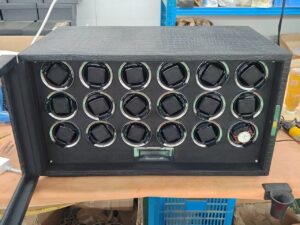
Discover the Twing-Pak Watch Winder + Storage Kit: Japanese silent motors, customizable TPD (turns per day), and protective casing to shield from daily hazards. it’s a one-stop fix for power issues and beyond. At [Twing-Pak] and say goodbye to manual hassles—your watches stay wound, reset-free, and ready to wear.
Conclusion: Troubleshoot Common Mechanical Watch Problems Like a Pro
From a slow-running mechanical watch due to low power or magnetization to resetting the date effortlessly, addressing these common problems keeps your timepiece performing at its best. Regular checks and tools like a watch winder prevent most issues, ensuring accuracy and longevity.
Facing persistent glitches? Our Twing-Pak kits offer all-in-one science-backed solutions for power and storage woes. Visit [Twing-Pak] for expert picks, or drop a comment below—what’s your biggest mechanical watch headache? Let’s solve it together!