In the global jewelry market, packaging has evolved from a protective necessity into a strategic brand asset. For professional buyers, retailers, and private-label operators, selecting the right manufacturing partner is no longer only about unit cost; it is about speed to market, customization capability, quality consistency, and supply chain resilience. This is why a Guangzhou Jewelry Box Source Factory has become an increasingly important solution for brands seeking OEM customization with greater control over design, production, and commercial outcomes.
Guangzhou has long been recognized as one of China’s most dynamic manufacturing and export hubs, supported by mature supplier networks, logistics infrastructure, and skilled labor in packaging, leather processing, printing, and decorative finishing. Within this ecosystem, source factories that specialize in Jewelry Boxes are well positioned to support brands that require differentiated packaging for rings, necklaces, bracelets, watches, and gift sets. More importantly, they can provide OEM solutions that align product presentation with target market expectations, helping jewelry businesses strengthen both customer experience and perceived value.
This article examines how a Guangzhou-based source factory supports brand OEM customization, what capabilities professional buyers should evaluate, and why packaging development should be integrated into a broader brand strategy. It also includes practical implementation recommendations, a real-world style application scenario, and fictionalized client cooperation cases to illustrate how packaging partnerships can influence commercial performance.
The Strategic Value of OEM Jewelry Packaging in Modern Brand Building
For jewelry brands, packaging is not an isolated accessory. It contributes directly to product positioning, unboxing experience, retail display efficiency, gift suitability, and social-media visibility. In premium and mid-to-high-end segments, customers often interpret packaging quality as an extension of jewelry craftsmanship. If the box feels generic, fragile, or visually inconsistent with the brand, it can weaken perceived value even when the jewelry itself is well designed.
OEM customization allows brands to tailor dimensions, materials, internal structures, colors, logos, textures, and accessories according to their market strategy. Instead of purchasing generic Jewelry Boxes, companies can create packaging systems that match product categories, regional preferences, and price tiers. This is especially relevant for brands that operate across e-commerce, wholesale, boutique retail, and gifting channels, where packaging requirements vary significantly.
A capable Guangzhou Jewelry Box Source Factory can support this process with integrated development resources. These often include design consultation, material sampling, prototype production, logo application testing, structural engineering, and bulk manufacturing. The result is a more efficient pathway from concept to commercial launch, reducing coordination costs that would otherwise arise if sourcing were fragmented across multiple vendors.
Why Guangzhou Is a Competitive Manufacturing Base for Jewelry Packaging
Guangzhou’s advantage lies in industrial clustering. A source factory located in this region can access surrounding suppliers for paperboard, PU leather, velvet, microfiber, hardware, magnets, ribbons, printing foils, and decorative accessories with relatively short lead times. This concentration of upstream resources improves responsiveness during OEM development, particularly when brands request sample revisions or material substitutions.
Another advantage is production flexibility. Many professional buyers need a supplier that can handle both standardized production and semi-custom or fully customized orders. A Guangzhou Jewelry Box Source Factory often supports this through modular production systems, combining standard box structures with custom finishes, inserts, or branding elements. This approach helps brands balance originality with cost efficiency.
Logistics is also a material consideration. Guangzhou’s export infrastructure supports sea freight, air freight, and courier distribution, making it suitable for international buyers managing seasonal launches or replenishment cycles. When lead time compression is important, a source factory with mature project management can shorten development cycles and improve delivery predictability.
Core OEM Customization Capabilities That Brands Should Evaluate
Not all packaging manufacturers offer the same level of OEM competence. For professional sourcing teams, evaluating a factory requires attention to both visible product quality and less visible operational systems.
Material Development and Finish Selection
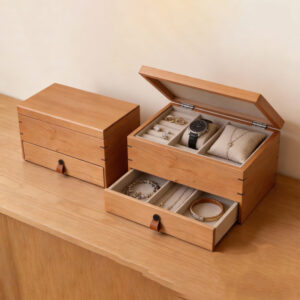
Material choice determines both visual impact and functional performance. Common options include rigid paperboard, coated paper, suede lining, flocked foam, microfiber, velvet, and synthetic leather. For brands positioned in the premium segment, Jewelry Box-Leather solutions are particularly attractive because they offer a refined tactile experience and strong compatibility with luxury retail presentation.
A professional Guangzhou Jewelry Box Source Factory should be able to explain the trade-offs among material types, including abrasion resistance, color stability, moisture response, logo adhesion suitability, and target price impact. In high-volume programs, material standardization across product families can also improve cost control while maintaining brand consistency.
Structural Engineering and Product Fit
The internal structure of Jewelry Boxes must be aligned with the geometry, weight, and fragility of the jewelry item. Ring slots, necklace hooks, pendant recesses, bracelet cushions, and removable trays all affect usability and presentation. Inadequate fit can result in movement, scratching, or poor visual alignment during display and shipping.
Factories with stronger OEM capacity usually provide insert engineering support. This is particularly important for brands offering multiple SKUs under one packaging family. Well-designed structural systems can reduce the number of unique box molds required and improve inventory efficiency without compromising product appearance.
Branding Techniques and Visual Consistency
Logo presentation is central to OEM customization. Common applications include hot stamping, silk-screen printing, debossing, embossing, metal plate attachment, and UV printing. The correct method depends on substrate compatibility, brand guidelines, and target market expectations. A reliable Guangzhou Jewelry Box Source Factory should be able to recommend branding solutions that maintain clarity and durability across different material surfaces.
Color matching is equally important. Professional brands often require Pantone consistency across packaging, shopping bags, tissue paper, and inserts. This demands controlled sampling and process discipline, especially for international orders where visual inconsistency can affect brand trust.
Display Integration Beyond the Box
OEM customization increasingly extends beyond closed packaging into retail presentation tools. For example, a coordinated Jewelry Stand can complement box packaging in boutiques, exhibitions, and pop-up retail environments. When product packaging and display accessories are developed together, the brand experience becomes more coherent, improving merchandising impact and customer recall.
For wholesalers and chain retailers, combining Jewelry Boxes with a matching Jewelry Stand can also simplify visual merchandising standards across multiple locations. This creates operational efficiency while reinforcing premium brand perception.
How a Source Factory Supports the OEM Process from Brief to Delivery
The OEM process is most effective when the factory acts not only as a producer but also as a development partner. In practice, the workflow generally begins with a technical and commercial briefing. The brand provides product dimensions, positioning requirements, target price range, order quantity, preferred materials, logo artwork, and market application scenarios. The Guangzhou Jewelry Box Source Factory then translates this information into structure proposals, finish recommendations, and prototype options.
The sampling stage is especially important. At this phase, experienced factories test material combinations, logo effects, insert tolerances, and opening/closing mechanisms. Brands should assess samples not only for appearance but also for stacking efficiency, shipping durability, and usability in retail or customer gifting contexts.
Once the sample is confirmed, pre-production controls become critical. These include final specification approval, color standard definition, packaging method confirmation, and quality checkpoint setting. A factory that can manage these details systematically will reduce the risk of production deviation and rework.
For international clients, communication clarity is a major determinant of OEM success. Many buyers therefore review the supplier’s about-us information to evaluate business background, production specialization, and service orientation before initiating a long-term project. Strong documentation, clear quotation structures, and responsive project management often indicate a more dependable manufacturing partner.
Practical Application Case: Launch Packaging for a Mid-Premium DTC Jewelry Brand
Consider a direct-to-consumer jewelry brand preparing to launch a new collection of engagement rings, everyday necklaces, and gift-ready bracelets in North America and Europe. The company’s objective is to strengthen perceived quality while maintaining packaging costs within a disciplined margin framework. Rather than buying generic Jewelry Boxes, the brand works with a Guangzhou Jewelry Box Source Factory to develop a tiered packaging system.
For engagement products, the factory proposes a rigid Jewelry Box-Leather format with a soft-touch exterior, magnetic closure, and custom ring insert. For everyday necklaces, it develops a lighter rigid paper box with anti-tangle insert engineering. For bracelets intended for gifting campaigns, it adds ribbon detailing and optional sleeve customization for holiday promotions. A coordinated Jewelry Stand is also produced for retail events and photography styling.
After launch, the brand observes several operational benefits. Product photography becomes more standardized, customer unboxing feedback improves, and wholesale partners report better shelf presentation. Return rates related to packaging damage decline because inserts are engineered to limit movement during transit. This example demonstrates that OEM packaging is not purely aesthetic; it can influence brand communication, logistics performance, and channel effectiveness simultaneously.
Boutique Brand Expansion Through Structured OEM Packaging
European boutique label, Liora Atelier, sought to enter Asian and Middle Eastern markets with a more premium visual identity. Its previous packaging relied on stock boxes purchased from multiple trading companies, resulting in color inconsistency and uneven product fit. The company selected a Guangzhou Jewelry Box Source Factory after reviewing its about-us profile, sample capabilities, and export communication process.
The factory redesigned Liora Atelier’s packaging architecture around three core formats: ring boxes, necklace boxes, and multi-item gift sets. It recommended a unified material language using matte exterior finishes, metallic logo stamping, and velvet inserts. For the high-end collection, it introduced a Jewelry Box-Leather series to enhance tactile quality and align with luxury price positioning. Matching Jewelry Stand accessories were developed for showroom use.
Within two seasonal cycles, the fictional brand reported stronger visual consistency across channels, improved retailer presentation, and more favorable customer feedback on gifting suitability. Although packaging cost per unit increased moderately, average order value improved because the upgraded presentation justified premium product bundles. This case illustrates how a Guangzhou Jewelry Box Source Factory can support not only manufacturing but also strategic repositioning.
OEM Efficiency for a High-Volume Promotional Program
Aurora Sterling, a corporate gifting supplier serving luxury department stores and event organizers. The company needed 50,000 units of customized Jewelry Boxes for a co-branded holiday campaign across several countries. The primary challenges were compressed lead times, strict logo compliance, and the need for a cost-controlled packaging format that still looked premium.
The Guangzhou Jewelry Box Source Factory proposed a semi-custom structure using a standard rigid base with customized sleeves, inserts, and foil branding. This reduced tooling complexity while preserving campaign identity. To support physical merchandising, a compact Jewelry Stand format was also supplied for countertop displays. The factory’s project team coordinated sample approval, pilot production, and batch scheduling to align with the campaign calendar.
The program was completed within the required timeline, and the fictional client recorded smoother rollout execution across participating stores. The case demonstrates an important sourcing principle: OEM customization does not always require fully bespoke structures. In many situations, the most effective solution is a hybrid model that combines standardization with selective customization.
Implementation Recommendations for Brands Seeking OEM Customization
Brands that plan to work with a Guangzhou Jewelry Box Source Factory should adopt a structured sourcing and development approach. The following recommendations are especially relevant for professional procurement, product development, and brand management teams:
- Define packaging objectives clearly. Determine whether the primary goal is luxury positioning, shipping protection, retail display enhancement, sustainability improvement, or margin optimization.
- Segment packaging by product line. Not every SKU needs the same box structure. Use premium formats such as Jewelry Box-Leather where perceived value impact is highest.
- Prepare complete technical briefs. Include product dimensions, target market, branding guidelines, unit budget, quantity forecasts, and channel-specific requirements.
- Request prototypes before volume commitment. Evaluate visual quality, tactile performance, fit precision, and transport suitability under real operating conditions.
- Consider display as part of the packaging system. A matching Jewelry Stand can improve merchandising efficiency and strengthen brand storytelling.
- Review supplier positioning carefully. The factory’s about-us information, service responsiveness, and sample quality often reveal whether it can support long-term OEM collaboration.
- Balance customization with scalability. Excessive complexity can raise cost and slow replenishment. Modular design thinking often creates better long-term economics.
Key Risks to Avoid in OEM Jewelry Packaging Projects
Despite the advantages, OEM packaging projects can fail when brands underestimate execution complexity. One common mistake is focusing exclusively on appearance while neglecting structural reliability. Elegant Jewelry Boxes that do not protect products during shipment can generate returns and customer dissatisfaction.
Another risk is over-customization without demand validation. Bespoke forms, special hardware, and highly specific materials may look impressive at sample stage but create procurement and inventory burdens at scale. A seasoned Guangzhou Jewelry Box Source Factory should be able to advise clients when a simpler design can achieve similar market impact with better operational efficiency.
Brands should also be careful about inconsistent communication during artwork approval and color confirmation. Even small mismatches in logo placement or material finish can become significant issues in international retail environments. Structured documentation and pre-production approval are therefore indispensable.
Conclusion
A Guangzhou Jewelry Box Source Factory offers more than manufacturing capacity; it provides an integrated platform for OEM packaging development that can support branding, product protection, retail presentation, and operational scalability. For professional jewelry businesses, customized packaging should be treated as a strategic investment rather than a secondary procurement item. When designed and executed properly, it contributes to stronger perceived value, better merchandising outcomes, and more resilient supply chain performance.
Whether a brand requires premium Jewelry Boxes, refined Jewelry Box-Leather solutions, or coordinated retail accessories such as a Jewelry Stand, the right OEM partner in Guangzhou can convert packaging from a cost center into a measurable brand asset. The most effective strategy is to combine clear technical briefs, disciplined sampling, modular customization, and long-term supplier collaboration. Under these conditions, OEM packaging becomes a practical engine for brand growth, not merely a container for the product.
FAQ
What distinguishes a source factory from a trading company in jewelry packaging?
A source factory typically manages direct production and often provides better control over sampling, material selection, quality consistency, and lead time coordination. For OEM projects, this can improve communication efficiency and reduce the risk of specification gaps.
When should a brand choose Jewelry Box-Leather over other materials?
Jewelry Box-Leather is particularly suitable for premium collections, formal gifting programs, and luxury retail settings where tactile quality and visual refinement significantly influence purchase perception.
Can Jewelry Boxes and Jewelry Stand products be developed together in one OEM project?
Yes. Many brands benefit from developing Jewelry Boxes and a matching Jewelry Stand together so that packaging and retail display maintain a unified design language across customer touchpoints.
How can buyers assess whether a Guangzhou Jewelry Box Source Factory is suitable for long-term cooperation?
Buyers should review sample quality, communication responsiveness, OEM development ability, production consistency, and company background information such as the supplier’s about-us page. Pilot orders are also useful for validating real operating performance before scaling up.