
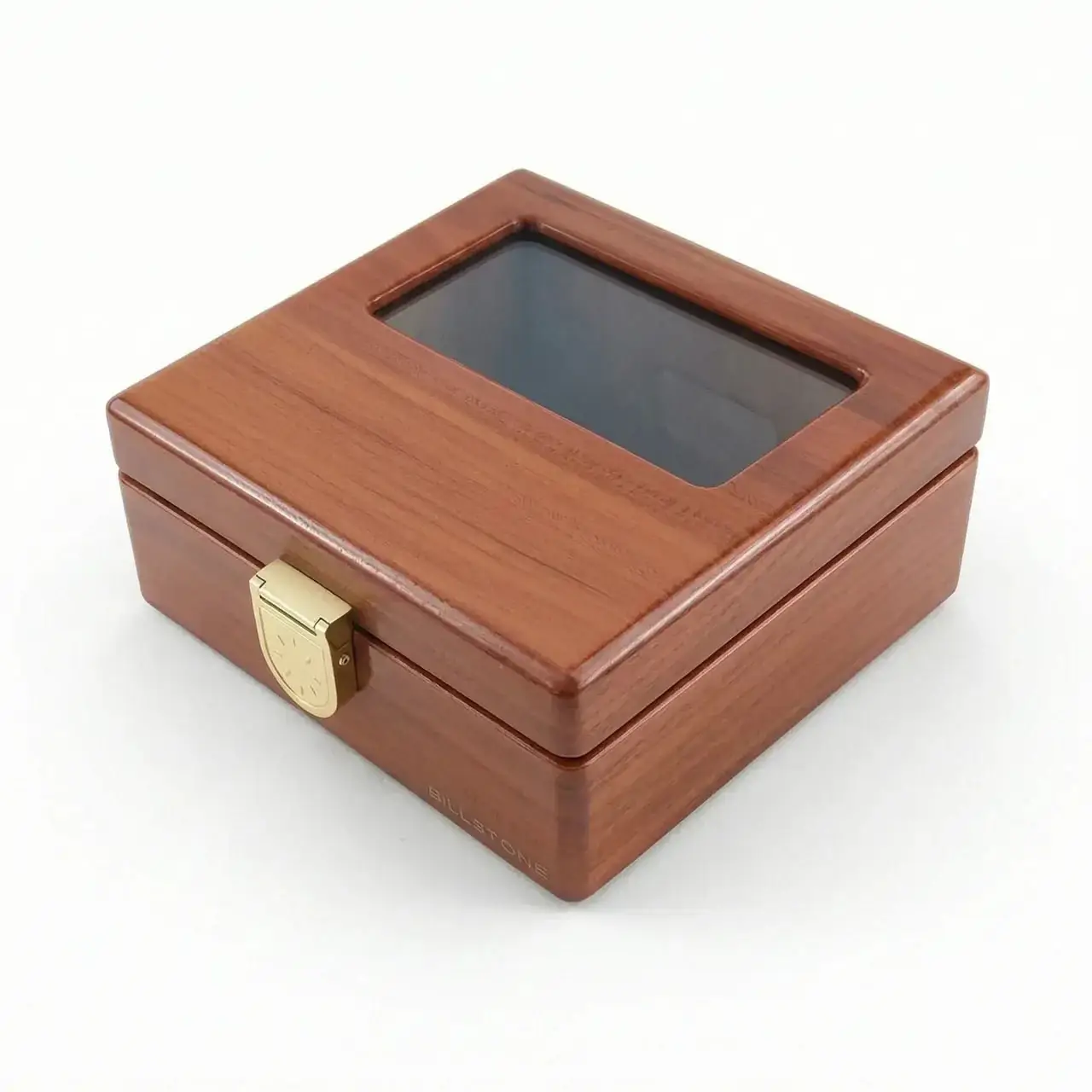
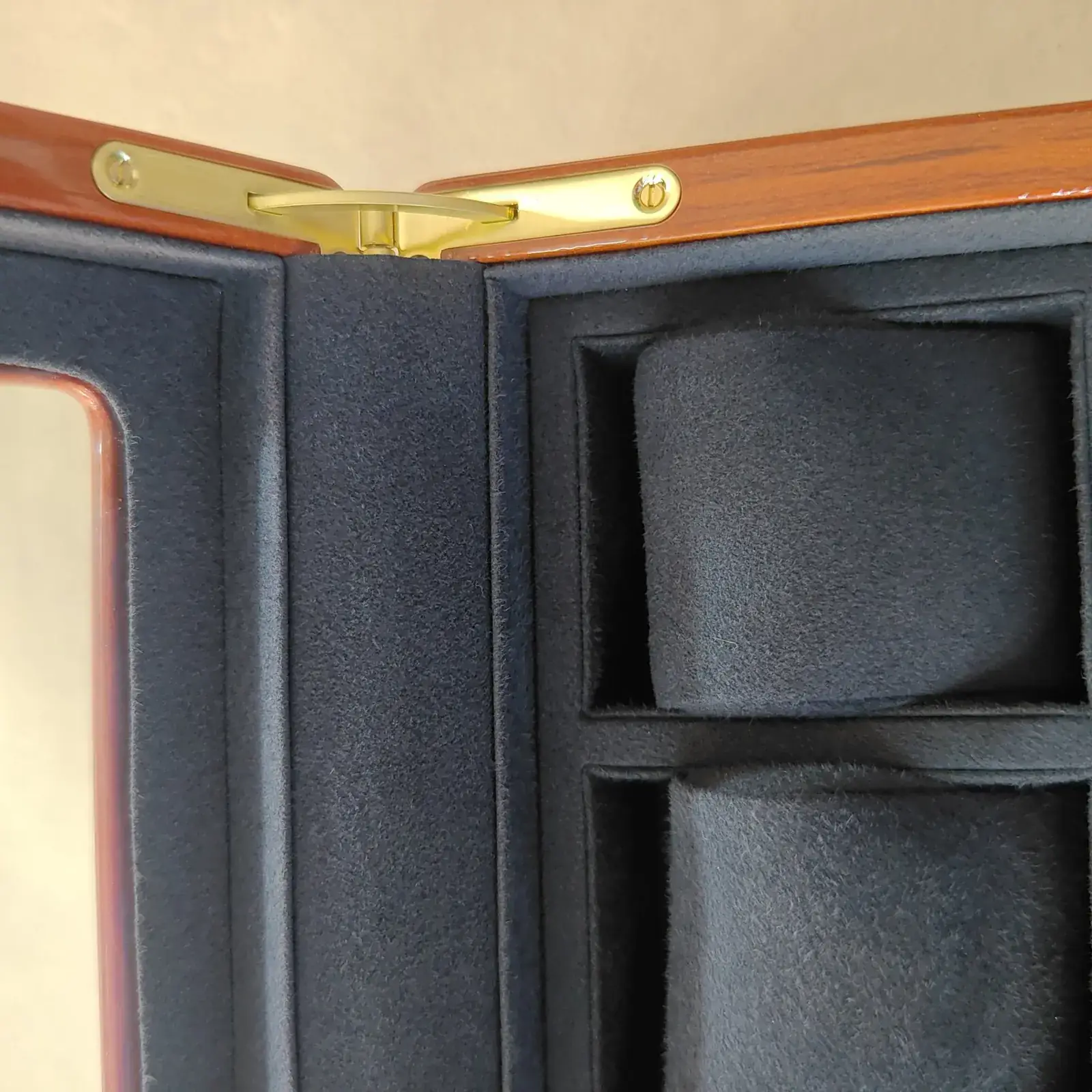
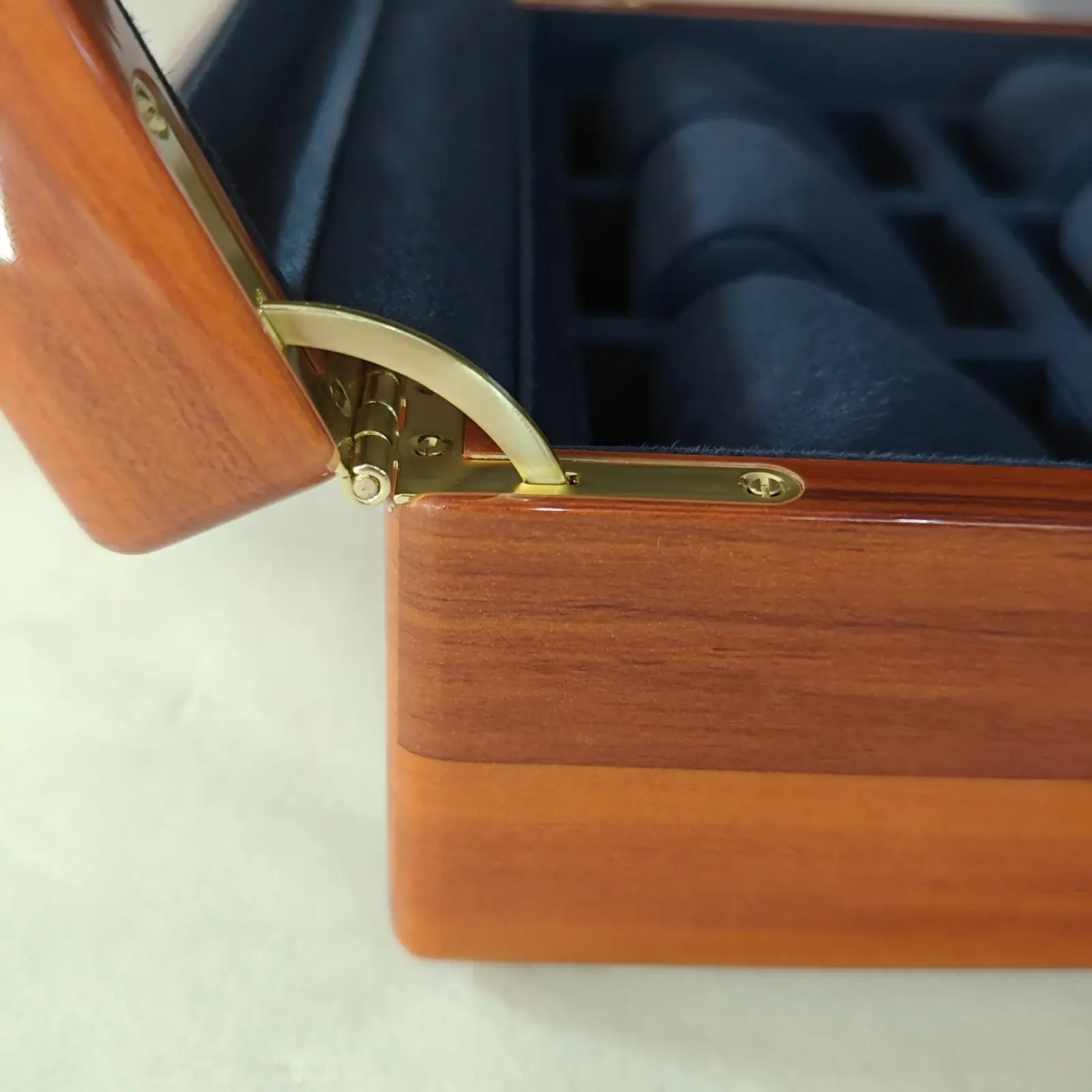
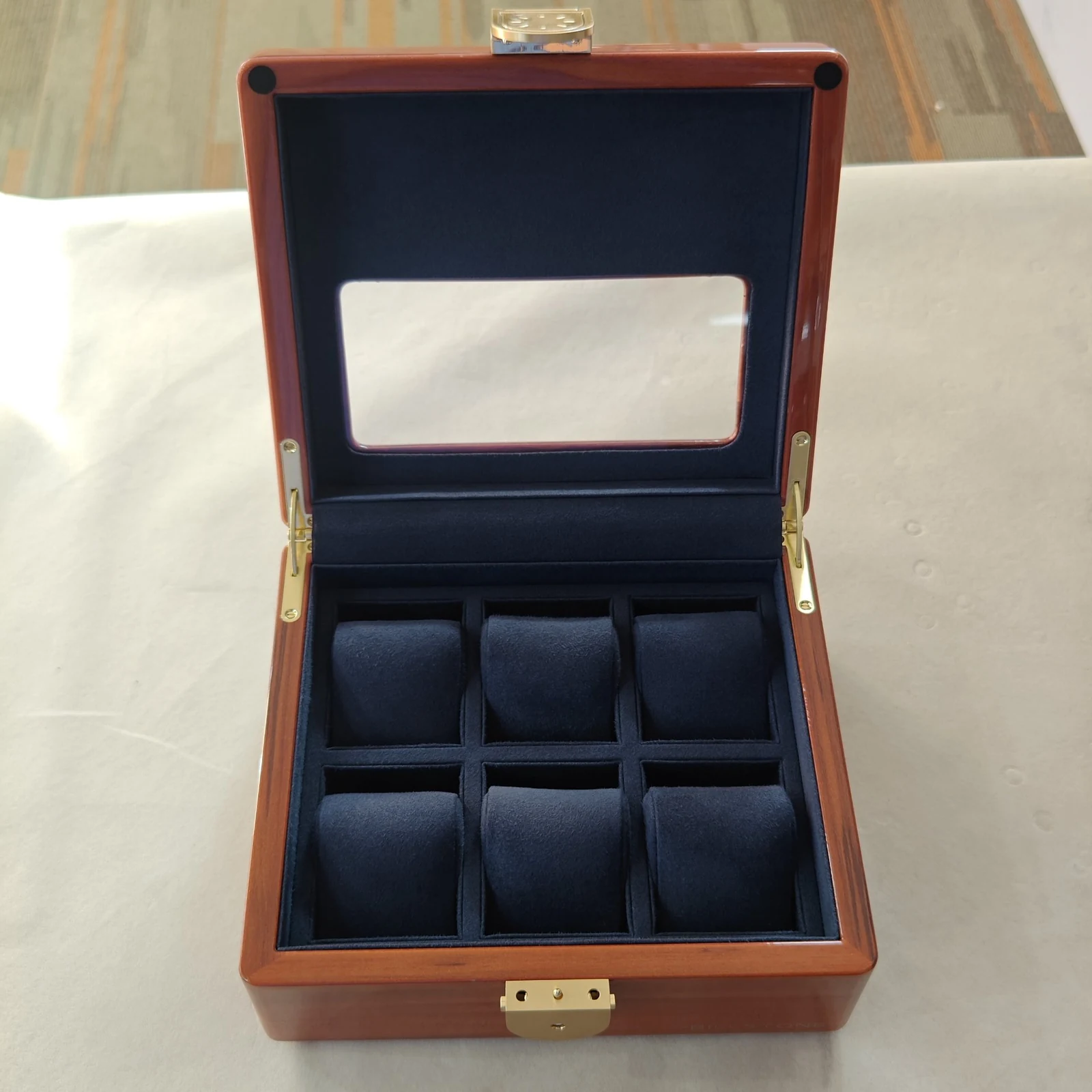
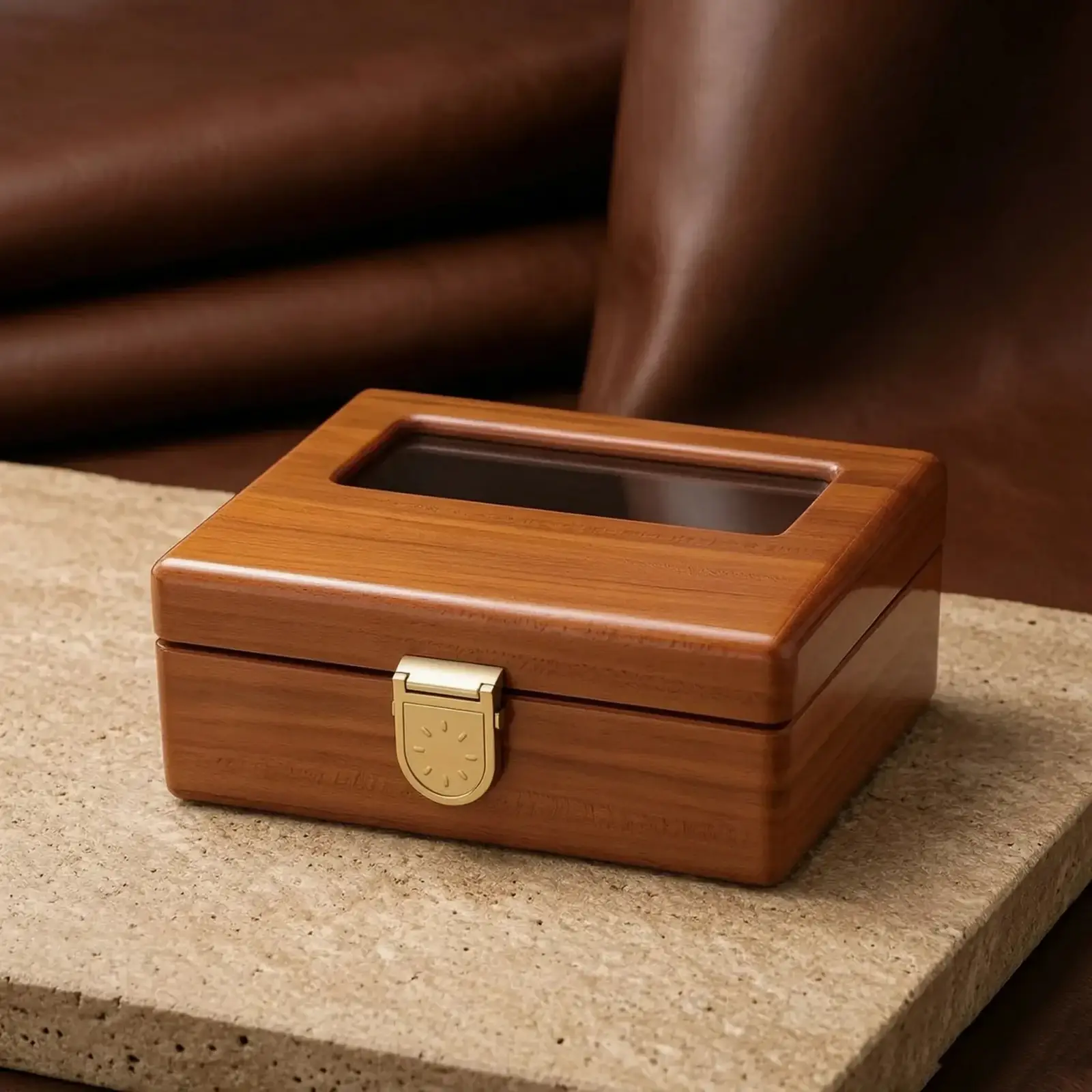
This wooden watch box holds six watches in a rosewood case finished in a deep, high-gloss lacquer, with a glass viewing window and a mirror set into the lid, six navy suede cushions in a 2 x 3 layout, and polished brass hinges and clasp. It is produced by T.WING-PAK, a packaging manufacturer in Nansha, Guangzhou with more than 19 years of export production, and it is available for OEM and ODM programmes from 50 to 100 pieces with your own finish, lining and branding. For a collector it solves the everyday problem of six watches living in a drawer; for a brand it is a presentation case that stays in use long after the purchase.
What this wooden watch box is for
Watches kept loose in a drawer pick up the marks that devalue them: bracelet links scuffing case backs, crowns catching on other pieces, dust settling into the clasp. The this wooden watch box gives every piece its own watch slot on a soft cushion, so nothing touches anything else and the collection stays presentable between wears.
The usual reason a watch loses condition is not wear, it is storage – pieces knocking together in a drawer, dust working into bracelets, straps creased from being coiled. This watch box allocates six watch slots with a cushion per piece, which keeps cases apart and lets a collection be seen at a glance instead of hunted through.
Design details
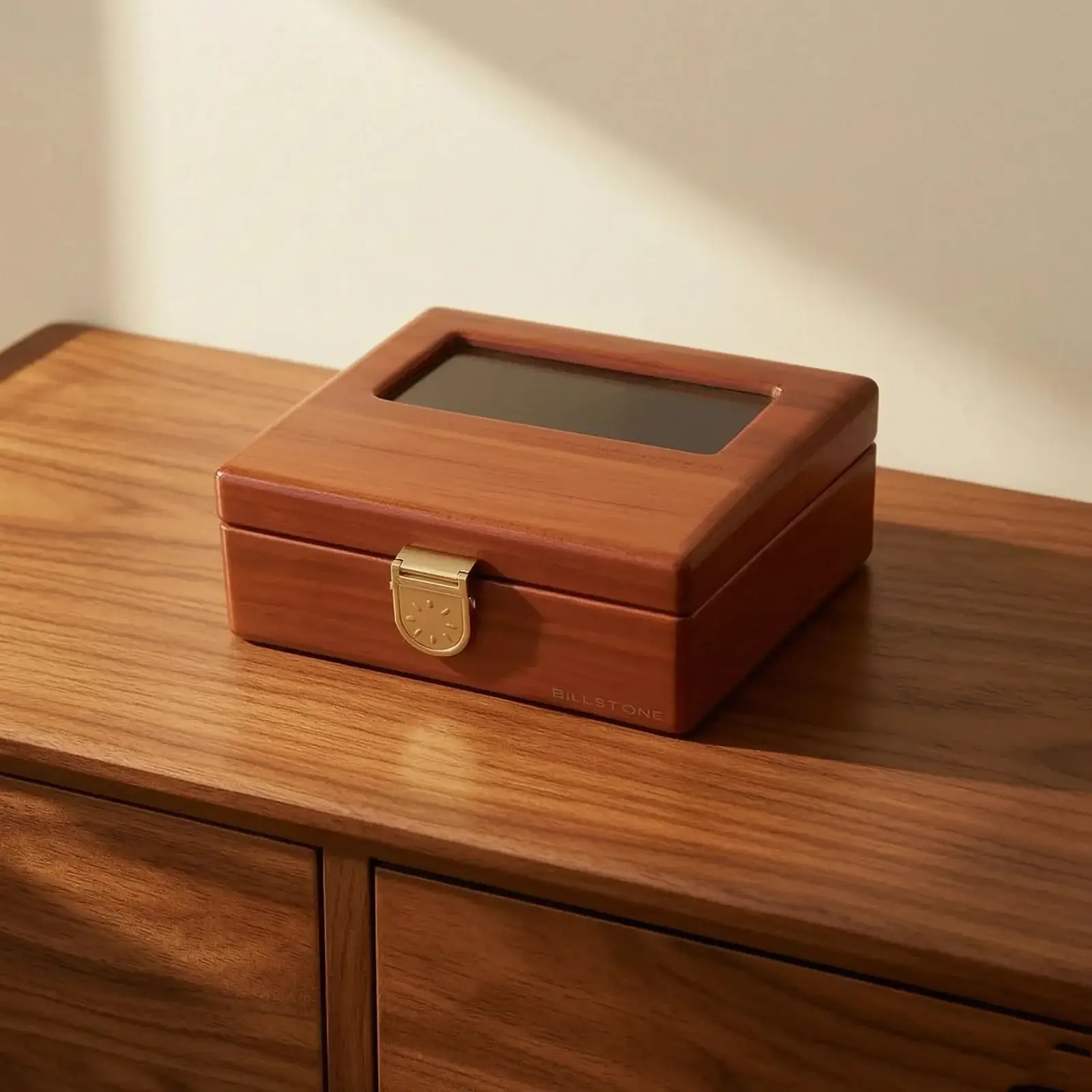
- Glass viewing window set into the lid, so the collection is visible without opening the box.
- Full-width mirror fitted into the underside of the lid.
- Six watch cushions arranged in a 2 x 3 layout, each seated in its own suede-lined bay.
- Deep navy suede lining across the lid interior, cushion wells and base.
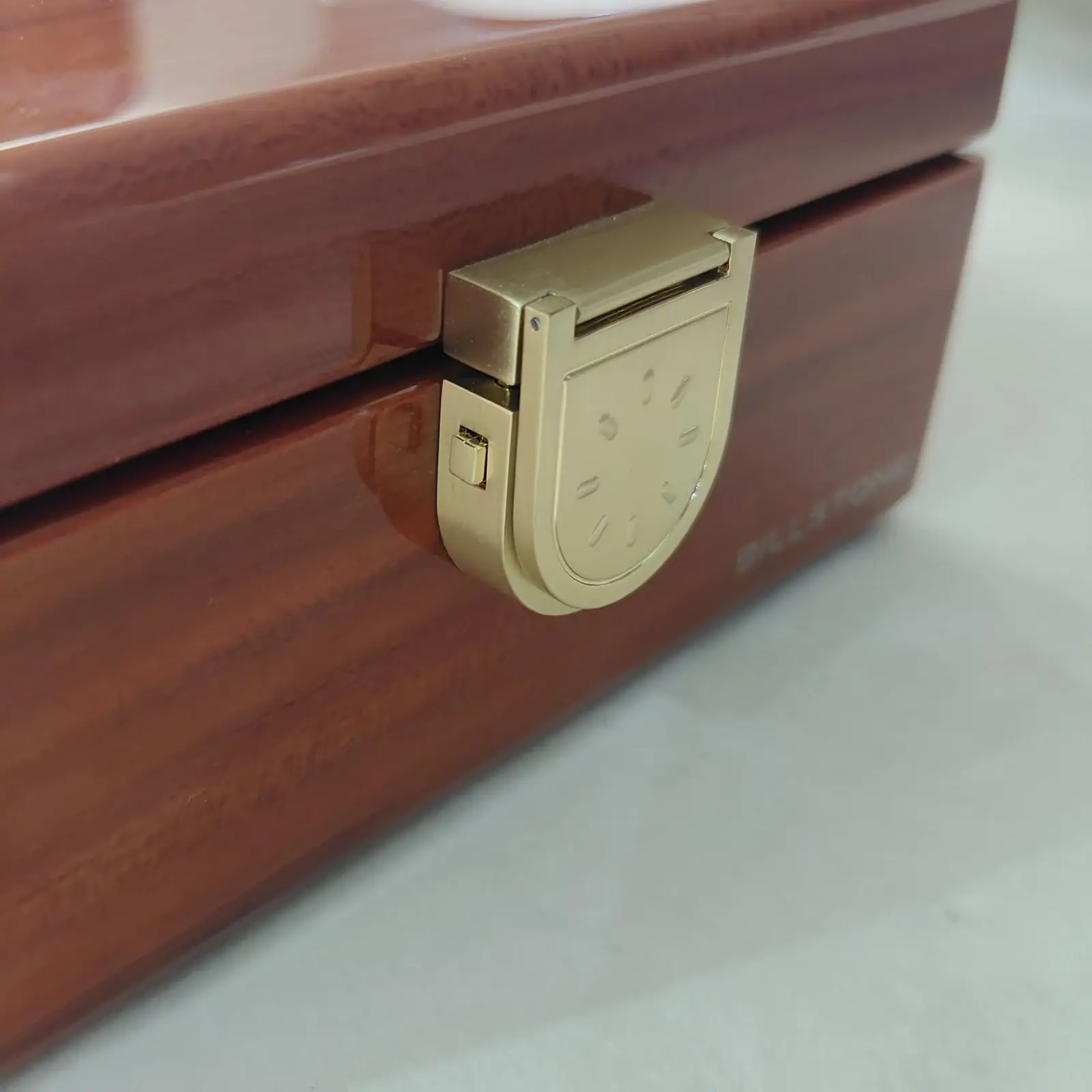
- Polished brass clasp on the front, with a flat face suited to logo engraving on OEM orders.
- Brass lid hinges that hold the lid open at a stable angle while pieces are being selected.
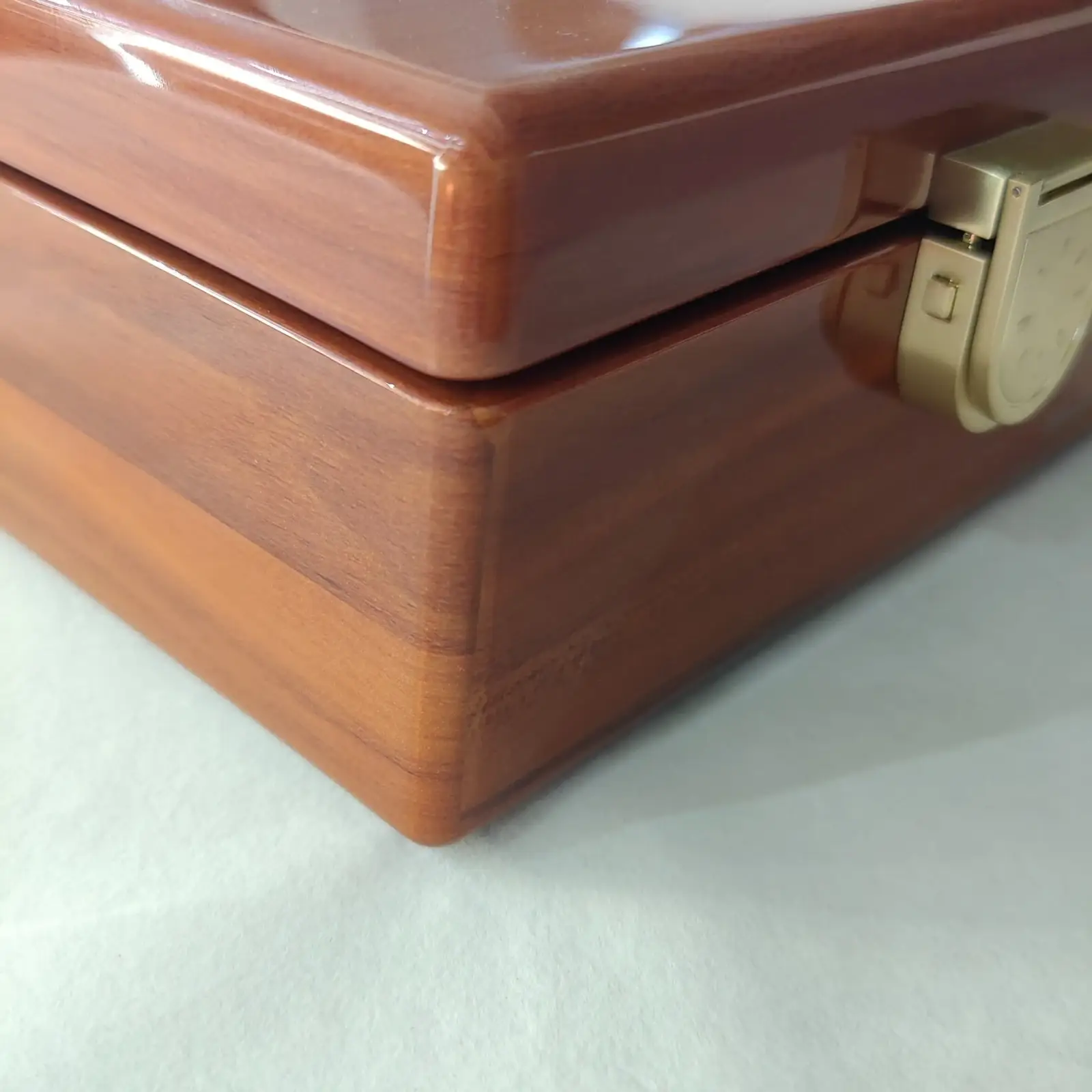
- Two-tone rosewood body – a deeper tone on the lid and a lighter band around the base.
- High-gloss piano-style lacquer over the wood, wiped clean with a dry cloth.
Wooden watch box specifications
| Specification | Detail |
|---|---|
| Product type | Wooden watch box for 6 watches |
| Capacity | 6 watch slots (2 x 3 cushion layout) |
| Exterior | Rosewood-tone wood with high-gloss piano-style lacquer, two-tone body |
| Lid | Glass viewing window, full-width interior mirror, brass clasp |
| Interior | Navy suede lining, 6 removable watch cushions |
| Hardware | Polished brass hinges and clasp |
| Branding options | Hot foil, screen print, laser engraving or metal plate on the clasp |
| OEM minimum order quantity | 50 to 100 pieces, depending on finish and customisation |
| Sample lead time | 7 days |
| Bulk production lead time | 20 to 30 days from sample approval |
Material, finish and build
Construction is conventional and deliberate: a rigid engineered-wood carcass chosen because it stays flat where solid timber can move, a surface finish applied in stages, and an interior lined and fitted to the layout rather than loosely glued. Hinges and closures are checked at assembly, and units are packed so the finish the brand photographs is the finish that arrives.
Packaging decisions are commercial decisions. The global jewelry market alone generated an estimated USD 388.9 billion in revenue in 2025, with China, India and the United States as the three largest markets (Statista Market Insights). In a market that size, the box is one of the few things a brand fully controls – and unlike the product inside it, the box stays on the customer’s dresser.
Who this 6 watch box suits
This is for a growing collection that has outgrown a drawer: Six watch slots gives room for daily pieces alongside the ones worn a few times a year. It also works as retail presentation, since a customer can see the whole range without handling each piece. Collectors who need rotation as well as storage should look at a winder instead.
Suited to collectors who want their pieces visible and separated, and to retailers showing a range on the counter. With six watch slots it holds a working collection rather than a single watch. It stores – it does not wind – which is the honest distinction to make against a winder.
Where and how it is used
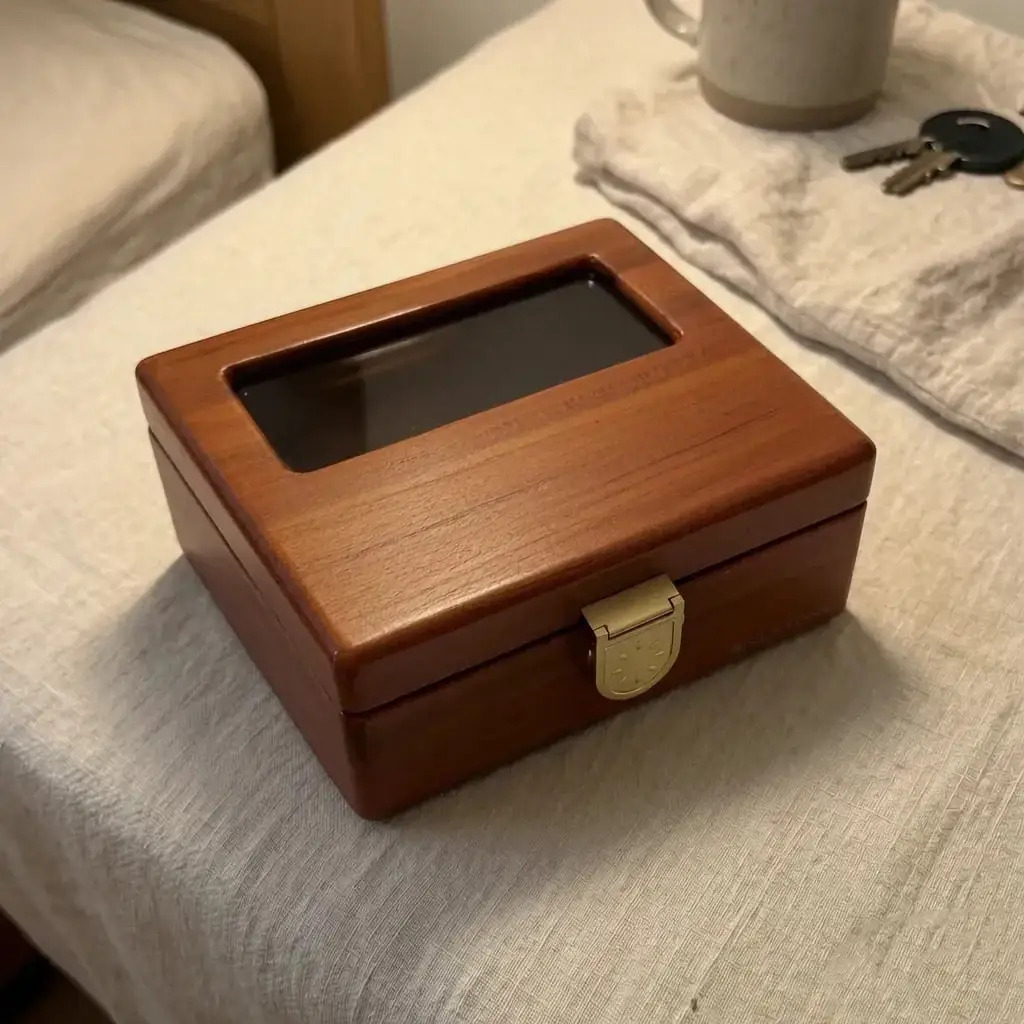
Keep it on a dresser, a shelf or inside a safe where it can be opened flat. Give it a dry spot out of direct sun, and fasten each watch on its cushion rather than laying it loose, so bracelets do not drag across the lining. A quick dry-cloth wipe of the exterior is enough to keep it presentable.
Place it where the lid can open fully, away from prolonged sunlight that can shift wood tone or fade lining colour. Store each piece closed on its cushion, heavier bracelets supported rather than hanging. If it goes into a safe, the closed lid keeps dust off the pieces between openings.
Care is simple: dust with a dry microfibre cloth, keep the piece out of prolonged direct sunlight, and avoid solvent cleaners on lacquered or lined surfaces. Wipe the interior occasionally and let anything damp dry fully before it goes back inside.
Presentation, gifting and brand programmes
Two things decide whether a presentation box earns its cost: whether the customer keeps it, and whether it survives the journey. This case is built for both. The rigid shell takes the knocks that a paperboard carton cannot, and the lined interior means the box stays in service on a dresser or in a wardrobe instead of going into recycling – which is the part that keeps a brand visible after the sale. For gift programmes it also removes a step: the outer box and the product arrive as one unit, so nothing has to be re-wrapped before it is handed over.
A box that gets thrown away is a cost; one that stays on a shelf is advertising. This one is specified with the second outcome in mind – rigid enough to protect the contents in transit, and finished well enough that the recipient keeps using it. For brands running gift-with-purchase or seasonal programmes, that is the practical argument for spending on the case rather than treating it as packing material.
What to settle before ordering
Four things are worth settling before an order goes in. The exterior finish and the substrate beneath it, since that drives both the look and the unit cost. The lining material and colour, which is what the customer touches every time. The interior layout – cushion count, compartment divisions, insert shape – because that is the part that has to fit the product rather than the other way round. And the branding method, since foil, print, engraving and metal plates behave differently on different surfaces. All four are confirmed on the 7-day sample rather than assumed from a drawing.
OEM and ODM customisation
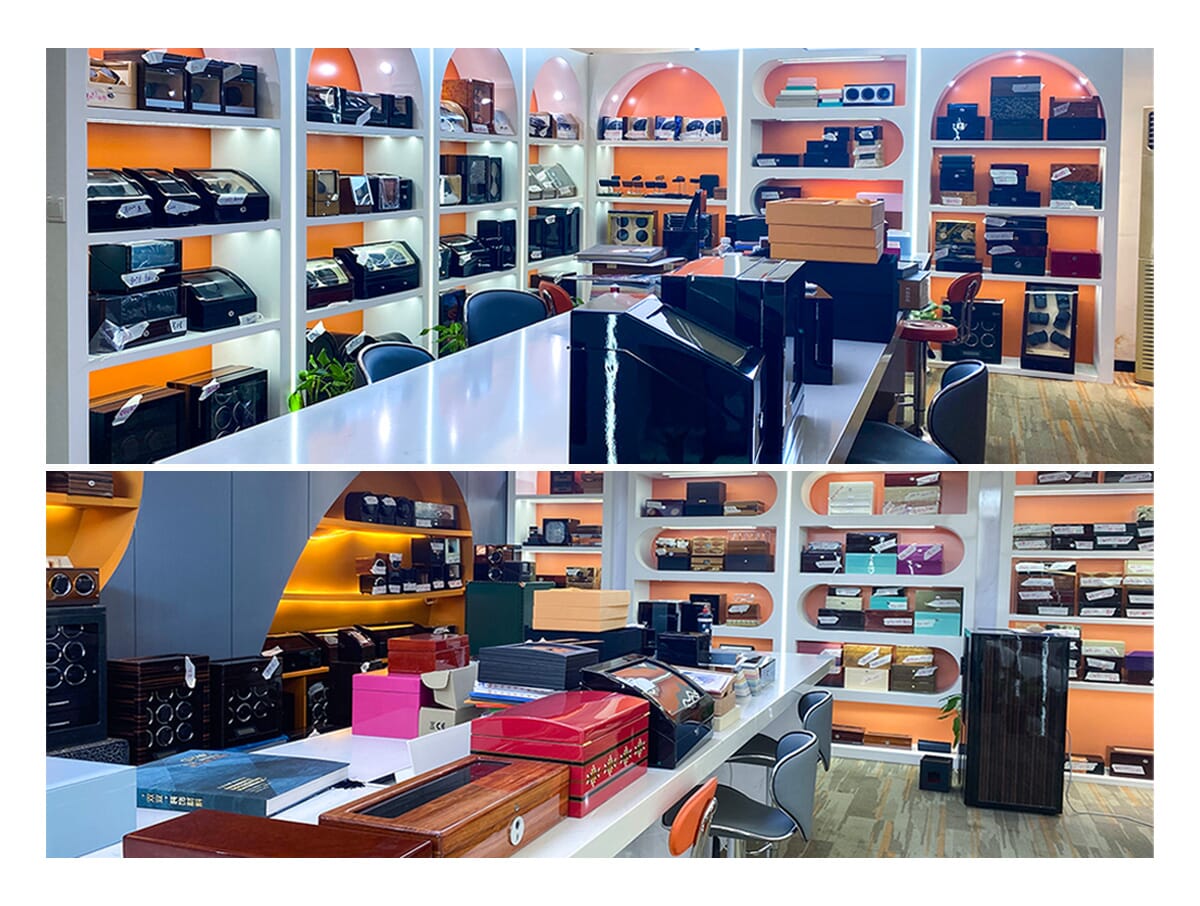
T.WING-PAK builds this line in Nansha, Guangzhou, on equipment that also runs OEM and ODM programmes. Exterior finish, wood species under the lacquer, lining material and colour, and cushion or insert geometry can all be specified, and branding can be applied by hot foil, screen print, laser engraving or a fitted metal plate. Matching retail packaging – rigid box, insert and print – is produced in the same facility, so the outer carton and the case are developed together. Minimum order quantity is 50 to 100 pieces depending on the finish and the level of customisation, a sample is produced in 7 days, and bulk production takes 20 to 30 days from sample approval.
Packaging and shipping
Units are packed individually, with the exterior surfaces protected and the interior supported so nothing shifts inside the carton. Export cartons are specified to the order, and for branded programmes the retail box, insert and print can be developed in the same facility, so the shipping carton and the presentation box are designed together rather than bought separately.
Frequently asked questions
Does the wooden watch box hold large watches?
The cushions are compressible and take the usual range of wristwatches, including larger sports cases and metal bracelets. Fit matters more than raw size: each watch should sit snugly on its cushion so it cannot shift when the box is moved. Unusual sizes – very small vintage cases or oversized pilot watches – can be accommodated with a different cushion on OEM orders.
Can the interior be changed to hold jewellery instead of watches?
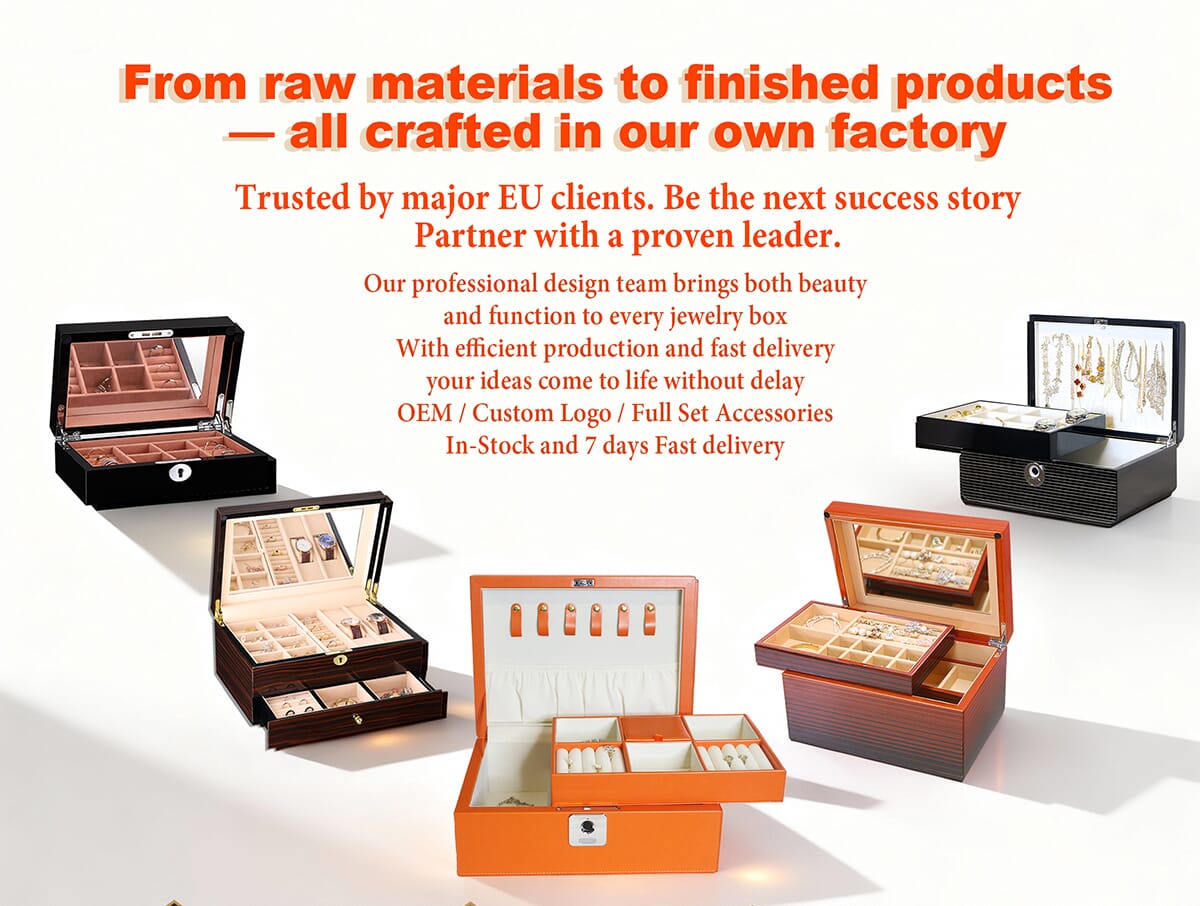
Yes. The cushion layout and the compartment geometry are engineered per order, so the interior can be converted to ring rolls, pendant compartments or a mixed layout. Changes are confirmed on a 7-day sample before bulk production, so the layout is signed off on the actual product.
Can I add my logo to the box?
The flat brass clasp face is the natural position for a logo, and hot foil stamping, laser engraving, screen printing and metal plates are all available. Position and artwork are confirmed on the pre-production sample, so the branding is approved on the real surface rather than a drawing.
How should the lacquered surface be cleaned?
A dry microfibre cloth is all the lacquer needs. Avoid solvents, alcohol wipes and household sprays, which can dull a polished finish, and keep the box out of prolonged direct sunlight, which can shift wood tone over time. The suede interior can be brushed lightly to lift dust.
What are the terms for a bulk order?
Minimum order quantity is 50 to 100 pieces depending on the finish and the level of customisation. A sample is produced in 7 days, and bulk production takes 20 to 30 days from sample approval. Finish, lining colour, cushion layout and branding are all specified before the sample stage.
Bottom line
If you want packaging that customers keep rather than discard, this is a reasonable place to start: a rigid case, a lined and compartmented interior, and a specification you can adjust to your own range. Order a single unit to evaluate, or send T.WING-PAK your finish, lining and logo requirements for an OEM quotation – MOQ from 50 pieces, samples in 7 days, delivery in 20 to 30 days.


Reviews
There are no reviews yet.