Noise is the single most common reason watch winders are returned on Amazon, in boutiques, and to retailers. Not malfunctions. Not cosmetic defects. Noise.
A customer buys a watch winder to place in their bedroom — the same room where they sleep. If the winder can be heard from the other side of the room, it is going back. If the motor emits a high-pitched whine or a rhythmic clicking, it is going back. And every return is a negative review that depresses your listing’s conversion rate for months.
For retailers and B2B buyers, the noise specification in your product brief is not a technical nicety — it is a commercial protection measure.
This guide explains the acoustics of watch winder motors, why some winders are noisy and others are not, how to specify and test for noise, and what “under 25dB” actually means in practice.
The Physics of Watch Winder Motor Noise
A watch winder generates noise from three sources:
1. The motor itself. DC motors generate a characteristic electromagnetic hum at the operating frequency. At low speeds (watch winders turn slowly — typically 0.5–2 RPM at the rotor), quality motors are inaudible. Low-quality motors hum audibly at all speeds due to manufacturing tolerances in the rotor and stator assembly that allow for vibration.
2. The gear train. Most watch winder motors drive the rotor through a reduction gear train — a series of small plastic or nylon gears that reduce the motor’s native RPM (typically 5,000–15,000 RPM) down to the 0.5–2 RPM required at the winding rotor. Each gear mesh is a potential noise source. Cheap gear trains use injection-moulded plastic gears with poor dimensional consistency; quality gear trains use precision-moulded nylon or metal gears with consistent tooth profiles.
3. The housing resonance. The motor and gear train vibration is transmitted to the housing — the wooden box or leather exterior. If the motor is not decoupled from the housing (no vibration-isolating mount), the housing acts as a speaker, amplifying the motor noise. A well-designed watch winder mounts the motor module on vibration-isolating silicone feet or rubber isolators.
Most cheap watch winder noise comes from source 3: a technically quiet motor and gear train that is rigidly bolted to a resonant wooden housing. The housing vibrates, the vibration couples to the surface the winder sits on, and the entire nightstand becomes a sounding board.
What 25dB Actually Means
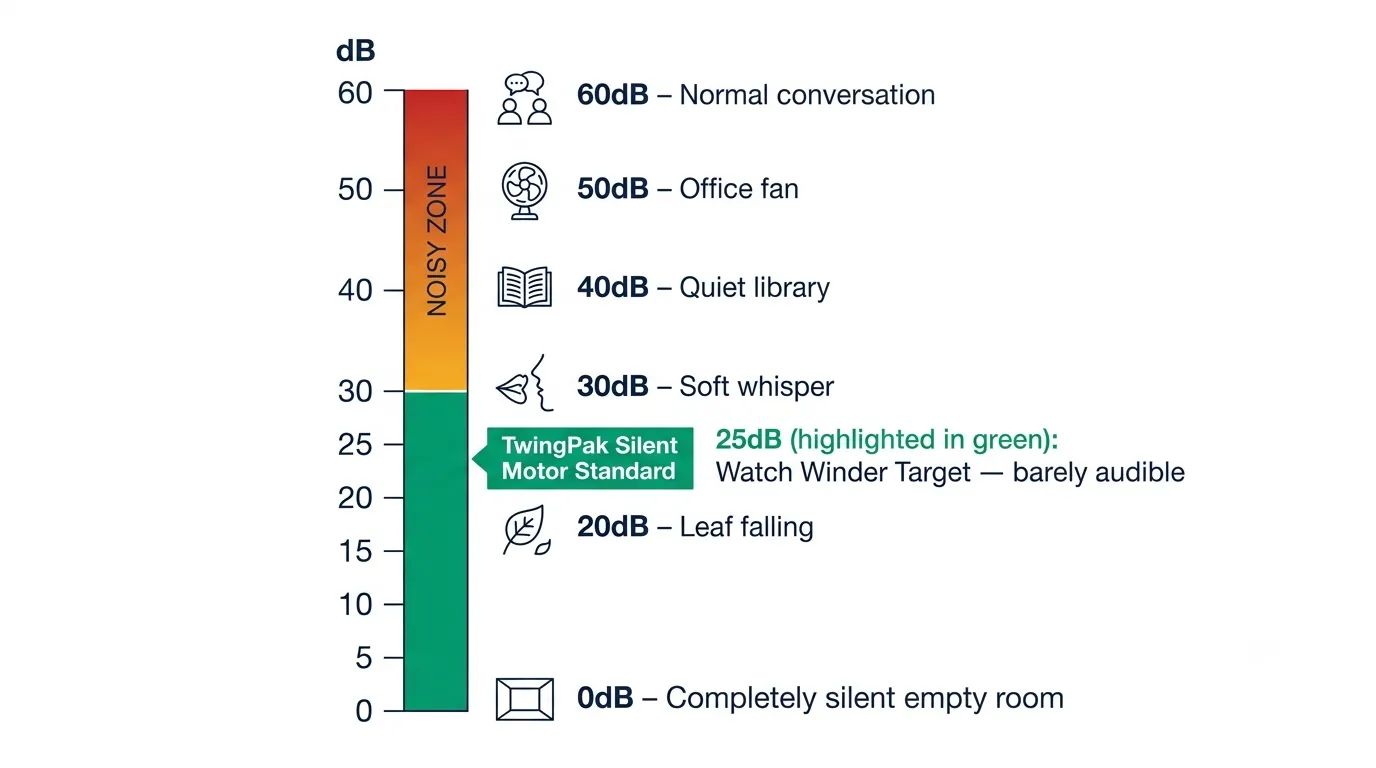
The decibel scale is logarithmic. Here are reference points:
| Decibel Level | Reference Sound | Perception |
|---|---|---|
| 0 dB | Threshold of hearing | Inaudible |
| 10 dB | Still air in anechoic chamber | Inaudible |
| 20 dB | Rustling leaves in calm conditions | Barely perceptible |
| 25 dB | Silent room, AC off, midnight | At the edge of perception |
| 30 dB | Quiet whisper at 1 metre | Audible |
| 40 dB | Library | Clearly audible |
| 50 dB | Quiet office, AC running | Comfortably audible conversation |
A watch winder operating at 25dB or below is at or below the ambient noise floor of a quiet bedroom with no HVAC running. In practice, it is inaudible to most people in normal sleeping conditions.
A watch winder operating at 35dB — which many generic products produce — is clearly audible in a silent room. At 40dB, it is as loud as a library environment.
The commercial implication: a product that tests above 30dB will receive noise complaints. A product above 35dB will receive a return rate significantly higher than category average.
Why Japanese Motors Are the Noise Benchmark
Japanese manufacturers — most relevantly Mabuchi Motor Co. Ltd. — produce DC gearmotors that are the industry benchmark for low-noise operation in watch winders. The Mabuchi advantage comes from:
Precision manufacturing: tighter tolerances on rotor shaft runout, armature balancing, and gear tooth profile. This reduces vibration at the source.
Quality materials: sintered metal bushings and precision nylon gears resist wear and maintain consistent meshing through tens of thousands of operating hours.
Consistency: Mabuchi motors vary less unit-to-unit than their Chinese equivalents. A batch of 1,000 Mabuchi motors has a narrower noise variance than a batch of low-cost Chinese motors — critical for a product category where noise consistency is a quality signal.
The typical Mabuchi gearmotor used in premium watch winders operates at 18–22dB at 1 metre — well below the 25dB specification threshold.
What “Japanese quality” without a name means: many watch winder suppliers describe their motors as “Japanese quality” or “inspired by Japanese technology” without naming the motor manufacturer. This typically indicates a Chinese-manufactured motor selected and designed to resemble a Japanese-spec product. It is not a Mabuchi or equivalent named Japanese motor. Ask for the motor manufacturer’s name and country of origin.
How to Specify Motor Noise in Your OEM Brief
Your product brief should include:
Motor specification:
- Type: Japanese DC gearmotor (Mabuchi or specified equivalent)
- Operating noise: ≤25 dB(A) measured at 1 metre, free field, at maximum TPD setting
- Vibration isolation: motor mounted on silicone vibration-isolating feet, no direct contact between motor housing and wooden/leather exterior
- Operating speed range: rotation speed at rotor 0.5–2 RPM (equivalent to 720–2,880 TPD range)
- Power supply: 5V DC adapter, 1A minimum
The dB(A) weighting is important: the A-weighting filter adjusts the measurement to reflect human perception of sound, giving lower weight to very low and very high frequencies. All auditory noise specifications for consumer products should reference dB(A).
“At maximum TPD setting” is important: noise increases at higher RPM. A motor that meets 25dB at 650 TPD may not meet it at 3,000 TPD. Specify the maximum operating speed as the measurement condition.
How to Test Noise Level on a Sample
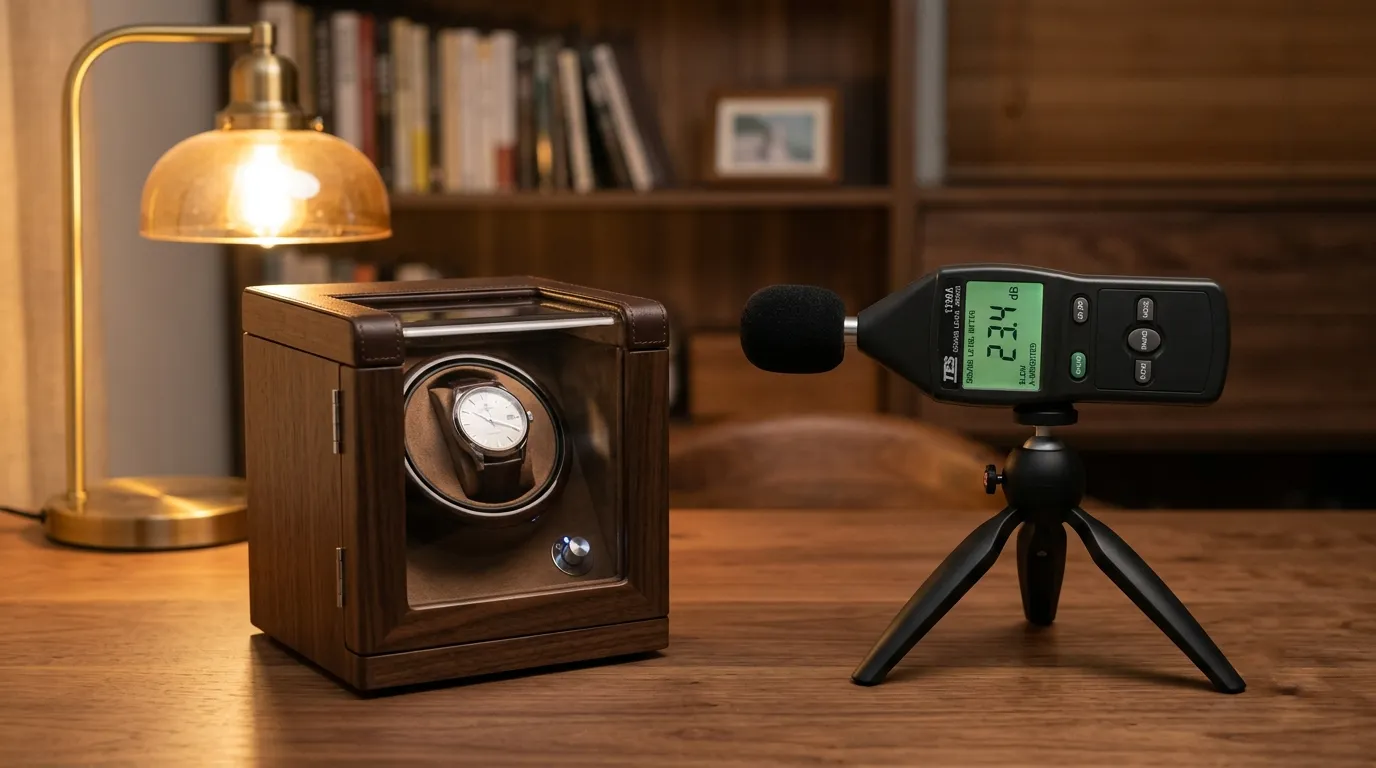
You do not need a professional sound level metre to conduct a useful noise test — though having one ($50–$80 for a phone attachment or basic handheld metre) is far more accurate than listening.
Basic test:
- Wait until your home or office is quiet (after 10pm in a residential area, with no HVAC running)
- Place the running watch winder on a hard surface (wooden table — not acoustic foam)
- Place your sound level metre (or phone app: NIOSH Sound Level Metre app) at 1 metre distance
- Measure the ambient noise floor first (should be under 25dB in a quiet room)
- Start the winder at maximum TPD setting
- Record the peak dB(A) reading over a 10-second measurement period
Acceptable result: ≤25 dB(A) above ambient floor. If ambient is 22dB and the winder reads 27dB, the winder contributes approximately 25dB — marginal but acceptable.
Fail condition: any reading above 35dB(A) in a quiet room. This product will generate noise complaints.
Test the housing separately: place your finger lightly on the housing while the winder is running. If you feel vibration transmitted through the wood or leather, that vibration will couple to any surface the winder stands on. A well-isolated motor should produce minimal housing vibration at normal operating speeds.
The Noise-Quality Connection: Why It Matters Beyond Returns
A quiet watch winder communicates quality independently of any other product attribute. Every time a collector opens their bedroom door and doesn’t hear their winder, they receive a subconscious quality signal. The watch is being cared for, silently, without demanding attention.
This is not sentimental: it is measurable in review sentiment. Watch winder products that receive 4.8+ stars consistently describe the motor noise (or lack of it) in their reviews: “whisper quiet,” “can’t hear it at all,” “runs silently all night.” Products at 3.5–4.2 stars consistently include noise complaints.
For retailers and OEM buyers: a quiet motor is your most effective review management tool.
Frequently Asked Questions
Q: What is the quietest motor available for watch winder OEM production? A: Mabuchi Motors (Japan) gearmotor series are the industry benchmark for watch winder noise performance, typically operating at 18–22 dB(A) at 1 metre. Equivalent Japanese-manufactured gearmotors from other precision manufacturers (Nidec, Tsukasa) can achieve similar noise floors. Specify by manufacturer name, not by national-origin claim.
Q: Can the housing material affect noise even if the motor is quiet? A: Yes, significantly. A motor producing 20dB(A) rigidly bolted to a thin MDF housing can read 30dB(A) at 1 metre because the housing amplifies and transmits the motor vibration. Specify: (1) vibration-isolating motor mount (silicone feet, not rigid fasteners), (2) housing wall thickness minimum 8mm MDF or 6mm solid wood, (3) no direct contact between motor casing and interior surfaces.
Q: Is 30dB acceptable for a premium watch winder product? A: 30dB is audible in a quiet room but only marginally so — below the level of a quiet whisper. Premium products should target ≤25dB for bedroom use. 30dB may be acceptable for an office or living room application but will generate occasional noise complaints from bedroom users.
Q: How does a watch winder’s noise level change over time? A: Quality motors with precision bearings and sintered bushings maintain stable noise levels through 50,000+ operating hours. Low-quality motors with pressed-fit bearings experience bearing wear that progressively increases noise and vibration over 12–24 months of use. A watch winder that is quiet on delivery but becomes noisy after one year is a symptom of inadequate bearing specification.