Every year, a number of importers place their first cigar humidor order specifying “cedar interior” — and receive a product with regular cedar, aromatic red cedar, or plantation softwood that smells vaguely of pencil shavings. Their retail buyers or end customers reject the product. The return process is expensive. The relationship with their factory is damaged.
This outcome is entirely preventable. It requires one sentence in the product brief: “interior lining: Spanish cedar (Cedrela odotica), minimum 3mm solid planed boards, kiln-dried to 10–12% moisture content, no engineered wood substitutes.”
This guide explains why Spanish cedar is the non-negotiable interior standard, what makes it different from every other cedar species, and how to specify it in a way that leaves no room for substitution.
What Spanish Cedar Actually Is
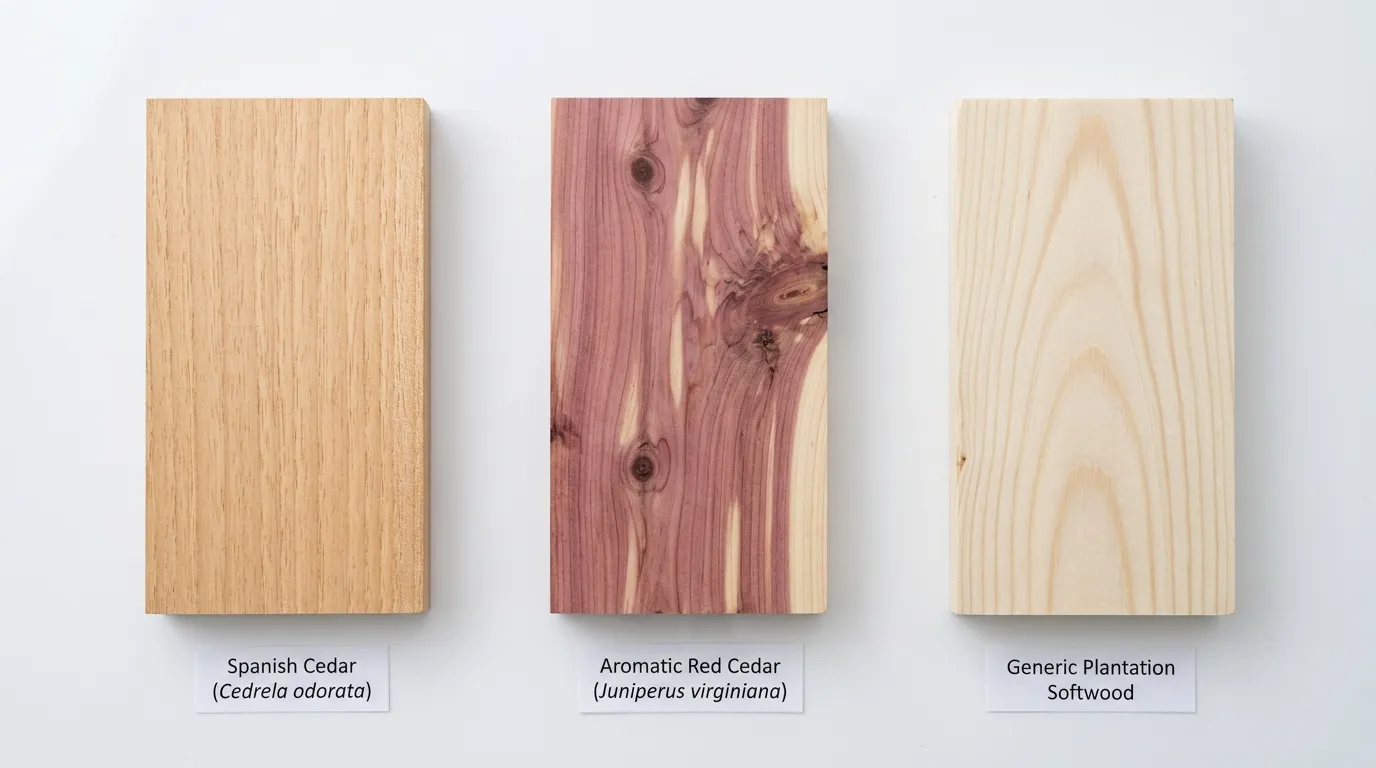
Spanish cedar (Cedrela odorata) is a hardwood native to the tropical forests of Central and South America and the Caribbean. It is not a true cedar (genus Cedrus) — it is a member of the mahogany family (Meliaceae). It has no botanical relation to the North American aromatic red cedar (Juniperus virginiana) that lines wardrobes and repels moths.
The name “Spanish cedar” originated with colonial-era Spanish traders who used the wood extensively for furniture and boxes because of its workability and aromatic properties — the “cedar” name stuck commercially, even though botanically incorrect.
For cigar humidors, the distinction matters: only Cedrela odorata performs the three functions that make a humidor work.
The Three Functions Spanish Cedar Performs in a Humidor
Function 1: Humidity Buffering
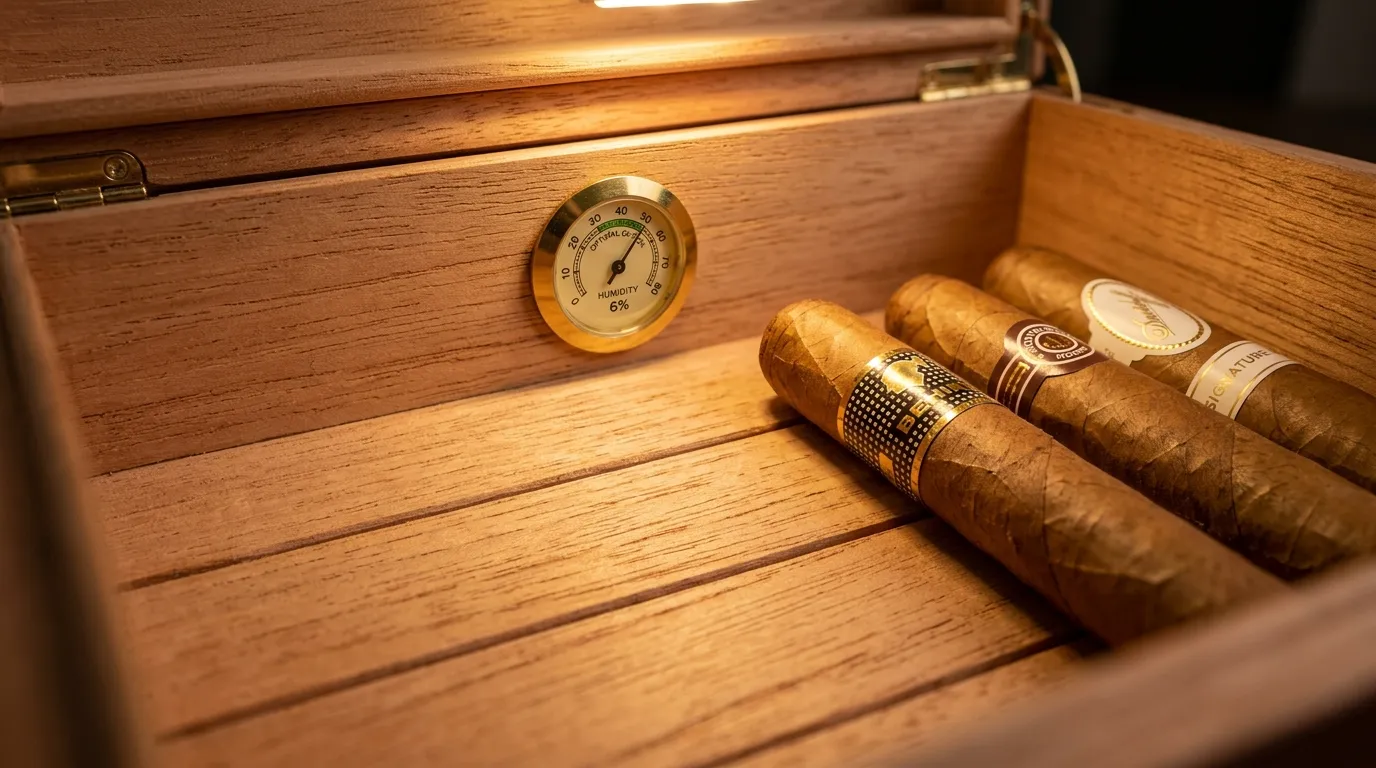
Cedrela odorata has a cellular structure that absorbs and releases moisture at a rate well-suited to maintaining the stable 65–70% RH environment that cigars require. When the interior of the humidor drops below 65% RH, the Spanish cedar releases stored moisture to buffer the decline. When the RH rises above 72%, it absorbs excess moisture to prevent over-humidification.
No other commonly available wood species matches this hygroscopic buffering capacity at cigar storage humidity levels. Regular pine, poplar, or MDF interiors do not buffer humidity — they respond inconsistently, leading to humidity swings that cause cigars to crack, bloom, or dry out.
Technical note: the buffering capacity is not unlimited. A Spanish cedar humidor requires seasoning before first use — the wood needs to be brought to its equilibrium moisture content (typically 12–14% for 70% RH storage). An unseasoned humidor with bone-dry Spanish cedar will absorb your humidification element’s output entirely for the first 24–48 hours before settling.
Function 2: Aromatic Compatibility
Spanish cedar’s aromatic compounds — primarily a combination of terpenes and sesquiterpenes — are compatible with the complex flavour profile of premium cigars. Extended contact between cigars and Spanish cedar does not introduce off-flavours; in fact, master blenders argue that Spanish cedar contributes positively to the ageing of premium tobacco.
Aromatic red cedar (Juniperus virginiana) is strongly incompatible with cigar storage. Its volatile aromatic compounds — primarily cedrol and thujopsene — are detectable in cigars stored in contact with it within 2–4 weeks. The flavour transfer is permanent; it cannot be reversed. A humidor lined with aromatic red cedar will ruin its cigars.
This is the most critical reason for specifying Cedrela odorata by name, not by common name. A factory briefed on “cedar interior” will use whatever cedar is cheapest and available — and the cheapest and most available cedar in China is aromatic red cedar softwood, which is grown commercially in China at low cost.
Function 3: Tobacco Beetle Deterrence
The tobacco beetle (Lasioderma serricorne) is the primary pest threat to stored cigars. It can eat through cigars, destroying entire humidor contents in days when conditions are warm (above 73°F / 23°C). Spanish cedar’s aromatic compounds are a natural deterrent to the tobacco beetle, reducing the probability of infestation in well-sealed humidors.
No synthetic insecticide should be used inside a humidor — chemical treatments will contaminate the tobacco. Spanish cedar is the non-toxic solution.
Spanish Cedar Specification: What to Write in Your Brief
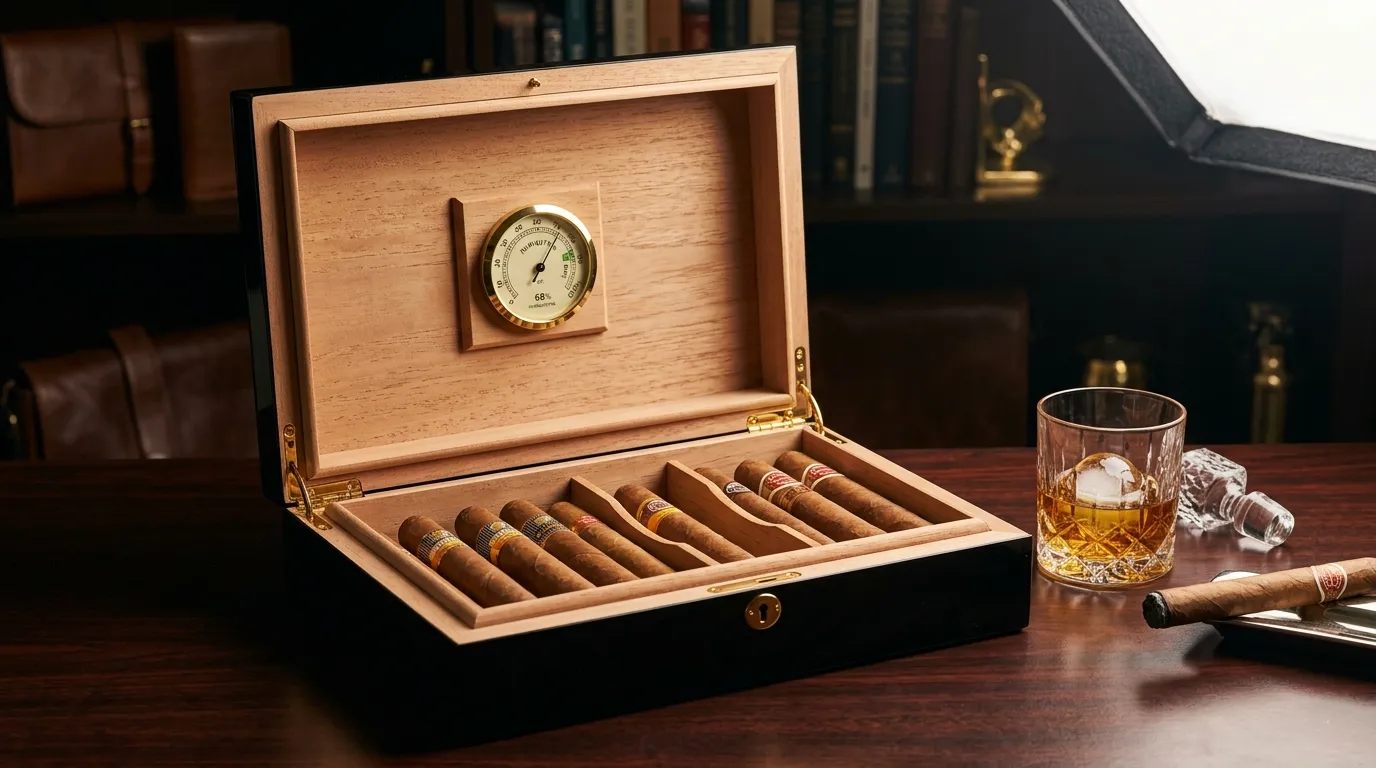
Species: Cedrela odorata (not Juniperus virginiana, not Thuja plicata, not generic “cedar”)
Form: solid planed boards or solid planed panels. Not MDF, not particleboard, not veneer over a non-Spanish cedar substrate. Solid boards maintain humidity buffering through multiple seasoning cycles; veneers do not.
Thickness: minimum 3mm for drawer and tray liners; minimum 6mm for side wall lining in desktop humidors; minimum 8mm for walk-in or cabinet humidors.
Moisture content: kiln-dried to 10–12% moisture content before manufacturing. Boards above 15% will shrink after manufacturing, potentially cracking the finished humidor.
Surface finish: lightly planed smooth surface, not sanded. Sanding removes the surface pores that contribute to humidity buffering. No lacquer, paint, or sealant on the interior surfaces — these would block moisture exchange.
Grain orientation: vertical grain (radial or quarter-sawn) preferred. Flat-sawn boards have higher dimensional movement in humidity cycles; quarter-sawn boards are more stable.
CITES compliance note: Cedrela odorata was listed on CITES Appendix III by several countries in 2001, and has been listed on Appendix II in some producing countries. As of 2026, commercially traded Spanish cedar must be accompanied by CITES documentation demonstrating legal harvest. Request CITES documentation alongside your material specification confirmation. Suppliers who cannot provide CITES documentation for their Spanish cedar stocks are sourcing illegally harvested material — a significant legal and reputational risk.
Seasoning Your Humidor: What Your Customers Need to Know
A common negative review pattern for cigar humidors is: “I charged the humidifier, but the humidity inside won’t stay above 55%.” This is almost always an unseasoned humidor, not a defective one.
Including a seasoning instruction card in your humidor packaging is a quality signal that differentiates premium products and reduces returns. The instruction should cover:
How to season a new humidor:
- Wipe the interior Spanish cedar surfaces lightly with a clean cloth dampened with distilled water. Do not soak.
- Place a small shot glass of distilled water (not tap water — mineral deposits damage the wood) inside the closed humidor for 24 hours.
- Remove the shot glass. Check the hygrometer reading.
- Repeat steps 1–2 until the hygrometer stabilises at 65–70% RH.
- Total seasoning time: 24–72 hours depending on the dryness of the wood.
Why distilled water: tap water contains minerals that deposit on the Spanish cedar surface over time, reducing its humidity buffering capacity and potentially causing surface staining.
For OEM buyers: the addition of a 100ml bottle of distilled water and a condensed seasoning instruction card to your humidor packaging adds approximately $0.80–$1.20 to unit cost and substantially reduces the most common first-use return reason.
The Humidity System: Passive vs. Active
Beyond the Spanish cedar interior, the humidor’s humidity maintenance system must be specified:
Passive humidification (standard for desktop humidors): A Spanish cedar humidor with a passive humidifier (either a floral foam humidifier charged with propylene glycol solution, or Boveda-style two-way humidity packs) can maintain 65–70% RH for 2–6 weeks between recharging in a well-sealed box.
Key specifications: lid seal (ensure the lid closes with a slight resistance — a test strip of paper should be held firmly by the seal), hygrometer accuracy (analogue hygrometers require calibration; digital hygrometers with ±2% accuracy are preferred), and humidifier capacity (match to box volume — overfilling a small humidor with a large humidifier causes condensation on the cedar).
Active humidification (cabinet and larger desktop humidors): Electronic humidifiers with a fan and humidity sensor maintain consistent RH without manual recharging. Required for humidors above 100 cigar capacity and for retail display humidors. Active systems cost more ($15–$60 additional for OEM) but dramatically reduce maintenance requirements.
The Boveda advantage for retail buyers: Boveda two-way humidity packs (available in 65%, 69%, 72%, 75% RH options) are the most popular humidification system for premium retail humidors. Including a Boveda pack in your humidor packaging is a quality signal and a practical benefit to the end consumer. A Boveda 60g pack costs approximately $2–$4 wholesale and adds perceived value far exceeding its cost.
Cigar Humidor OEM Buyers: Pricing Structure by Specification
| Specification Level | Interior Wood | Capacity | Ex-Factory Cost |
|---|---|---|---|
| Entry | Aromatic cedar (not Cedrela) | 20–30 cigars | $8–$15 |
| Standard | Spanish cedar (Cedrela odorata) | 25–50 cigars | $18–$35 |
| Premium | Spanish cedar, solid 6mm boards | 50–100 cigars | $35–$65 |
| Collector | Spanish cedar, quarter-sawn, active humidification | 100–200 cigars | $80–$160 |
Note: the entry-tier product at $8–$15 will not perform as a cigar humidor. It will look like a humidor, but the aromatic cedar interior will damage cigars and the buyer will receive returns and negative reviews. The minimum viable humidor specification for a retailer or brand who wants to avoid product liability and return costs is the Standard tier.
Frequently Asked Questions
Q: How can I verify that the cedar used is genuine Cedrela odorata? A: Request a wood species certificate from the factory identifying the timber species by scientific name, with CITES documentation. For verification, a sample board can be tested by a timber testing laboratory — Cedrela odorata has a distinctive density (0.40–0.45 g/cm³), aromatic compound profile, and cellular anatomy identifiable under microscopy. The scent test is useful but not definitive — an experienced cigar smoker can usually identify Spanish cedar by its distinctly sweet, rosy-cedar aroma, distinct from the sharper menthol note of aromatic red cedar.
Q: Why does the humidity in my new humidor drop to 55–60% immediately after charging? A: New Spanish cedar is dry from manufacturing and must absorb moisture to reach equilibrium before it will maintain stable humidity. This is normal and is resolved by seasoning the humidor (see above). A humidor that cannot reach 65% after 3 full days of seasoning has a seal problem — test by placing a damp sponge inside and checking whether humidity rises to 80%+. If it does, the humidification element is undersized. If it doesn’t, the lid seal is inadequate.
Q: Does Spanish cedar need to be replaced over time? A: No. Well-maintained Spanish cedar interior boards last indefinitely — the wood improves with age as it takes on more tobacco aroma and becomes more hygroscopically stable. The humid environment inside a functioning humidor is actually protective of the wood. Spanish cedar boards do not need replacement unless physically damaged.
Q: Can I use a Spanish cedar humidor for cigarettes or pipe tobacco? A: A Spanish cedar humidor is designed specifically for cigars and maintains 65–70% RH. Cigarettes are typically stored and smoked at lower humidity levels (50–55% RH) — a cigar humidor will over-humidify cigarettes, causing them to swell and burn inconsistently. Pipe tobacco requires 60–65% RH and can be stored in a cigar humidor at the lower end of its range, but a dedicated pipe tobacco storage solution is preferred.
Sourcing Spanish cedar cigar humidors for retail or wholesale? TwingPak uses verified Cedrela odorata with CITES documentation on all orders.
Request a Cigar Humidor Sample → | Download Cigar Humidor Catalogue →