How premium brands bring bespoke wooden packaging to market — without building a factory
Introduction: The Packaging Decision That Defines Your Brand
You’ve spent months — maybe years — perfecting your product. The movement inside your mechanical watch keeps flawless time. The blend of your reserve cigar is aged to perfection. Your jewelry collection catches light like nothing else on the market. But the moment a customer receives your product, what do they touch first?
The packaging.
In luxury goods, packaging is not an afterthought — it is the first chapter of the brand story. A study by Dotcom Distribution found that 40% of online shoppers are more likely to purchase again from a brand that delivers premium packaging. For B2B buyers — procurement managers, brand founders, and distributors — the question isn’t whether wooden packaging matters. The question is: How do you get world-class wooden packaging produced efficiently, affordably, and at scale?
That’s where OEM/ODM wooden packaging comes in. And that’s exactly what this guide covers.
Over the next 2,000+ words, we’ll walk through the entire OEM/ODM wooden packaging process — from the first sketch to the last box loaded into a container. Whether you’re evaluating your first custom packaging manufacturer or looking to switch from an underperforming supplier, this guide will help you make smarter decisions, avoid costly mistakes, and understand why partnering with an experienced wooden box factory in China like Twing-Pak can be a strategic advantage.
1. Understanding OEM vs. ODM: Which Model Fits Your Brand?
Before diving into the production process, it’s essential to understand the two dominant manufacturing models in the wooden packaging industry — and which one aligns with your business needs.
1.1 OEM (Original Equipment Manufacturing)
In an OEM partnership, you provide the design, and the factory produces it to your exact specifications. This model is ideal for brands that have:
- An established design language and brand identity
- In-house industrial design or packaging engineering teams
- Specific material, finish, or structural requirements that are non-negotiable
With OEM, you retain full creative control. The custom packaging manufacturer acts as your production arm, translating your blueprints into physical products with precision.
1.2 ODM (Original Design Manufacturing)
In an ODM partnership, the factory provides both the design and the manufacturing. You select from the manufacturer’s existing design catalog or collaborate on modifications. This model works best for brands that:
- Are launching new product lines and need packaging design support
- Want to reduce time-to-market without hiring a design team
- Prefer proven, pre-engineered structures with customization options
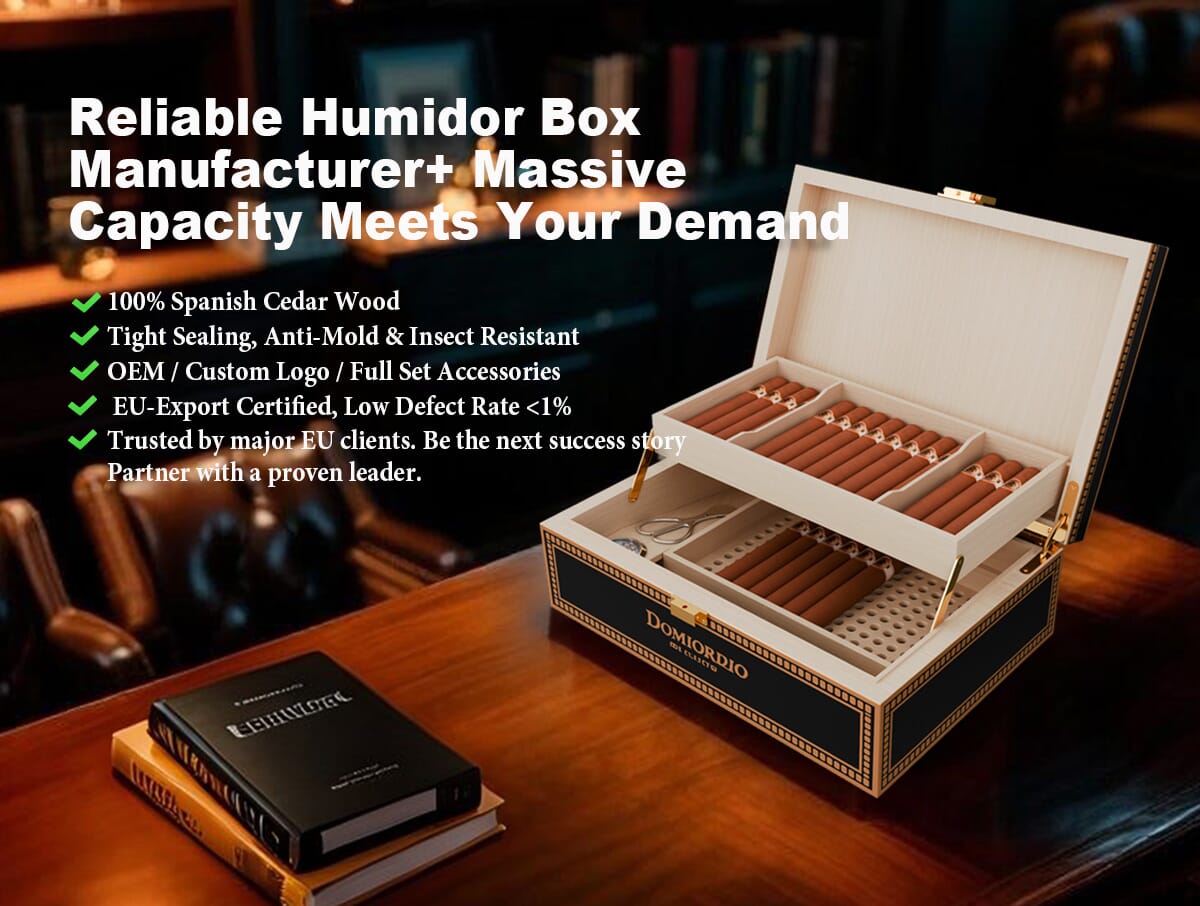
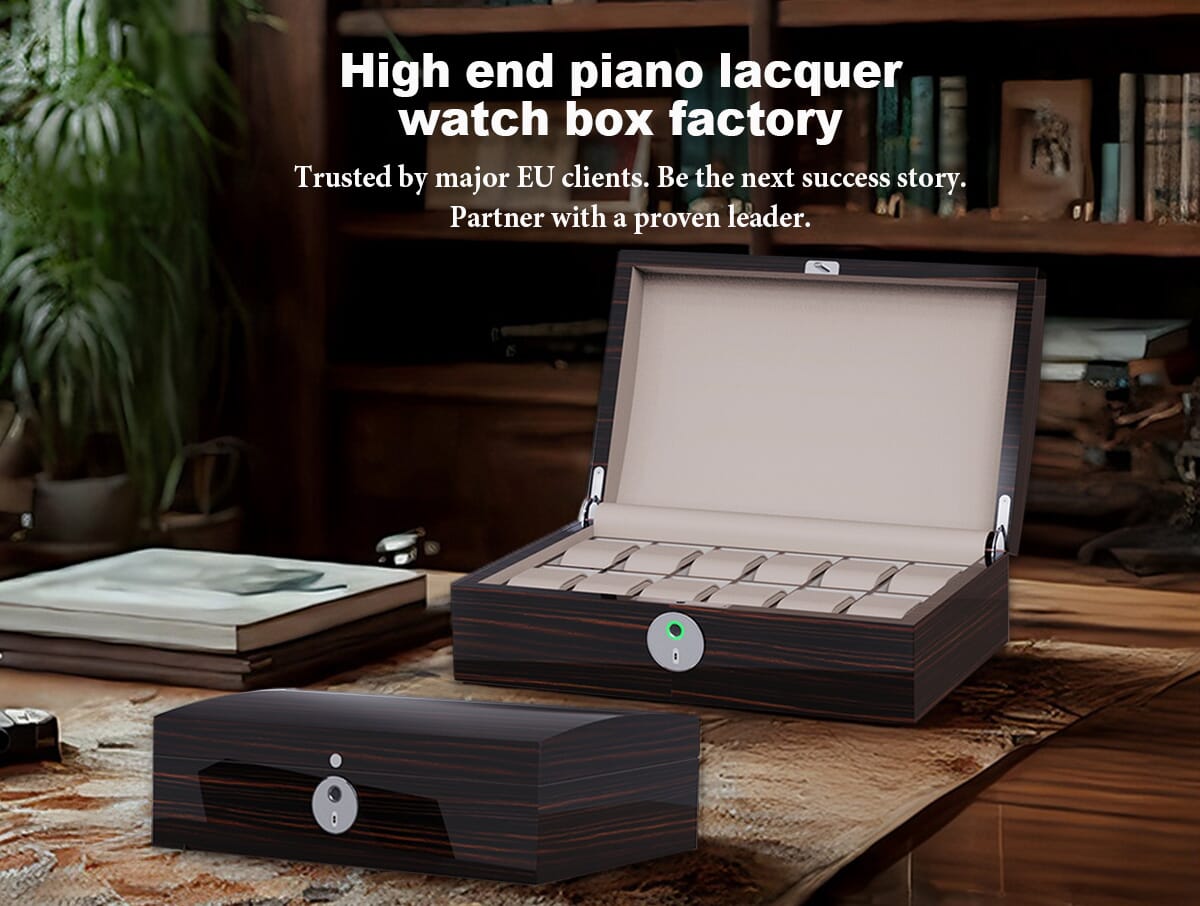
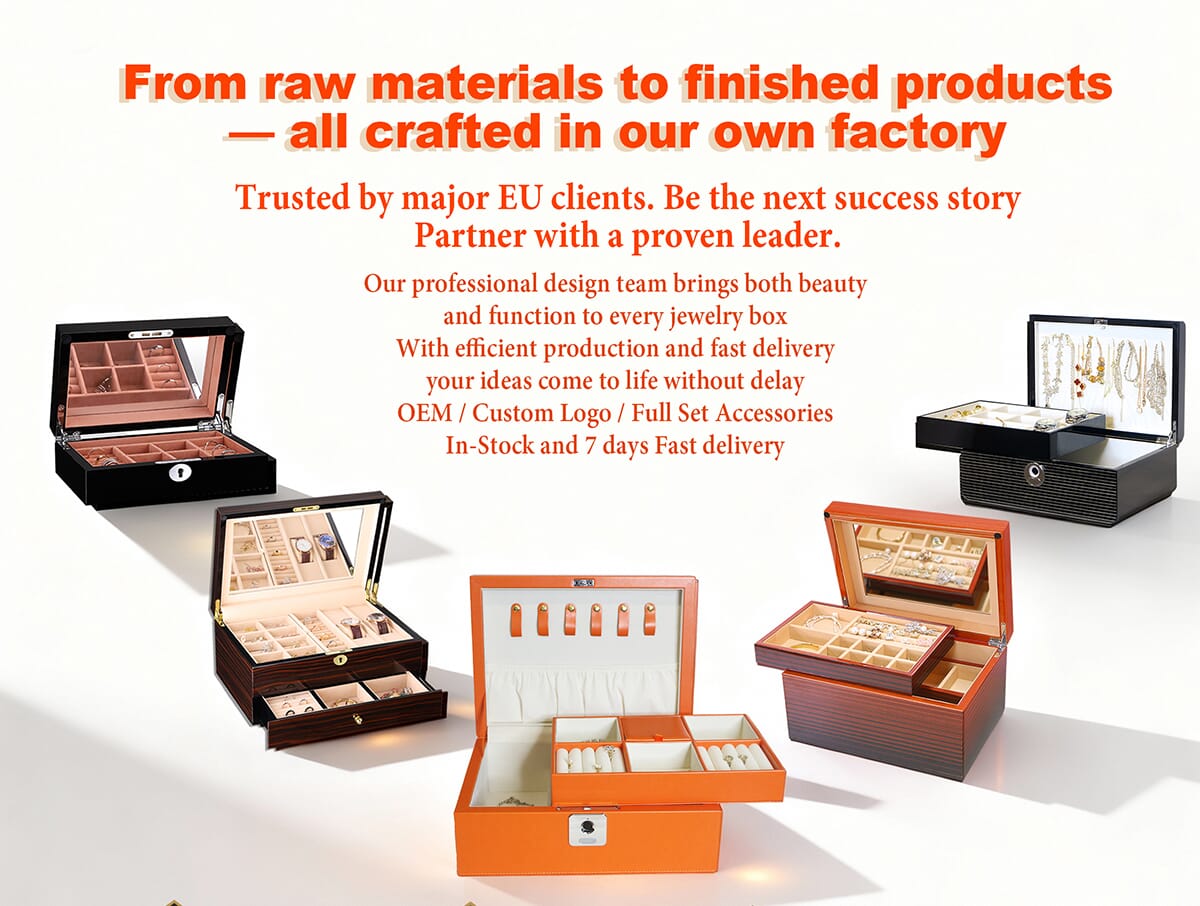
An ODM wooden box supplier like Twing-Pak maintains an extensive portfolio of validated designs across categories — cigar humidors, watch boxes, jewelry boxes, watch winders, and winder safes — that can be customized with your logo, color scheme, and interior layout.
1.3 OEM vs. ODM at a Glance
| Factor | OEM | ODM |
|---|---|---|
| Design ownership | Client | Shared / Factory |
| Time to prototype | Longer (custom from scratch) | Shorter (base design exists) |
| Minimum order quantity | Typically higher | Typically lower |
| Creative control | Maximum | Moderate |
| Cost of entry | Higher (tooling, engineering) | Lower (leverages existing molds) |
| Best for | Established brands with design teams | Emerging brands, fast launches |
Key Insight: According to a McKinsey & Company analysis of manufacturing outsourcing, companies that leverage ODM partnerships can reduce their product development timeline by 30–50% compared to building in-house capabilities from zero. For a startup watch brand racing to a holiday launch, that difference can be existential.
2. The Market Case for Wooden Packaging: Why Wood, Why Now?
If you’re reading this guide, you probably already have an intuition that wood is the right material for your packaging. But let’s back that up with data.
2.1 A Booming Global Market
The global wood packaging market was valued at approximately USD 12.1 billion in 2024 and is projected to reach USD 17.39 billion by 2030, growing at a CAGR of 6.4% (source: The Business Research Company, Wood Packaging Market Report 2026). This growth is driven by rising demand for sustainable materials, premium unboxing experiences, and the expansion of luxury consumer goods globally.
Meanwhile, the broader luxury packaging market reached USD 11.05 billion in 2024 and is forecast to hit USD 17.43 billion by 2033 at a CAGR of 5.2% (source: SkyQuest Technology Consulting, Luxury Packaging Market Report 2024–2033). Within this market, wood has been identified as the fastest-growing material segment, outpacing paperboard, plastic, glass, and metal — driven by its natural appeal, sustainability credentials, and unmatched premium feel.
2.2 The Watch Winder Opportunity
For brands in the horological space, the data is equally compelling. The global automatic watch winder market was valued at approximately USD 1.92 billion in 2025 and is growing at a CAGR of 6.9% through 2033 (source: Archive Market Research, Automatic Watch Winders Market Report 2025–2033). North America accounts for 35% of the market, Europe 30%, and Asia-Pacific 25% — but the APAC region is accelerating fastest, fueled by rising disposable incomes and an expanding middle class.
For a custom watch box manufacturer or an OEM cigar humidor producer, these numbers signal a clear opportunity: demand is growing, and brands need reliable manufacturing partners to capture it.
2.3 OEM Outsourcing: The Cost Advantage
One of the most common questions B2B buyers ask is: “Should I build my own production line or partner with an OEM factory?”
The numbers tell a clear story. Setting up a basic production line for wooden packaging — including CNC machines, finishing equipment, dust collection systems, and facility build-out — can easily exceed USD 1 million in initial capital expenditure. Add annual staffing costs of \$165,000–\$235,000 and maintenance costs of \$25,000–\$40,000, and the financial burden becomes significant for all but the largest enterprises.
By contrast, partnering with an established OEM wooden packaging manufacturer can reduce capital expenditure by up to 80%, eliminate ongoing staffing and maintenance overhead, and provide immediate access to proven production processes and skilled labor (source: manufacturing cost analysis based on industry benchmarking data).
For procurement managers evaluating total cost of ownership, the OEM/ODM route delivers superior ROI — especially when the partner factory operates at scale with a demonstrated defect rate below 1%.
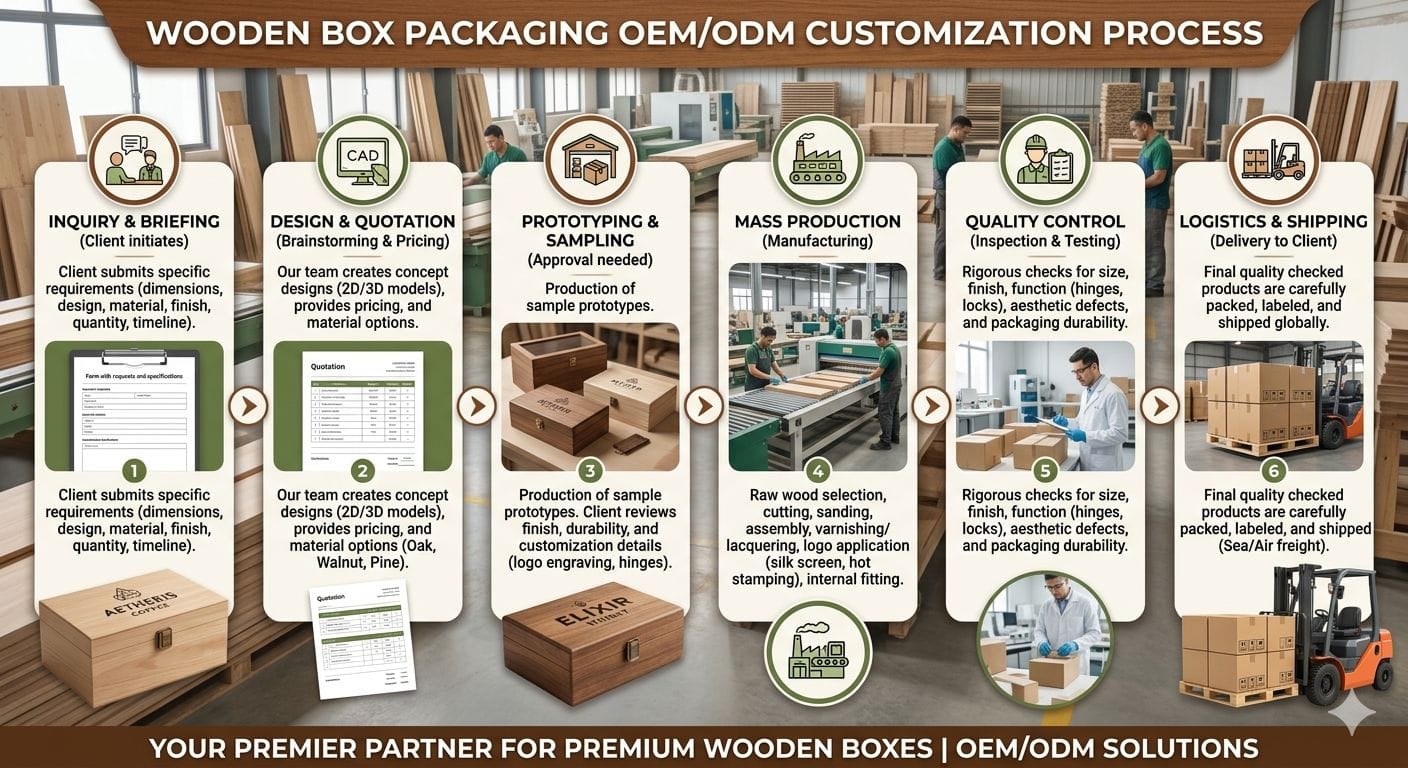
3. The OEM/ODM Wooden Packaging Process: Step by Step
Now let’s walk through the actual production journey — from your first conversation to the finished product arriving at your warehouse.
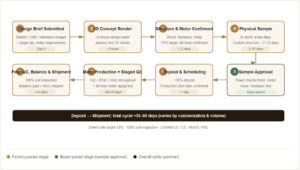
Step 1: Requirements Gathering & Consultation
Every successful project begins with a thorough discovery process. A professional custom packaging manufacturer will work with you to define:
- Product specifications: Dimensions, weight, fragility, and storage requirements of the item(s) to be packaged
- Material preferences: Wood species (mahogany, walnut, oak, beech, MDF, etc.), interior lining (velvet, suede, Alcantara, EVA), and hardware (hinges, locks, handles)
- Brand identity: Logo placement, color palette, finishing techniques (lacquer, matte, UV coating, embossing, laser engraving)
- Regulatory requirements: FSC certification, REACH compliance, ISPM 15 (for export pallets/crating), CPSIA (for products reaching end consumers)
- Volume & timeline: MOQ expectations, delivery milestones, and launch dates
At Twing-Pak, this consultation is typically completed within 1–2 business days, with a dedicated project manager assigned to your account from day one.
Step 2: Design & Engineering
For OEM projects, you provide CAD files, technical drawings, or reference samples. The factory’s engineering team reviews them for manufacturability (DFM analysis), identifies potential issues, and proposes optimizations — such as alternative joinery methods that reduce cost without compromising aesthetics.
For ODM projects, you select a base design from the factory’s catalog and specify customization details. The design team creates mockups and 3D renders for your approval before any material is cut.
Pro Tip: Always request a DFM (Design for Manufacturability) review. A study by the National Institute of Standards and Technology (NIST) found that design-related issues account for up to 70% of manufacturing defects. Catching these before production saves both time and money.
Step 3: Prototyping & Sampling
This is where your concept becomes tangible. A quality wooden box factory in China will produce physical samples for your evaluation, typically within 3–5 business days (Twing-Pak delivers prototypes in just 3 days).
During sampling, you should evaluate:
- Dimensional accuracy: Does the product fit snugly? Is there appropriate tolerance for insertion and removal?
- Surface finish: Is the lacquer even? Is the wood grain orientation correct? Are there visible tool marks?
- Interior quality: Is the lining smooth and properly adhered? Does the cushioning provide adequate protection?
- Functional testing: Do hinges operate smoothly? Do locks engage securely? For cigar humidors, does the seal pass the “dollar bill test”? For watch winders, do the motors operate at the specified TPD (turns per day) and direction settings?
Sampling typically involves 1–2 rounds of revision before final approval. Clear, specific feedback accelerates this process significantly.
Step 4: Material Sourcing & Preparation
Once the sample is approved, the factory procures raw materials in bulk. Key considerations include:
- Wood moisture content: Must be controlled to 8–12% to prevent warping, cracking, or mold growth during transit or storage. Twing-Pak uses kiln-dried lumber and verifies moisture content with pin-type meters before processing.
- FSC certification: Increasingly required by European and North American buyers. Ensure your supplier can provide chain-of-custody documentation.
- Hardware quality: Hinges, locks, and clasps are often the first components to fail in low-quality packaging. Specifying branded hardware (e.g., Hafele, Blum) or conducting salt-spray corrosion testing on generic alternatives can prevent returns.
Step 5: Production & Assembly
With materials prepared, production moves through these stages:
- CNC Machining & Cutting: Precision cutting of wood panels to specification
- Joinery & Assembly: Dovetail, finger joint, or miter joint construction depending on design
- Sanding & Surface Prep: Multi-stage sanding (80→120→180→320 grit) for a glass-smooth finish
- Finishing: Lacquer, polyurethane, or oil-based finishes applied in dust-controlled spray booths
- Interior Installation: Cut-and-sew lining, EVA die-cutting, and magnetic/ribbon pull tab installation
- Hardware Mounting: Hinge recessing, lock installation, handle attachment
- Quality Inspection: AQL (Acceptable Quality Level) inspection at multiple checkpoints
At Twing-Pak, the mass production cycle runs 15–20 business days from sample approval — significantly faster than the industry average of 25–35 days reported by procurement platforms such as Alibaba and Global Sources.
Step 6: Quality Control & Inspection
Quality control is the backbone of a successful OEM/ODM partnership. A best-in-class custom packaging manufacturer implements multi-stage QC:
- Incoming QC: Raw material inspection before processing
- In-process QC: Dimensional and visual checks during each production stage
- Final QC: Full AQL inspection before packaging (Twing-Pak maintains a <1% defect rate)
- Pre-shipment inspection (PSI): Third-party or client inspection before container loading
Industry Benchmark: According to the International Quality Federation, the average manufacturing defect rate across industries is approximately 3–5%. Twing-Pak’s sub-1% rate represents a significant competitive advantage — especially for brands where every unit is a brand touchpoint.
Step 7: Packaging, Logistics & Delivery
The final step is ensuring your products arrive in pristine condition. This includes:
- Individual packaging: Each box wrapped in protective film, placed in a corrugated inner box
- Master carton packing: 4–12 units per carton (depending on size), with foam corner protectors
- Palletization: Heat-treated (ISPM 15 compliant) pallets for international shipping
- Container loading: Professional stuffing and securing for sea freight
- Documentation: Commercial invoice, packing list, bill of lading, certificate of origin, FSC/REACH docs as required
Most shipments from Guangzhou to major ports (Los Angeles, Rotterdam, Sydney) transit in 14–28 days by sea, or 3–5 days by air for urgent orders.
4. Case Study: How ChronoVault Launched Their Signature Watch Box Line
The following case study is a composite scenario based on real-world OEM/ODM project workflows. It illustrates the complete journey from concept to delivery.
The Client
ChronoVault is a Switzerland-registered, Hong Kong-based watch brand founded in 2022. After two years of designing and selling mechanical timepieces in the \$800–\$2,500 range, they were ready to upgrade from generic stock packaging to a fully custom unboxing experience that reflected their brand’s “precision meets heritage” identity.
The Challenge
- Existing packaging was a generic black cardboard box — indistinguishable from competitors
- No in-house packaging design team; only a brand guidelines document and a Pinterest mood board
- Target: Launch custom packaging in time for their Q4 holiday collection (5-month timeline)
- Budget: Under \$15 per unit (FOB) for a two-piece watch box with outer sleeve
- MOQ: 500 units for the initial run, with potential to scale to 2,000+ units
The Solution: ODM Partnership with Twing-Pak
Week 1–2: Consultation & Design Selection
ChronoVault provided their brand guidelines, watch dimensions (42mm case, 50mm lug-to-lug, 12mm height), and mood board. Twing-Pak’s ODM team presented 5 base designs from their watch box catalog. ChronoVault selected Design #3 (hinged double-layer box with a watch pillow on top and a compartment for the warranty card and polishing cloth below).
Week 3: Customization & Prototyping
Customization included:
- Exterior: Dark walnut veneer with a matte PU finish and debossed logo (no color fill — pure blind emboss for a subtle, sophisticated look)
- Interior: Charcoal suede lining with a custom-cut EVA watch cushion wrapped in matching suede
- Hardware: Concealed hinges with soft-close mechanism, magnetic closure
- Outer sleeve: 157gsm art paper with spot UV logo and matte lamination
Twing-Pak delivered the first prototype in 3 days. After one round of minor revisions (increasing the interior compartment depth by 3mm and adjusting the logo emboss depth), the sample was approved.
Week 4–6: Production
Mass production of 500 units was completed in 16 business days. In-process QC identified 2 units with hinge misalignment (caught and reworked on the line). Final inspection confirmed a defect rate of 0.4% — well under the 1% threshold.
Week 7: Delivery
Units were packed (6 per master carton with foam corners), palletized, and loaded into a consolidated container at Nansha Port. Sea freight to Hong Kong took 3 days. ChronoVault received their order 6 weeks from initial consultation — 5 weeks ahead of their Q4 deadline.
The Results
- Cost per unit: \$12.80 FOB (18% under budget)
- Defect rate: 0.4% (3 units out of 500 required minor touch-up)
- Customer feedback: ChronoVault reported a 22% increase in repeat purchase rate and a 15% uplift in unboxing-related social media mentions within the first quarter after launch
- Scale-up: ChronoVault placed a follow-up order for 2,000 units 4 months later, adding a watch winder and jewelry box to their packaging lineup
“Partnering with Twing-Pak’s ODM team was the smartest operational decision we made that year. We went from a mood board to premium packaging in 6 weeks — without hiring a single designer or setting foot in a factory.” — Marcus Chen, Founder, ChronoVault
5. Choosing the Right OEM/ODM Wooden Packaging Partner
Not all factories are created equal. Here’s what to evaluate when selecting a custom packaging manufacturer:
5.1 Experience & Specialization
A factory that has been producing wooden packaging for 19 years (like Twing-Pak) has encountered — and solved — virtually every production challenge. This institutional knowledge translates directly into fewer mistakes, faster problem-solving, and higher consistency.
5.2 Facility Capabilities
Look for:
- In-house CNC machining (ensures precision and fast turnaround)
- Dedicated finishing booths (dust control is critical for lacquer quality)
- On-site QC team (not outsourced — the people inspecting your product should be factory employees who understand the process)
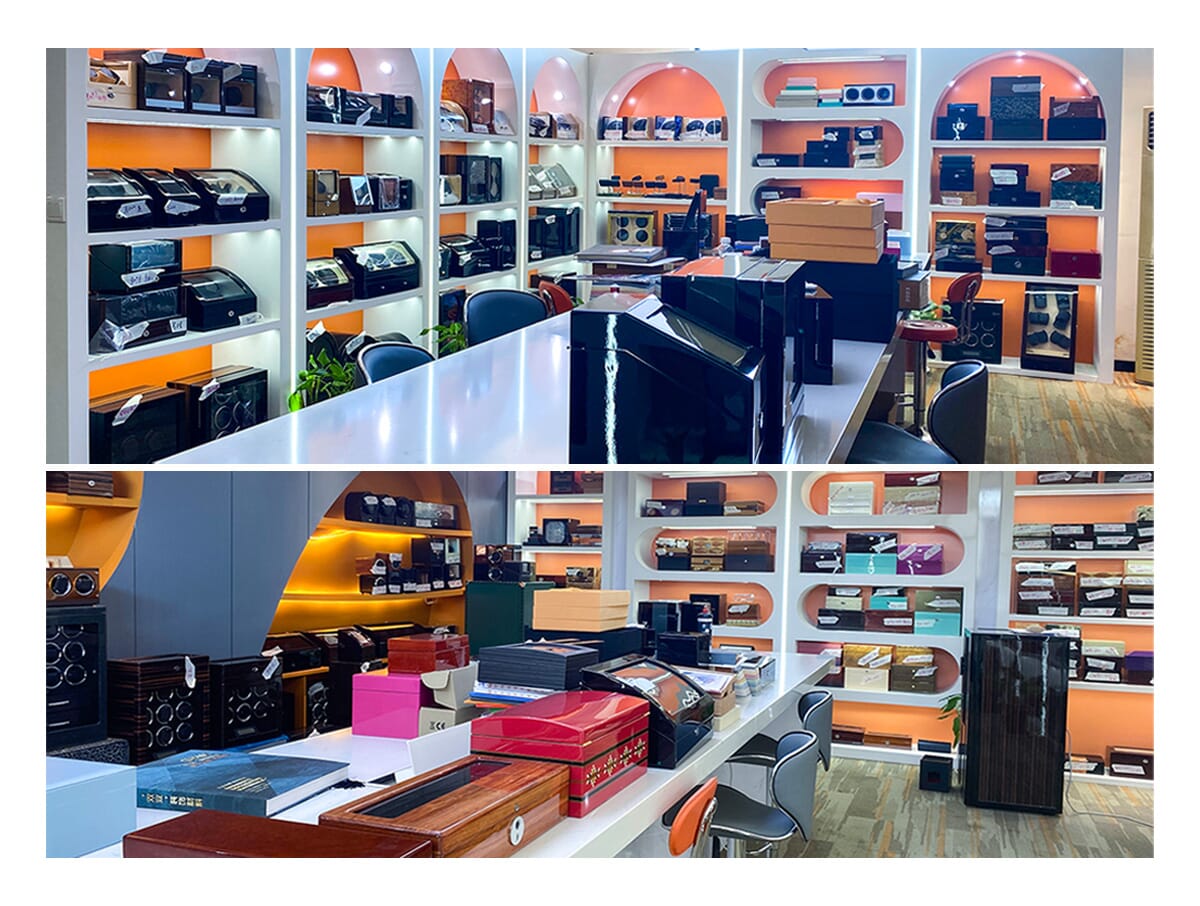
- Scale: A 3,000㎡ workshop with 100+ skilled workers provides the capacity to handle both small-batch and high-volume orders without bottlenecks
5.3 Certifications & Compliance
Verify:
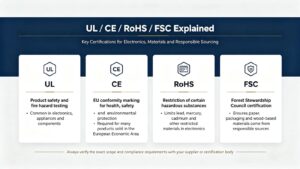
- FSC (Forest Stewardship Council) — for sustainable sourcing
- ISO 9001 — for quality management systems
- REACH / RoHS — for chemical safety (critical for European markets)
- BSCI / SEDEX — for social compliance and ethical labor practices
5.4 Communication & Project Management
The #1 complaint B2B buyers have about overseas manufacturing is not quality — it’s communication. A good partner should:
- Respond to inquiries within 12 hours during business days
- Provide weekly production updates with photos
- Offer a dedicated English-speaking project manager
- Use professional tools (not just WeChat screenshots) for documentation
5.5 Sample & Lead Time Guarantees
A factory confident in its processes will commit to:
- 3-day prototyping (not 2–3 weeks)
- 15–20 day mass production (not 30–45 days)
- <1% defect rate (not the industry average of 3–5%)
If a supplier can’t guarantee these benchmarks, ask why — and consider whether the savings are worth the risk.
6. Common Pitfalls to Avoid in OEM/ODM Wooden Packaging
Based on 19 years of working with international brands, here are the most frequent mistakes we see — and how to avoid them:
Pitfall 1: Specifying Aesthetics Without Defining Function
A beautiful box that fails to protect the product is worthless. Always define functional requirements (drop test standards, humidity resistance for humidors, motor specifications for winders) alongside aesthetic preferences.
Pitfall 2: Ignoring Moisture Content
Wood is a hygroscopic material. If moisture content isn’t controlled during production and storage, your packaging can warp, crack, or develop mold — sometimes months after delivery. Always specify 8–12% moisture content and ask for verification documentation.
Pitfall 3: Over-Customizing on the First Run
It’s tempting to specify every possible customization — exotic wood species, custom hardware, hand-painted details — on the initial order. But this increases both cost and risk. Start with a proven design and iterate based on market feedback.
Pitfall 4: Skipping the Pre-Shipment Inspection
A PSI catches issues before they become your problem. Whether you hire a third-party inspector (SGS, Bureau Veritas, TÜV) or inspect yourself, never skip this step — especially on first orders with a new supplier.
Pitfall 5: Focusing Only on Unit Price
The cheapest unit price often comes with hidden costs: higher defect rates, delayed shipments, inconsistent quality, and poor communication. Evaluate your total cost of ownership — including defect rework, returns, brand damage, and the time your team spends managing problems.
7. FAQ: Your Top Questions About OEM/ODM Wooden Packaging, Answered
Q1: What is the minimum order quantity (MOQ) for custom wooden packaging?
MOQs vary by product and complexity. At Twing-Pak, standard MOQs start at 100–300 units for ODM projects (based on existing designs) and 300–500 units for fully custom OEM projects. For new clients, we offer a trial order option at a slightly higher unit price to validate the partnership before committing to larger volumes.
Q2: How long does it take to go from concept to finished product?
With an experienced wooden box factory in China, the timeline is:
- ODM projects: 4–6 weeks (including 3-day prototyping + 15–20 day production + shipping)
- OEM projects: 6–8 weeks (including design finalization + DFM review + prototyping + production + shipping)
This is 40–50% faster than the industry average, which typically runs 8–12 weeks for comparable projects.
Q3: Can I get FSC-certified wooden packaging?
Yes. Twing-Pak sources FSC-certified wood for clients who require it. Please specify this requirement during the initial consultation, as FSC-certified materials may have slightly longer lead times (5–7 additional days) and a modest cost premium (typically 8–12% over non-certified equivalents).
Q4: What file formats do you accept for OEM designs?
We accept:
- CAD/Drawing: AutoCAD (.dwg, .dxf), SolidWorks (.sldprt, .sldasm), STEP/STP, IGES
- 2D Graphics: Adobe Illustrator (.ai), PDF, EPS
- Reference: Physical samples, photographs, or detailed sketches with dimensions
Our engineering team can also work from concept sketches and develop technical drawings on your behalf (ODM service).
Q5: How do you ensure consistent quality across large production runs?
Our multi-stage QC process includes:
- Incoming material inspection (wood moisture, veneer grade, hardware specs)
- In-process inspection at CNC, assembly, finishing, and interior installation stages
- Final AQL inspection per ISO 2859-1 standards (typically Level II, AQL 1.0/2.5)
- Pre-shipment inspection available for third-party verification
This system maintains our <1% defect rate across all product categories — from OEM cigar humidors to custom watch boxes to watch winder safes.
Q6: What types of wood do you work with?
We commonly work with:
- Solid woods: Mahogany, walnut, oak, beech, cherry, maple, ash
- Veneers: Natural and reconstituted veneers in 40+ species
- Engineered woods: MDF, plywood (for structural components and cost-sensitive projects)
- Exotic options: Ebony, rosewood, and zebrawood (subject to CITES compliance)
We recommend species based on your target price point, aesthetic requirements, and destination market regulations.
Q7: Can you handle the packaging for both the wooden box and the outer retail packaging?
Absolutely. Twing-Pak is a full-service custom packaging manufacturer. In addition to the wooden box itself, we produce:
- Outer sleeves (rigid or folding)
- Hang tags and care cards
- Warranty booklets and instruction manuals
- Corrugated shipping cartons with custom printing
This one-stop approach eliminates the coordination headaches of working with multiple suppliers.
Q8: What happens if I receive defective units?
Our <1% defect rate means this is rare — but we take it seriously when it happens. Our policy:
- Defects within the guaranteed rate (<1%): We provide replacement units in your next order at no charge
- Defects exceeding the guaranteed rate: We investigate the root cause, provide a corrective action report (CAR), and offer full replacement or credit based on the severity
We stand behind our work because our reputation — and yours — depends on it.
8. Why Twing-Pak: 19 Years of Wooden Packaging Excellence
With thousands of OEM/ODM partners to choose from, why should Twing-Pak be your custom packaging manufacturer of choice?
| What Matters | Twing-Pak Advantage |
|---|---|
| Experience | 19 years specializing in premium wooden packaging — cigar humidors, watch boxes, watch winders, jewelry boxes, and winder safes |
| Speed | 3-day prototyping, 15–20 day mass production — 40–50% faster than industry average |
| Quality | <1% defect rate vs. 3–5% industry average |
| Scale | 3,000㎡ production facility, 100+ skilled workers in Guangzhou Nansha |
| Service | Dedicated English-speaking project manager, 12-hour response time |
| Range | Full OEM/ODM capability across 5 core product categories |
| Compliance | FSC-available, REACH-compliant, ISO 9001-aligned processes |
We’re not a trading company. We’re not a jack-of-all-trades manufacturer. We are a specialized wooden packaging factory — and that focus is what allows us to deliver exceptional results, consistently.
Ready to Bring Your Wooden Packaging Vision to Life?
Whether you need an OEM cigar humidor that passes the strictest seal test, a custom watch box manufacturer who understands the nuances of mechanical timepiece presentation, or an ODM wooden box solution that gets you from concept to container in under 6 weeks — Twing-Pak is ready.
Get your free quote and prototype in 3 days.
📧 Email: contact@twing-pak.com
🌐 Website: www.twing-pak.com
📍 Factory: Nansha District, Guangzhou, China
Kathy Mong
- Office: Sales Manager
- Email: kathy@twingpak.com.cn
- Whatsapp:+86 13431139311
Tell us about your project — our team will respond within 12 hours with a detailed proposal, timeline, and pricing.
About the Author: This guide was produced by the Twing-Pak editorial team, drawing on 19 years of manufacturing experience and insights from hundreds of OEM/ODM partnerships with brands across North America, Europe, Asia, and the Middle East. All market data cited in this article is sourced from publicly available industry reports by The Business Research Company, SkyQuest Technology Consulting, and Archive Market Research. For the latest market data, please refer to the original reports.
Last updated: 2026